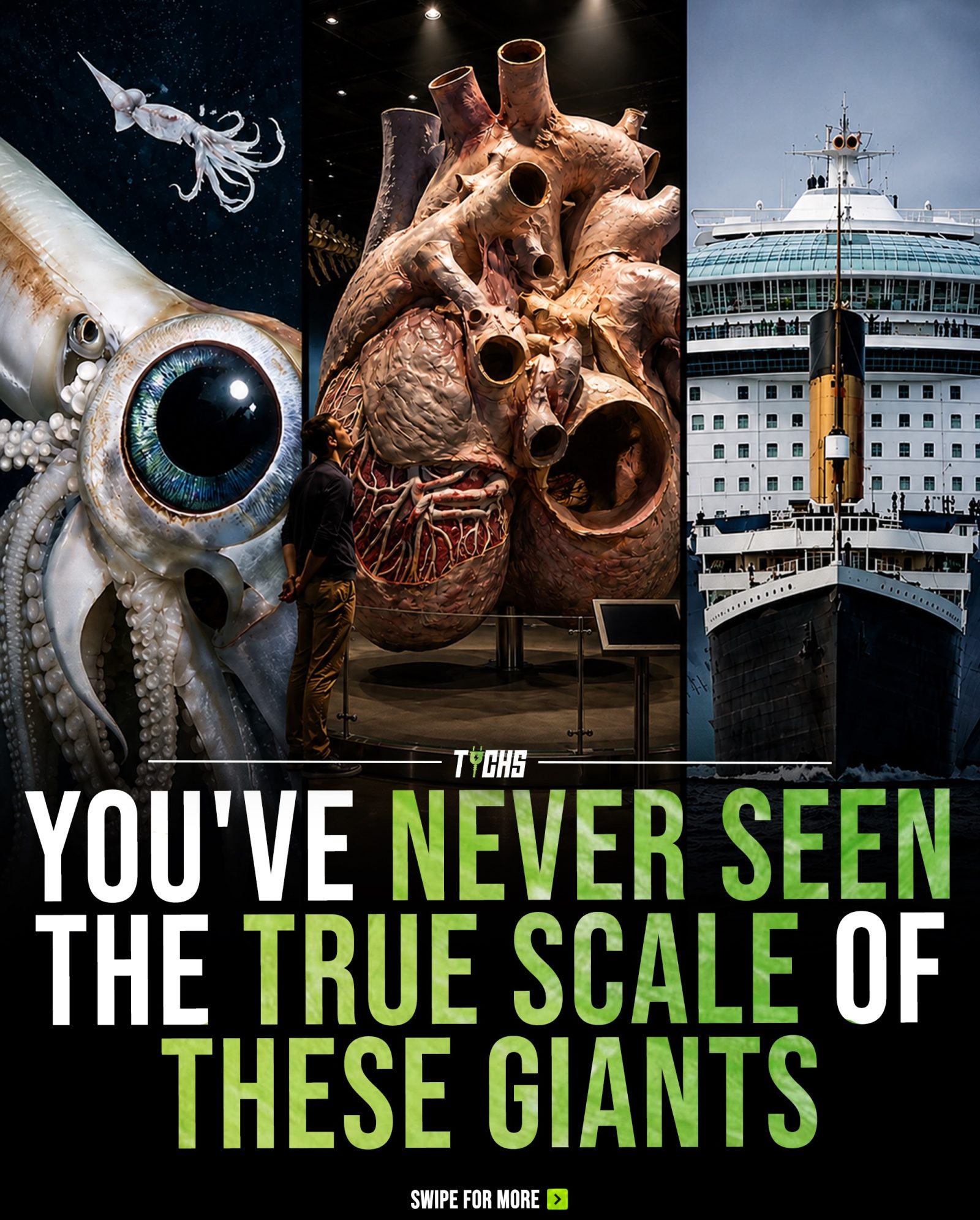
The True Scale of Giants
From the heart of a blue whale to the titanic storm of Jupiter and the vast continents of our own planet, the scale of these giants is truly astounding. The traditional methods of describing sizes in words often fall short, but visuals can bridge that gap and provide a more accurate perspective.
Why This Matters
Understanding the true scale of natural and human-made giants offers more than just fascinating trivia. It gives context to our world, helping us appreciate the vastness of our universe and the monumental achievements of both nature and humanity. This perspective can inspire awe, drive curiosity, and even inform practical decisions in fields like engineering, environmental conservation, and space exploration.
The True Scale of Giants
Nature's Majestic Creations
The natural world is home to some of the most awe-inspiring giants. Marine life, in particular, showcases creatures of astonishing proportions. For instance, the heart of a blue whale alone is as large as a car, illustrating the immense size of these ocean giants. The heart of a blue whale, the largest animal on Earth, weighs as much as an elephant.
These massive hearts pump blood through vessels the size of fire hoses, making the blue whale's cardiovascular system a marvel of biological engineering. Giant squids, with their massive bodies and enormous eyes, add to the list of underwater giants. Their tentacles can reach lengths exceeding 40 feet, making them one of the most formidable creatures in the deep sea.
The world's tallest trees, such as the coast redwoods, also dazzle with their sheer size. These giants can reach heights over 350 feet, making them some of the tallest living organisms on Earth. Their scale is mind-blowing when compared to the average human or even other tall trees.
The Vastness of Space
Space offers a different kind of scale, one that is often difficult to comprehend. Mars, for example, is home to the largest volcano in the solar system, Olympus Mons. This volcano is about 13.6 miles high, making it roughly 2.5 times taller than Mount Everest. The sheer size of Olympus Mons challenges our understanding of planetary geography and highlights the unique geological processes on Mars.
Jupiter, the largest planet in our solar system, is a giant in every sense of the word. Its Great Red Spot, a massive storm that has raged for centuries, is larger than the entire planet Earth. This storm is a testament to the dynamic and violent nature of Jupiter's atmosphere, offering a stark contrast to the relatively calm conditions on Earth.
Human Achievements
Humans have also created structures and vessels that dwarf many natural wonders. Cruise ships, for example, are engineering marvels that can accommodate thousands of passengers and crew members. These ships often exceed the length of three football fields, making them some of the largest moving structures on Earth. When compared to the Titanic, these modern cruise ships truly dwarf the infamous ocean liner, highlighting the advancements in maritime engineering.
The True Size of Continents
The size of continents can be surprisingly deceiving when viewed on conventional maps. Africa, for instance, is much larger than it appears on standard world maps. These maps, often based on the Mercator projection, distort the sizes of landmasses, particularly near the poles. When viewed with accurate size comparisons, Africa's true size becomes evident, challenging common perceptions and highlighting the need for more accurate geographical representations.
The Scale of Planets
Understanding the scale of planets in our solar system provides a unique perspective on the vastness of space. From the smallest, Mercury, with a diameter of about 4,879 kilometers, to the largest, Jupiter, with a diameter of approximately 139,822 kilometers, the differences in size are staggering. Each planet, with its unique characteristics, offers a glimpse into the diversity and complexity of our solar system.
Practical Tips
Understanding the true scale of giants can be both intriguing and practical. Here are a few tips to help appreciate and contextualize these scales:
Use Comparisons
One of the best ways to grasp the true scale of something is to compare it to familiar objects. For example, comparing the size of a blue whale's heart to a car or the height of a redwood to a building can make the scale more relatable and easier to visualize.
Visual Aids
Visual representations, such as diagrams, images, and videos, can provide a clearer understanding of scale. These aids can help bridge the gap between words and the actual size of an object, making it easier to comprehend.
Interactive Tools
Interactive tools and simulations can offer a hands-on approach to understanding scale. Virtual reality experiences, for example, can transport users to different environments, allowing them to see the true size of objects from a first-person perspective. Models and replicas can also provide a tangible way to interact with and measure large objects.
Important Takeaways
The true scale of giants, whether natural or man-made, is a testament to the incredible diversity and complexity of our world. Understanding these scales can inspire awe, drive curiosity, and inform practical decisions in various fields. This knowledge underscores the importance of accurate representations and highlights the need for continued exploration and discovery.
Conclusion
The true scale of giants, from the heart of a blue whale to the vastness of Jupiter's storm, reveals the extraordinary nature of our world and the universe. By understanding and appreciating these scales, we gain a deeper respect for the wonders of nature and the achievements of humanity. Whether through comparisons, visual aids, or interactive tools, grasping the true size of these giants offers a unique perspective on the vastness and beauty of our world.
Watch the Reel
Questions readers ask
What is the largest planet in our solar system and how does its size compare to Earth?
The largest planet in our solar system is Jupiter. It is so large that over 1,300 Earths could fit inside it. To put it into perspective, Jupiter's diameter is roughly 11 times wider than Earth's.
How big is the largest volcano in the solar system?
The largest volcano in the solar system is Olympus Mons on Mars. It is about 13.6 miles (21.9 km) high, making it approximately 2.5 times taller than Mount Everest, the highest peak on Earth.
What is the size of a blue whale and how does it compare to other large animals?
Blue whales are the largest animals to have ever lived on Earth. They can grow up to 100 feet (30 meters) long, which is roughly the size of a basketball court. This length is more than 300 times larger than a human and longer than the height of the Statue of Liberty.
What is the scale of the largest human-made structure compared to natural wonders?
The largest human-made structure is the Great Wall of China, stretching over 13,000 miles (21,000 kilometers). While impressive, it is dwarfed by natural wonders like the Great Barrier Reef, which is the world's largest single structure made by living organisms, stretching over 1,400 miles (2,300 kilometers).
Why is understanding the scale of natural and human-made giants important for space exploration?
Understanding these scales is crucial for space exploration as it provides context for the environment and challenges astronauts and engineers might face. For example, knowing the size of Mars' volcanoes can help in planning lander sites and understanding the geological history of the planet.
How does the size of continents on Earth compare to the planets in our solar system?
Earth's continents, such as Asia and Africa, are vast, but they pale in comparison to the size of planets. For instance, the continent of Asia is about 17.2 million square miles (44.6 million square kilometers), while Earth itself is approximately 197 million square miles (510 million square kilometers).
What is the significance of visualizing the true scale of natural and human-made giants?
Visualizing these scales helps bridge the gap between abstract numbers and real-world understanding. It allows us to grasp the immense sizes of natural wonders and human achievements, fostering a deeper appreciation for the world around us and the cosmos beyond.
Related deep dives
Similar reads based on topic and creator.




Recent articles
Fresh deep dives from the latest Reels we unpacked.




Comments
Be the first to comment.