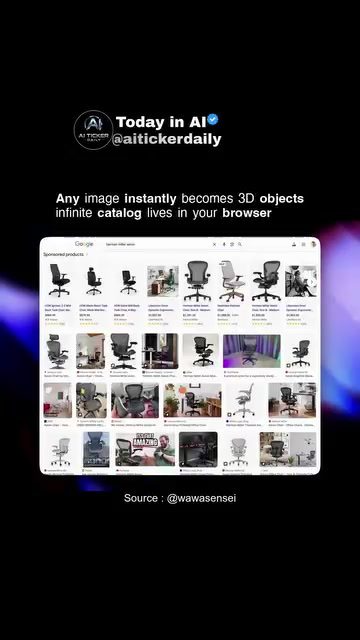
Browser-Based AI Software for Creating 3D Objects
Today, creating 3D objects from 2D images is faster and more accessible than ever, thanks to advanced browser-based AI software. This technology leverages sophisticated algorithms and tools like SAM 3D Objects, Three.js, and WebGPU to convert images into 3D models in real-time. The result is an effectively infinite catalog of 3D objects, all accessible directly from your browser.
Why This Matters
The ability to convert 2D images into 3D objects has significant implications for various industries, including design, e-commerce, and virtual reality. This technology allows for the creation of detailed and realistic 3D models, which can be used for product visualization, virtual prototyping, and even immersive gaming experiences. This democratizes the process, making it accessible to anyone with a web browser, regardless of their technical expertise.
The Technology Behind 3D Object Creation
SAM 3D Objects
SAM 3D Objects is a powerful tool that enables the conversion of 2D images into 3D models. By leveraging advanced AI algorithms, SAM 3D Objects can analyze the features and details of an image and transform them into a three-dimensional representation. This technology is particularly useful for creating detailed and accurate 3D models of various objects, from furniture to complex machinery.
Three.js and WebGPU
Three.js is a popular JavaScript library used for creating and displaying 3D graphics in a web browser. It provides a range of tools and functionalities for working with 3D objects, animations, and interactive experiences. WebGPU, on the other hand, is a new graphics API that enables high-performance rendering on the web. Together, Three.js and WebGPU allow for the creation of sophisticated and visually impressive 3D models directly in the browser.
Real-Time Conversion
One of the standout features of this technology is its ability to convert 2D images into 3D objects in real-time. This means that users can see the 3D model immediately after uploading an image, without the need for lengthy processing times. This real-time capability is crucial for applications that require quick turnaround times, such as e-commerce and virtual prototyping.
Practical Uses of 3D Object Creation
Design and Visualization
The ability to create 3D models from 2D images has numerous applications in the design and visualization fields. Architects, interior designers, and product designers can use this technology to create detailed and realistic 3D models of their designs, allowing for better visualization and more accurate representation of their ideas. This can help in making informed decisions and improving the overall quality of the design.
E-commerce
In the e-commerce industry, 3D models can enhance the shopping experience by providing customers with a more immersive and interactive way to explore products. By converting 2D product images into 3D models, retailers can offer virtual try-ons, 360-degree views, and interactive product configurations, which can lead to higher customer satisfaction and increased sales.
Virtual Reality and Gaming
The gaming and virtual reality industries can also benefit from this technology. Developers can use 3D models created from 2D images to populate virtual environments, create realistic characters, and design intricate game levels. This can significantly reduce the time and cost associated with creating detailed 3D assets, allowing developers to focus on other aspects of game development.
Practical Tips
Experiment with Different Images
When using AI-powered 3D object creation software, it's essential to experiment with various images to see how different features and details are translated into 3D models. Try uploading images with varying levels of complexity and detail to understand the capabilities and limitations of the software.
Use High-Quality Images
The quality of the 3D model will depend largely on the quality of the input image. High-resolution, well-lit images with clear details will produce better 3D models. Avoid using blurry or low-resolution images, as they may result in less accurate and less detailed 3D representations.
Explore Different Software Options
While SAM 3D Objects, Three.js, and WebGPU are powerful tools, there are other software options available that offer similar functionalities. Explore different software solutions to find the one that best fits your needs and workflow. Look for features like ease of use, customization options, and compatibility with other tools and platforms.
Leverage Community Resources
Engage with online communities and forums dedicated to 3D modeling and AI-powered object creation. These platforms can provide valuable insights, tips, and tutorials that can help you improve your skills and make the most of the technology. Don't hesitate to ask questions and seek advice from other users.
Important Takeaways
The ability to convert 2D images into 3D objects using AI-powered software in a web browser has transformed the way designers, developers, and creators work. Real-time conversion, high-quality 3D models, and the ability to manipulate and arrange objects in a virtual environment offer numerous advantages for various applications.
Understanding the technology behind 3D object creation, such as SAM 3D Objects, Three.js, and WebGPU, can help you make informed decisions about which tools to use and how to best utilize them. Practical tips such as experimenting with different images, using high-quality inputs, and exploring various software options can enhance your experience and improve the quality of your 3D models.
Conclusion
In conclusion, AI-powered 3D object creation software has revolutionized the way we approach design, e-commerce, and virtual experiences. By converting 2D images into 3D models in real-time, this technology offers endless possibilities for creativity and innovation. Whether you're a designer, developer, or enthusiast, leveraging these tools can help you achieve your goals and stay ahead in a rapidly evolving technological landscape.
Watch the Reel
Questions readers ask
What software tools are commonly used for converting 2D images to 3D objects in a browser?
Several advanced tools facilitate the 2D to 3D conversion directly in your browser. Key tools include SAM 3D Objects, Three.js, and WebGPU, which leverage AI algorithms to create detailed and lifelike 3D models in real-time.
How does AI enhance the process of creating 3D objects from 2D images?
AI significantly speeds up and simplifies 3D object creation. By using sophisticated algorithms, AI can analyze 2D images and generate accurate 3D models, making the process more accessible and efficient. Unlike traditional methods, AI can handle complex details and textures, resulting in high-quality 3D visualizations.
What industries benefit most from converting 2D images to 3D objects?
Several industries greatly benefit from this technology. Designers can create detailed prototypes, e-commerce platforms can offer immersive product visualization, and virtual reality developers can enrich gaming and interactive experiences. This technology enhances creativity and engagement across these fields.
Can I create 3D models for e-commerce using browser-based AI tools?
Absolutely. Browser-based AI tools are ideal for creating 3D models for e-commerce. They allow businesses to generate lifelike 3D product models that customers can interact with online, enhancing the shopping experience and potentially increasing sales. This is particularly useful for visualizing products from different angles and in various settings.
What are the advantages of using browser-based AI for 3D model design?
Browser-based AI for 3D model design offers several advantages, including real-time rendering, ease of access, and no need for specialized hardware. Users can create, view, and manipulate 3D models directly in their web browser, making the process more convenient and cost-effective. This accessibility democratizes 3D modeling, allowing anyone to generate high-quality 3D objects.
How does 2D to 3D conversion technology improve virtual reality experiences?
2D to 3D conversion technology enhances virtual reality by enabling the creation of detailed and immersive 3D environments. This technology can generate lifelike 3D models that elevate the realism of virtual worlds, making interactions more engaging and believable. This is particularly beneficial for gaming, virtual tours, and other VR applications.
What are the steps involved in converting a 2D image to a 3D object using AI?
The process typically involves uploading the 2D image to a browser-based AI tool, which then uses algorithms to analyze the image and generate a 3D model. The AI tool can add depth, texture, and other details to create a lifelike 3D object. Users can then view, manipulate, and refine the 3D model directly in the browser, ready for use in design, e-commerce, or virtual reality projects.
Related deep dives
Similar reads based on topic and creator.




Recent articles
Fresh deep dives from the latest Reels we unpacked.




Comments
Be the first to comment.