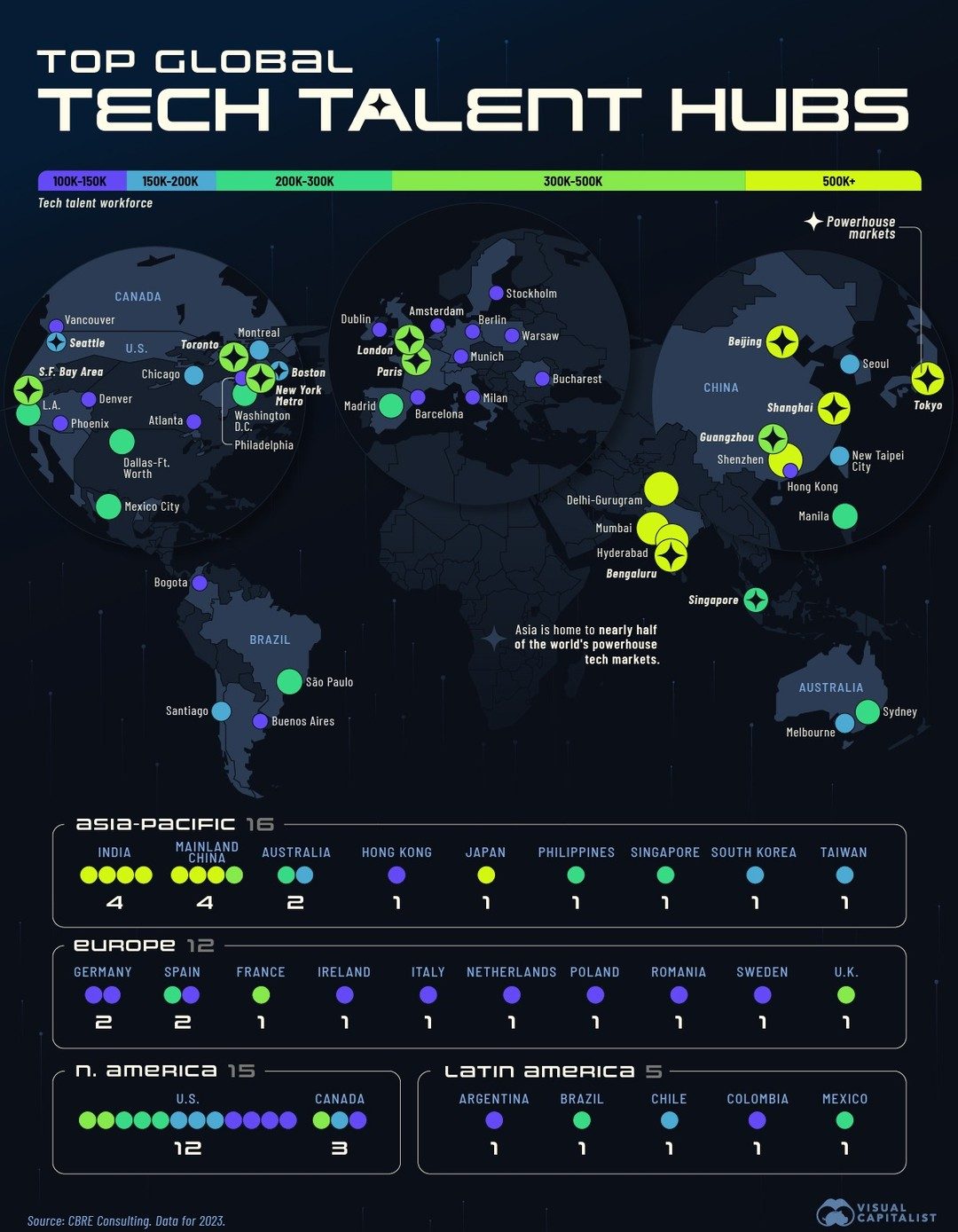
Global Tech Talent Hubs
In 2023, the landscape of global tech talent is shifting significantly, with Asia emerging as a dominant force. Eight out of the top tech talent hubs, each boasting over 500,000 workers, are concentrated in Asia, specifically across India, China, and Japan. This decentralization of tech talent is challenging longtime leaders like Silicon Valley, making Asia a formidable player in the global tech arena.
Why this matters
The distribution and concentration of tech talent have profound implications for the global economy. As Asia's tech power rises, it not only influences the regional economy but also impacts global innovation, investment, and competition. Understanding the distribution of these talent hubs is crucial for businesses, investors, and policymakers seeking to capitalize on or navigate this shifting landscape.
The Global Map of Tech Talent
Asia: The Powerhouse
Asia's dominance in the tech talent market is evident. Key cities like Beijing, Shanghai, and Shenzhen in China, along with Hyderabad, Bangalore, and Delhi-Gurugram in India, and Tokyo, Seoul, and New Taipei City in Japan, are at the forefront. These cities house over 500,000 tech workers each, making them some of the largest talent hubs globally. This concentration of talent in Asia is not only a testament to the region's investment in education and technology but also to its strategic policies that attract and retain tech talent.
North America: Established Hubs
North America remains a stronghold for tech talent, with key cities like the S.F. Bay Area, Seattle, and Dallas-Ft. Worth in the U.S. and Toronto, Montreal, and Vancouver in Canada. These cities have a rich history in tech innovation and continue to be magnets for tech talent, with workforce sizes ranging from 150,000 to over 500,000.
Europe: Diverse and Growing
Europe is home to a diverse set of tech talent hubs with cities like London, Berlin, Dublin, and Barcelona leading the charge. These cities offer a mix of established tech companies and a vibrant startup ecosystem, contributing to the region's tech talent pool. The presence of multiple languages and cultures in Europe also adds to its appeal as a global tech hub.
Latin America: Emerging Markets
Latin America, while smaller in scale compared to other regions, is home to burgeoning tech markets. Cities like Sao Paulo, Mexico City, and Santiago are quickly gaining traction as tech hubs. These cities are benefiting from a growing demand for tech services and increasing investment in the tech sector.
Key Cities by Population
The world map infographic showcases major cities categorized by the size of their tech talent workforce:
- 150,000 to 200,000 workers: Atlanta, Phoenix, Denver, Chicago, Buenos Aires
- 200,000 to 300,000 workers: Boston, Dallas-Ft. Worth
- 300,000 to 500,000 workers: Toronto, Washington D.C., Philadelphia, Montreal, Dublin, London and more
- 500,000+ workers: Seattle, the SF Bay Area, Shanghai, Shenzhen, Beijing, New Taipei City, Delhi-Gurugram, Bangalore, Mumbai, Hong Kong, Tokyo, Seoul, and New Taipei City
Understanding the Distribution
The distribution of tech talent hubs is influenced by several factors:
Investment in Education and Infrastructure
Cities that invest heavily in education and technological infrastructure are more likely to attract and retain tech talent. For instance, the presence of top-tier universities and robust internet infrastructure in cities like Beijing, Bangalore, and the SF Bay Area contributes to their status as leading tech hubs.
Government Policies
Government policies play a crucial role in attracting and retaining tech talent. Tax incentives, visa programs, and funding for research and development are some of the strategies employed by governments to foster a thriving tech ecosystem. For example, Singapore's proactive policies have positioned it as a global tech hub, and cities in the U.S. like Seattle and the SF Bay Area benefit from government support for innovation.
Economic Opportunities
Economic opportunities and job market stability are significant drivers of tech talent distribution. Cities with a robust job market and ample opportunities for career growth are more likely to attract tech professionals. The presence of leading tech companies and startups in cities like Beijing, Tokyo, and the SF Bay Area makes them attractive destinations for tech talent.
Cost of Living
The cost of living is another crucial factor in the distribution of tech talent. Cities with a lower cost of living relative to their economic opportunities tend to attract more talent. For example, cities in Asia like Bangalore and Hyderabad offer a lower cost of living compared to cities in the U.S. and Europe, making them appealing options for tech professionals.
Practical Tips for Navigating the Global Talent Landscape
For Businesses
-
Identify Key Hubs: Understand the tech talent landscape in your target region. Identify the key cities and the size of their tech talent workforce. This information can guide your expansion plans and help you tap into the right talent pool.
-
Invest in Local Infrastructure: Invest in local infrastructure to support the growth of your tech workforce. This can include funding for education, research, and development initiatives.
-
Leverage Government Policies: Take advantage of government policies and incentives to attract and retain talent. This can include tax breaks, visa programs, and funding for innovation.
-
Embrace Diversity: Recognize the diverse skill sets and cultural backgrounds of tech talent in different regions. Embrace this diversity to foster innovation and creativity.
For Talent
-
Research Opportunities: Explore job opportunities in different regions to understand the economic landscape, job market stability, and career growth prospects.
-
Consider Cost of Living: Evaluate the cost of living in different cities and weigh it against your earning potential. This can help you make an informed decision about where to base your career.
-
Stay Informed: Keep up-to-date with the latest trends and developments in the tech industry. This can help you identify new opportunities and stay competitive in the job market.
-
Network: Build a strong professional network in your target region. Attend industry events, join professional organizations, and leverage social media to connect with other professionals in your field.
Important Takeaways
The global tech talent landscape is dynamic and evolving, with Asia emerging as a dominant player. Understanding the distribution of tech talent hubs and the factors influencing their growth is crucial for businesses and professionals alike. By investing in education, infrastructure, and leveraging government policies, businesses can tap into the vast potential of these talent hubs. For professionals, research, networking, and staying informed can open up new opportunities and career paths.
Conclusion
The shift in the global tech talent landscape toward Asia is a significant development with far-reaching implications. As businesses and professionals navigate this changing environment, staying informed about key regions and cities, as well as the underlying factors driving tech talent distribution, will be critical. Whether you are an established tech company looking to expand or a professional seeking new opportunities, understanding the global map of tech talent hubs can guide your decisions and strategies for success.
Watch the Reel
Questions readers ask
Which cities in Asia are leading the tech talent landscape in 2023?
In 2023, the top tech talent hubs in Asia are primarily concentrated in China, India, and Japan, with eight cities from these countries each having over 500,000 tech workers. These cities are reshaping the global tech landscape by attracting significant investment and driving innovation.
How does the distribution of tech talent in Asia compare to Silicon Valley?
While Silicon Valley has long been a leader in tech, Asia is quickly catching up, with a significant concentration of tech talent hubs. Eight of the top tech talent cities globally are now located across China, India, and Japan, challenging Silicon Valley's traditional dominance.
What are the implications of Asia's rise as a tech talent hub for the global economy?
Asia's growing prominence as a tech talent hub influences the global economy by driving innovation, attracting investment, and fostering competition. This shift is impacting how businesses, investors, and policymakers approach the tech industry worldwide.
Which countries in Asia have the most significant tech talent hubs?
China, India, and Japan are the countries with the most significant tech talent hubs in Asia. These nations are home to eight of the top global tech talent cities, each boasting over 500,000 tech workers, making them pivotal players in the global tech landscape.
Why are tech companies considering relocation to Asia's tech talent hubs?
Tech companies are considering relocation to Asia's tech talent hubs due to the availability of a large and skilled workforce, significant investment opportunities, and the potential for innovation. The concentration of talent in these hubs makes them attractive for both established and emerging tech firms.
How can businesses benefit from understanding the distribution of Asia's tech talent hubs?
Understanding the distribution of Asia's tech talent hubs can help businesses identify strategic locations for expansion, investment, and recruitment. This knowledge is crucial for staying competitive in the global tech market and capitalizing on the region's growth.
Related deep dives
Similar reads based on topic and creator.


Recent articles
Fresh deep dives from the latest Reels we unpacked.




Comments
Be the first to comment.