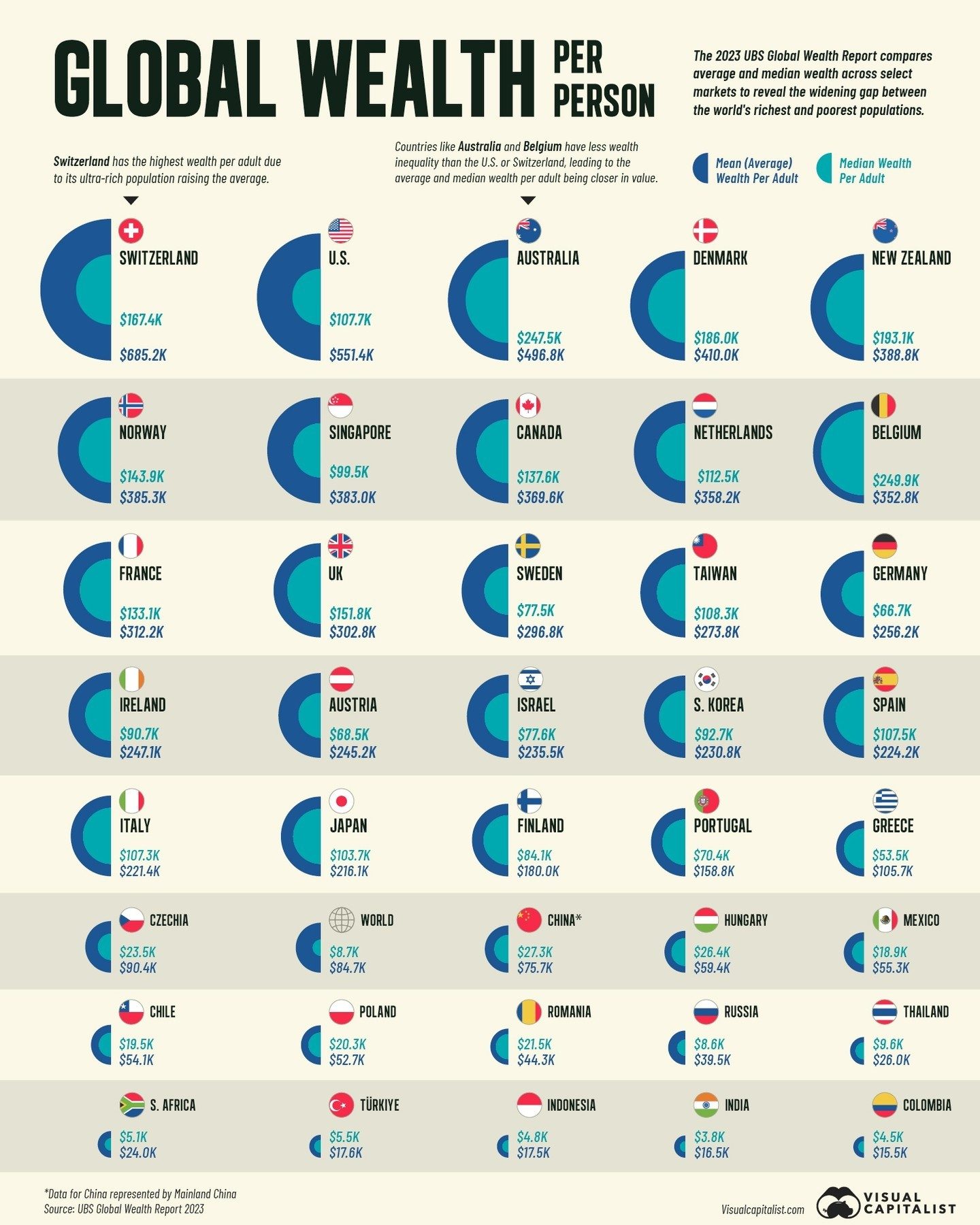
Global Wealth Comparison
In 2022, the global average wealth per adult reached $84,718, with Switzerland leading at a staggering $685,226 per person, according to a comparison of wealth across various countries. This information comes from the 2023 UBS Global Wealth Report, which provides a detailed look at the mean and median wealth per adult in select markets. The report highlights the widening gap between the world’s richest and poorest populations.
Context / Why This Matters
Understanding the distribution of wealth globally is crucial for recognizing economic trends and disparities. This data offers insights into the economic health of different countries and the overall global economic landscape. It also highlights the economic inequalities present in various regions and the challenges faced by nations with lower average wealth.
Mean and Median Wealth
The 2023 UBS Global Wealth Report compares average and median wealth across select markets. This distinction is important because the mean (average) wealth per person can be skewed by the presence of extremely wealthy individuals, while the median wealth provides a more accurate picture of the typical wealth level for the average person.
Comparing Mean and Median Wealth
The report includes several key findings that underscore the significance of comparing both mean and median wealth:
- Switzerland tops the list with a mean wealth of $187,400 per adult, reflecting its economic stability and high standard of living. This is significantly higher than the global average of $76,800.
- Australia follows closely with a mean wealth of $247,600, showcasing its robust economy and high quality of life.
- The United States has a mean wealth of $107,700, indicating its economic strength and diversity but also pointing to significant wealth disparities within the country.
- Denmark, New Zealand, and Norway also rank high with mean wealth of $186,000, $193,100, and $211,900 respectively, reflecting their strong economic policies and high social welfare standards.
Comparatively, countries like Greece, Hungary, and Mexico have lower mean wealth, at $55,500, $36,500, and $36,100 respectively. This highlights the economic challenges faced by these nations and the need for structural changes to improve wealth distribution.
Top Countries by Wealth per Person
Switzerland
Switzerland stands out as the wealthiest country, with a mean wealth of $187,400 per adult. This high level of wealth can be attributed to a stable economy, strong financial sector, and high-quality education and healthcare systems.
United States
The United States has a mean wealth of $107,700, reflecting its status as a global economic powerhouse. However, the country also has significant wealth disparities, with a large portion of the population experiencing lower median wealth compared to Switzerland and some other wealthy nations.
Australia
Australia's mean wealth of $247,600 per adult underscores its robust economy and high standard of living. The country benefits from strong economic policies, a well-developed infrastructure, and a diverse economy.
Denmark
Denmark, with a mean wealth of $186,000, is another country that stands out in terms of wealth. The country's strong welfare system, high-quality education, and comprehensive social policies contribute to its high wealth levels.
Wealth Disparities
The report reveals significant wealth disparities, both within and between countries. These disparities can have far-reaching impacts on societal well-being, economic stability, and social cohesion.
Economic Implications
The widening gap between the richest and poorest populations has economic implications for both individuals and nations. For individuals, lower wealth can mean limited access to opportunities, lower living standards, and increased economic insecurity. For nations, it can lead to social unrest, economic instability, and slower economic growth.
Social Implications
Wealth disparities also have profound social implications. Lower wealth can lead to reduced access to education and healthcare, which can perpetuate intergenerational poverty. It can also exacerbate social inequalities and create divisions within societies.
Low Wealth Countries
The report also highlights countries with lower wealth levels, which face significant economic and social challenges. These countries often struggle with limited resources, weak economic infrastructure, and high levels of poverty.
Greece
Greece has a mean wealth of $55,500, reflecting the economic struggles faced by the country in recent years. The global financial crisis and subsequent austerity measures significantly impacted Greece's economy, leading to high levels of unemployment and poverty.
Hungary
Hungary has a mean wealth of $36,500, pointing to ongoing economic challenges. The country has experienced economic instability and high levels of poverty, which have been exacerbated by economic crises and social inequality.
Mexico
Mexico, with a mean wealth of $36,100, also faces significant economic challenges. Despite economic growth in recent years, many Mexicans still live in poverty, and inequality remains a major issue.
Practical Tips
Understanding wealth distribution can offer practical insights for both individuals and policymakers. Here are some tips to consider:
- Invest in Education: High-quality education can improve economic opportunities and help close the wealth gap.
- Promote Financial Literacy: Encouraging financial literacy can help individuals make informed financial decisions and improve their economic stability.
- Implement Progressive Policies: Policies aimed at reducing wealth disparities, such as progressive taxation and increased social welfare, can help address economic inequalities.
- Support Economic Growth: Promoting economic growth and stability can help improve wealth levels and reduce poverty.
Important Takeaways
Global wealth distribution is a complex and multifaceted issue, reflecting a range of economic, social, and political factors. Key takeaways from the analysis include:
- Wealth Disparities: The gap between the richest and poorest populations is widening, highlighting significant economic and social inequalities.
- Healthy Economies: Countries with high mean wealth typically have strong economies, robust financial sectors, and well-developed social welfare systems.
- Economic Challenges: Lower wealth levels can lead to economic instability, limited opportunities, and reduced living standards.
- Policy Implications: Implementing policies to reduce wealth disparities and promote inclusive economic growth is essential for addressing these challenges.
Conclusion
The 2023 UBS Global Wealth Report provides a comprehensive look at the global wealth distribution, highlighting both the successes and challenges faced by different countries. By understanding the wealth trends and disparities, we can better address the economic and social issues that affect us all.
Watch the Reel
Questions readers ask
Which country has the highest wealth per adult in 2022?
Switzerland tops the list with an average wealth of $685,226 per adult in 2022, according to the 2023 UBS Global Wealth Report. This makes it the wealthiest country by this measure.
What is the global average wealth per adult in 2022?
The global average wealth per adult is $84,718 in 2022. This figure is significantly lower than the wealth per adult in the world's top countries, highlighting global economic disparities.
Which countries are considered the richest in 2023 based on the UBS Global Wealth Report?
In addition to Switzerland, countries like Australia and the United States are among the richest in 2023. The UBS Global Wealth Report provides a detailed breakdown of wealth distribution in various countries, showing the average and median wealth levels.
How does the median wealth per person compare to the average wealth per person?
The median wealth per person is often lower than the average wealth per person because it is less affected by extreme wealth disparities. The median represents the middle point, where half the population has more and half has less, while the average can be skewed by very high wealth values.
What insights can be gained from comparing wealth per capita across different nations?
Comparing wealth per capita across nations provides insights into economic health, living standards, and economic policies. It helps identify trends, disparities, and areas where economic development is strongest, which can guide international investments and aid.
Why is understanding global wealth distribution important?
Understanding global wealth distribution helps in recognizing economic trends and inequalities. It offers a comprehensive view of the global economic landscape, illuminating the economic health of different countries and highlighting areas with significant wealth gaps.
Related deep dives
Similar reads based on topic and creator.




Recent articles
Fresh deep dives from the latest Reels we unpacked.




Comments
Be the first to comment.