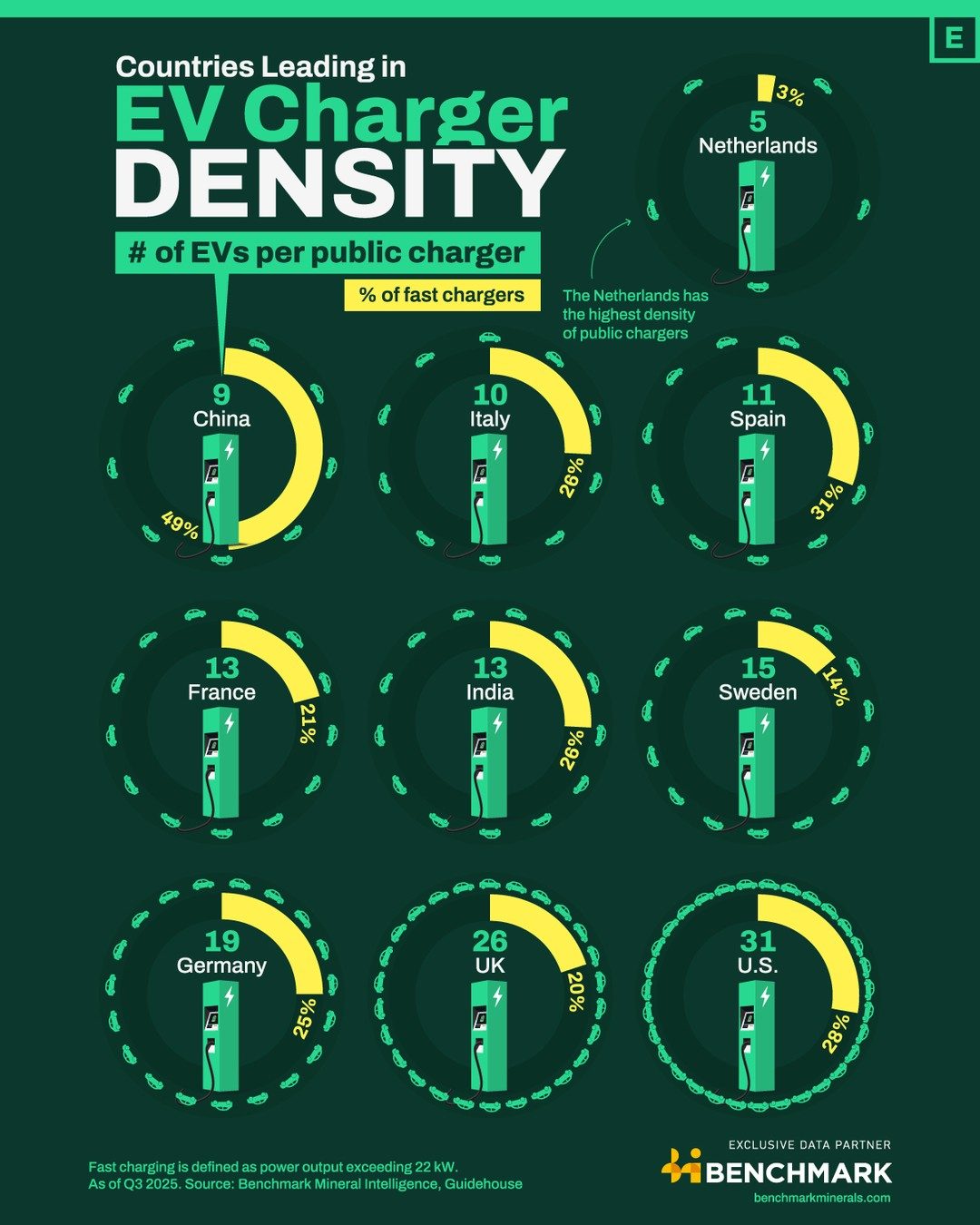
EV Charger Density
In the realm of electric vehicle (EV) infrastructure, the density of public charging stations is a critical metric. This measure, often expressed as the number of EVs per public charger, offers valuable insights into the accessibility and convenience of EV charging. As of Q3 2025, several countries stand out for their impressive EV charger densities, with notable progress made in both the quantity and speed of charging infrastructure.
Why This Matters
Adequate EV charger density is essential for the widespread adoption of electric vehicles. It directly impacts the convenience and reliability of EV ownership, addressing range anxiety and encouraging more people to make the switch to electric. Governments and industries around the world are investing heavily in charging infrastructure to support this transition.
Countries Leading in EV Charger Density
The Netherlands
The Netherlands currently holds the top spot with an impressive charger density of just 5 EVs per public charger. This high density is a result of proactive policies and significant investments in public charging infrastructure, making it one of the most EV-friendly countries in the world. The Dutch model emphasizes widespread availability, ensuring that EV owners have easy access to chargers throughout the country.
China
China is notable for its rapid expansion of fast-charging stations. Fast charging, defined as power output exceeding 22 kW, makes up nearly half of China's public charging network. With 9 EVs per public charger, China is aggressively building out its infrastructure to support the growing number of EVs on its roads. This focus on fast charging is crucial for long-distance travel and commercial EVs, addressing one of the key challenges in EV adoption.
Spain
Spain follows closely with 11 EVs per public charger. The country has been actively investing in both slow and fast-charging infrastructure to support its growing EV fleet. Spain's approach includes integrating charging points into urban planning, ensuring that chargers are convenient and accessible for residents.
France and India
France and India are also making substantial strides. France, with a balanced approach to charging infrastructure, has seen a steady increase in the number of chargers, supporting its ambitious EV targets. India, with a large and growing EV market, is focusing on both fast and slow chargers, especially in urban areas, to support its rapidly expanding EV fleet.
Sweden, Germany, and the UK
Sweden, Germany, and the UK are recognized for their well-developed charging networks. Sweden, in particular, has a strong focus on sustainability and renewable energy, making EV charging a key component of its green energy strategy. Germany, the automotive powerhouse, is investing heavily in charging infrastructure to support its domestic EV industry. The UK, with its ambitious net-zero goals, is rolling out both fast and slow chargers to support EV adoption across the country.
The United States
The U.S. has a lower charger density, with 31 EVs per public charger. However, there is significant investment in expanding the charging network, particularly along major highways and in urban areas. The U.S. is also seeing a rise in fast-charging stations, mirroring the trend in other leading countries.
Practical Tips for EV Owners and Potential Buyers
Plan Ahead
Knowing the charger density in your area or along your travel routes can help you plan your journeys more effectively. Use apps and resources that provide real-time charging station data to ensure you have access to reliable charging points.
Utilize Fast Charging
Fast charging is crucial for long trips and emergencies. Understanding the availability of fast-charging stations can ease range anxiety.
Advocate for Better Infrastructure
As an EV owner or potential buyer, you can advocate for better EV charging infrastructure. Engaging with local authorities, participating in community initiatives, and supporting policies that promote EV charging can contribute to a more robust and accessible charging network.
Important Takeaways
- Charger Density Matters: The number of EVs per public charger is a critical metric for EV adoption. Countries with lower ratios, such as the Netherlands and China, are leading the way in making EVs more accessible.
- Fast Charging is Key: The rapid rollout of fast-chargers, as seen in China, is a game-changer for long-distance travel and commercial use.
- Infrastructure Investment: Countries investing in both slow and fast charging infrastructure are better positioned to support the growing number of EVs.
- Public Support: Community engagement and public advocacy can drive policy changes that improve charging infrastructure.
Conclusion
The density of EV chargers is a crucial factor in the global shift towards electric vehicles. Countries leading in this area are not only investing in the number of chargers but also in the speed and accessibility of the charging network. For EV owners and potential buyers, understanding the charger density and planning accordingly can make the transition to electric vehicles smoother and more convenient. As more countries and regions invest in charging infrastructure, the future of electric mobility looks increasingly promising.
Watch the Reel
Questions readers ask
What does EV charger density mean and why is it important?
EV charger density refers to the number of public charging stations available per electric vehicle in a given area. It is important because it indicates how accessible and convenient it is to charge an EV, which directly affects the overall EV ownership experience and adoption rates.
Which countries are expected to have the best EV charging accessibility in 2025?
By 2025, countries like the Netherlands, China, and Spain are projected to have the highest EV charging accessibility due to their impressive densities of public charging stations. These countries are investing heavily in both the quantity and speed of their charging infrastructure.
What is the significance of a high EV charger density?
A high EV charger density ensures that EV drivers can easily find charging stations, reducing range anxiety and making EV ownership more reliable and convenient. This encourages more people to switch to electric vehicles, promoting sustainable transportation.
How does the Netherlands stand out in terms of EV charging infrastructure?
The Netherlands is leading the way in EV charging infrastructure with a high density of public charging stations. This makes it one of the most convenient countries for EV drivers, with a robust network of charging points to support electric vehicle use.
What investments are being made to improve EV charging accessibility?
Governments and industries worldwide are investing heavily in both the number and speed of public charging stations. These investments aim to enhance the convenience and reliability of EV charging, addressing range anxiety and promoting the widespread adoption of electric vehicles.
What are the advantages of a well-developed fast charging network?
A well-developed fast charging network allows EV drivers to recharge their vehicles quickly, reducing downtime and making long-distance travel more feasible. This is crucial for increasing the convenience and practicality of owning an electric vehicle, especially in countries with high EV adoption rates.
Related deep dives
Similar reads based on topic and creator.




Recent articles
Fresh deep dives from the latest Reels we unpacked.




Comments
Be the first to comment.