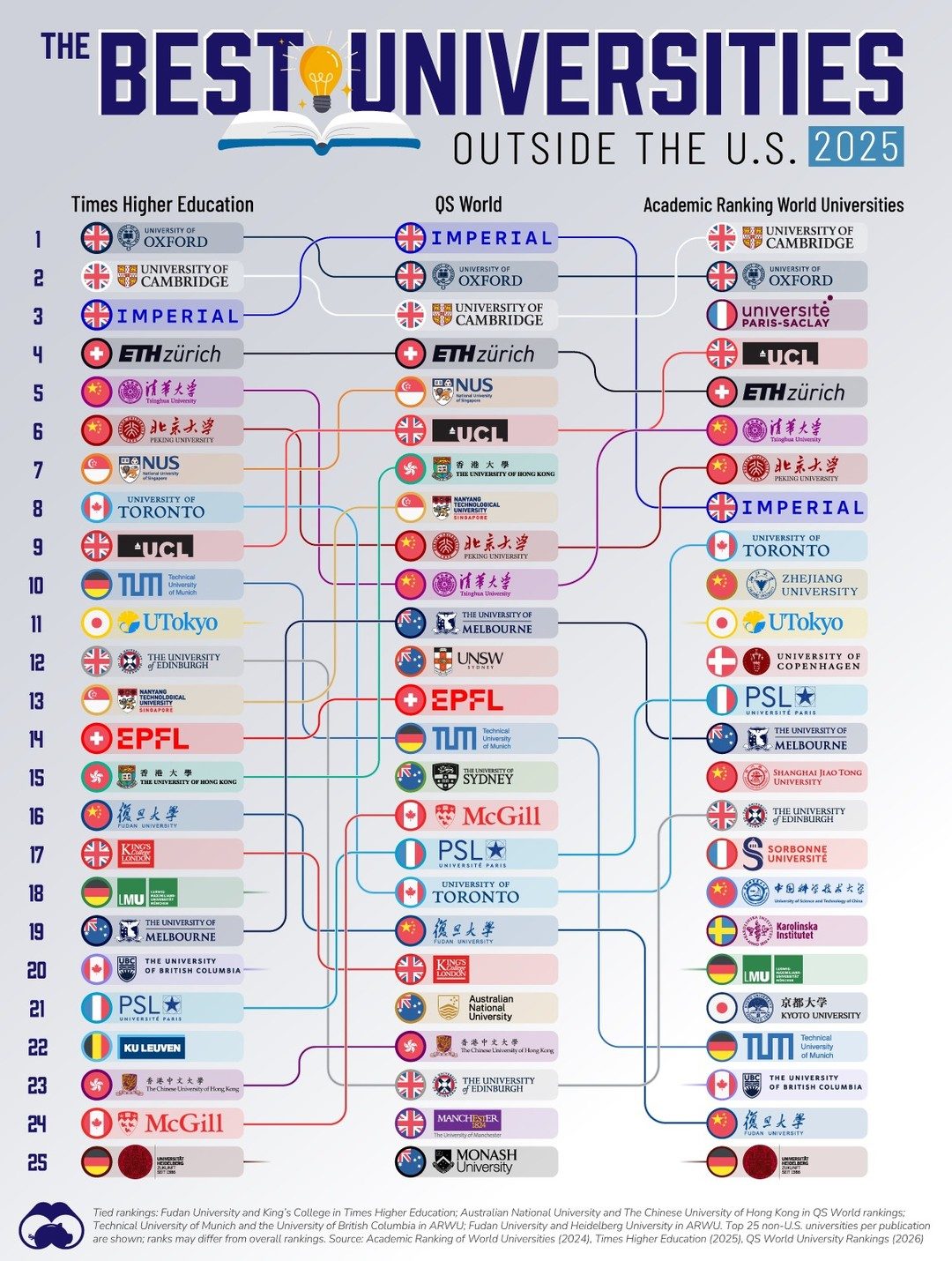
University Rankings Outside of the U.S. in 2025
The landscape of higher education is dynamic, with universities around the world vying for top positions in global rankings. As of 2025, Oxford and Cambridge Universities in the UK stand out as the most prominent non-U.S. institutions, dominating across three major rankings. These rankings—Times Higher Education, QS World, and Academic Ranking World Universities—provide a comprehensive view of the best universities outside the United States, highlighting the top 25 institutions across seven countries: the UK, China, Singapore, Australia, Canada, France, and Germany.
Why This Matters
University rankings play a crucial role in shaping the global perception of higher education institutions. They influence student choices, research collaborations, and funding opportunities. For universities, achieving a high ranking is a testament to their academic excellence, research output, and overall institutional reputation. For students, these rankings serve as a valuable guide in selecting institutions that offer world-class education and opportunities.
Main Discussion
The Powerhouses: Oxford and Cambridge
Topping the charts are the University of Oxford and the University of Cambridge. Both institutions have long been recognized for their academic rigor and historical significance. Their consistent performance across multiple rankings underscores their leadership in research, teaching, and innovation. While Oxford and Cambridge are no strangers to the top spots, their continued dominance is a reflection of their enduring commitment to academic excellence.
The Rising Stars
Beyond the UK, several other universities have made significant strides in global rankings. Notably, ETH Zürich in Switzerland, NUS (National University of Singapore), and the University of Toronto in Canada have climbed the ranks, showcasing their strengths in various academic disciplines.
-
ETH Zürich: Known for its strong focus on science, technology, engineering, and mathematics (STEM), ETH Zürich is a powerhouse in research and innovation. Its high ranking is a testament to its cutting-edge research and impactful contributions to various fields.
-
NUS (National University of Singapore): NUS has established itself as a leading institution in Asia, with a strong emphasis on interdisciplinary research and global collaborations. Its strategic location and commitment to excellence have earned it a coveted spot among the top universities.
-
University of Toronto: The University of Toronto is another rising star, recognized for its diverse academic programs and robust research initiatives. Its strong performance across various disciplines has solidified its position as a top-tier institution.
Emerging Contenders
Other notable universities that have made significant progress include the Australian National University, McGill University in Canada, and the University of Copenhagen in Denmark. These institutions have demonstrated their prowess in research and academic programs, earning them spots among the top non-U.S. universities.
-
Australian National University: Known for its research-intensive programs and strong academic rigor, the Australian National University has made significant strides in global rankings, particularly in areas like environmental science and public health.
-
McGill University: Located in Montreal, Canada, McGill University is renowned for its comprehensive academic offerings and research excellence. Its diverse student body and strong international collaborations have contributed to its high ranking.
-
University of Copenhagen: This Danish institution has gained recognition for its innovative research and high-quality teaching. Its focus on sustainability and interdisciplinary research has helped it secure a top position in global rankings.
The Ranking Methodology
Understanding the methodology behind these rankings is crucial for interpreting the results. Each of the three major rankings—Times Higher Education, QS World, and Academic Ranking World Universities—employs a unique set of criteria to evaluate universities.
-
Times Higher Education (THE): THE rankings consider a range of factors, including teaching, research, knowledge transfer, and international outlook. The balanced approach provides a comprehensive evaluation of a university's overall performance.
-
QS World: QS World Rankings focus on academic reputation, employer reputation, faculty-to-student ratio, citations per faculty, and international faculty and student ratios. This methodology emphasizes the global reach and impact of a university.
-
Academic Ranking of World Universities (ARWU): ARWU primarily assesses research output and quality, with a strong emphasis on Nobel laureates, Field Medalists, and highly cited researchers. This ranking is particularly influential in academic circles, highlighting research impact.
Practical Tips
For prospective students and researchers looking to leverage these rankings, here are some practical tips to navigate the landscape of global higher education:
-
Identify Your Priorities: Understand your academic and career goals. Different rankings might emphasize different strengths, so choose a university that aligns with your priorities, whether it's research, teaching, or international opportunities.
-
Explore Programme-Specific Rankings: While overall rankings provide a broad view, programme-specific rankings can offer more detailed insights into the quality of individual departments and programs.
-
Consider Location and Culture: The university's location and campus culture can significantly impact your experience. Research the environment, local amenities, and support systems available for international students.
-
Stay Updated: Rankings are updated annually, and universities continuously evolve. Stay informed about the latest developments and changes in rankings to make the most educated decision.
Important Takeaways
-
Global Competition: The competition among universities is fierce, with institutions from various countries vying for top positions. This global competition drives continuous improvement and innovation in higher education.
-
Diverse Strengths: Each university has its unique strengths, whether in research, teaching, or international collaborations. Prospective students and researchers should consider these diverse strengths when making decisions.
-
Methodology Matters: Understanding the methodology behind the rankings can provide deeper insights into a university's performance and help in making informed choices.
-
Dynamic Landscape: The landscape of higher education is dynamic, with new contenders emerging and established institutions adapting to stay at the top. Staying informed about these changes is crucial for making the best choices.
Conclusion
The 2025 rankings of universities outside the U.S. offer a fascinating glimpse into the global higher education landscape. With Oxford and Cambridge leading the way, and other institutions like ETH Zürich, NUS, and the University of Toronto making significant strides, the competition is intense and exciting. As prospective students and researchers navigate this landscape, understanding the nuances of these rankings and the diverse strengths of each institution is key to making informed decisions. The future of higher education is poised for continued growth and innovation, driven by the relentless pursuit of excellence by these top institutions.
Watch the Reel
Questions readers ask
What criteria are used to determine the top non-U.S. universities in 2025?
The rankings are based on several factors including academic excellence, research output, and global reputation. Specific metrics often include the number of research publications, citations, faculty-to-student ratio, and international student and faculty diversity.
How do Oxford and Cambridge universities maintain their top positions in 2025?
Oxford and Cambridge maintain their top positions through a combination of historical prestige, extensive research funding, high academic standards, and a strong global network of alumni and partnerships. They consistently excel in various ranking criteria, particularly in research and teaching quality.
Which Chinese universities are expected to be among the top in 2025?
Chinese universities that are expected to rank highly in 2025 include institutions like Tsinghua University and Peking University. These universities have seen significant investments in research and infrastructure, leading to improved global rankings and increased international recognition.
What makes National University of Singapore (NUS) a notable institution in 2025?
National University of Singapore (NUS) is notable for its strong emphasis on research and innovation, as well as its collaborative efforts with international universities. The university has made significant strides in various research fields and has a strong reputation in Asia and globally.
What impact do university rankings have on student choices in 2025?
University rankings significantly influence student choices by providing a benchmark for academic excellence and research output. Prospective students often refer to these rankings to identify institutions that offer the best opportunities for their academic and professional growth, considering factors like faculty quality, research output, and global reputation.
Which Australian universities are likely to be in the top 25 in 2025?
Australian universities such as the University of Melbourne and the University of Sydney are likely to be among the top 25. These institutions are recognized for their robust research programs, high academic standards, and strong global partnerships, which contribute to their high rankings.
What role do global partnerships play in the rankings of Canadian universities in 2025?
Global partnerships are crucial for Canadian universities as they enhance research collaborations, facilitate international student exchanges, and attract top faculty. Institutions like the University of Toronto and the University of British Columbia leverage these partnerships to maintain high standards and improve their global rankings.
Related deep dives
Similar reads based on topic and creator.




Recent articles
Fresh deep dives from the latest Reels we unpacked.




Comments
Be the first to comment.