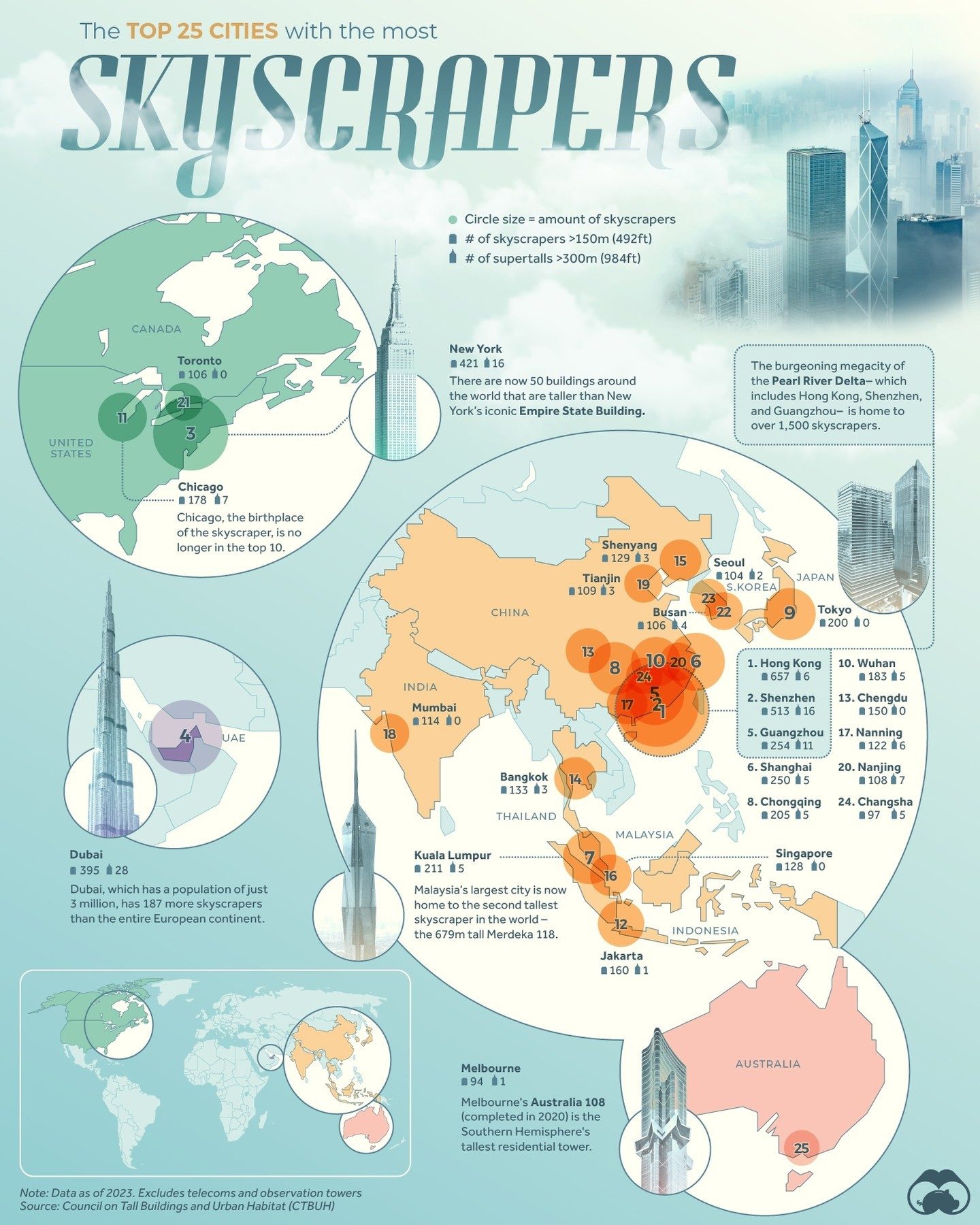
Top 25 Cities with Skyscrapers
Modern cities are defined by their skylines, and nowhere is this more evident than in the urban landscapes dominated by skyscrapers. These architectural marvels not only symbolize progress but also serve as crucial components of urban infrastructure. When it comes to soaring skylines and architectural marvels, no country has embraced the vertical revolution quite like China.
Why This Matters
The prevalence of skyscrapers in a city indicates urban density, economic activity, and technological advancement. These towering structures are more than just eye-catching; they are essential for accommodating a growing population and supporting economic growth. Understanding which cities have the most skyscrapers provides insight into global urban development trends and economic powerhouses.
Understanding the Data
To compile this list, data from the Council on Tall Buildings and Urban Habitat was used. This data provides a comprehensive view of the global skyscraper landscape, highlighting cities that have made significant strides in vertical construction. It is important to note that the data excludes telecommunications and observation towers, focusing solely on skyscrapers and supertall buildings.
Chicago: The Birthplace of the Skyscraper
Chicago tops the list with 1,178 skyscrapers. Known as the birthplace of the skyscraper, Chicago's architectural heritage dates back to the late 19th century. The city's dense urban core and innovative building techniques have led to a skyline that is both iconic and influential.
Toronto and New York: North American Giants
Toronto, with 1,165 skyscrapers, and New York, with 1,155, follow closely behind Chicago. Both cities are major financial and cultural hubs, and their skylines are synonymous with urban sophistication. These cities continue to push the boundaries of vertical construction, incorporating sustainable and technologically advanced building practices.
Asian Metropolises
China's dominance in the list is evident, with cities like Shenyang (1,043 skyscrapers), Tianjin (1,004), and Shanghai (828) making significant contributions. These cities are at the forefront of China's rapid urbanization and economic growth. Other Asian cities like Seoul (883), Hong Kong (853), Busan (1,001), and Singapore (804) also rank high, reflecting the region's intense urban development.
Dubai: The Icon of Super-tall Buildings
Dubai, with 814 skyscrapers, is renowned for its super-tall buildings and futuristic architecture. The city's skyline, featuring the iconic Burj Khalifa, is a testament to its ambitious urban planning and construction capabilities. Kuala Lumpur (805), Chengdu (813), and Nanning (812) are also notable for their extensive skyscraper landscapes.
The Global Reach
The list also includes cities from other continents, such as Jakarta (769), Melbourne (759), and Wuhan (798). These cities showcase the global trend of vertical urban development, driven by the need for efficient land use and sustainable growth.
Practical Tips for Urban Planning
For cities aiming to emulate these skyscraper hubs, there are several key considerations:
Land Use Efficiency
Vertical construction allows for efficient land use, accommodating a large population in a relatively small area. This is particularly important in cities with limited land and high population densities. Urban planners should focus on creating mixed-use developments that integrate residential, commercial, and recreational spaces.
Infrastructure Development
Building skyscrapers requires robust infrastructure, including transportation systems, utilities, and public services. Investing in infrastructure ensures that new developments are sustainable and beneficial to the community.
Environmental Considerations
Sustainable practices are crucial in vertical construction. Energy-efficient building designs, green spaces, and renewable energy sources can mitigate the environmental impact of skyscrapers. Urban planners should prioritize eco-friendly materials and green building certifications.
Technological Integration
The integration of smart technologies in skyscrapers can enhance efficiency and quality of life. Automated systems, smart grids, and digital infrastructure can improve building management, security, and sustainability.
Important Takeaways
The top 25 cities with the most skyscrapers offer a glimpse into the future of urban development. These cities are leaders in vertical construction, showcasing architectural innovation, technological advancement, and sustainable practices. For cities looking to follow suit, focusing on land use efficiency, infrastructure development, environmental considerations, and technological integration is essential.
Conclusion
The vertical revolution is here to stay, and cities around the world are embracing it with open arms. From Chicago's historical significance to Dubai's futuristic skyline, these cities are not just building tall; they are building smarter, more sustainable, and more efficient urban landscapes. Understanding the trends and practices of these top 25 cities can provide valuable insights for urban planners and developers aiming to create the cities of the future.
Watch the Reel
Questions readers ask
What factors contribute to a city being dominated by skyscrapers?
A city's dominance of skyscrapers is influenced by several factors, including urban density, economic growth, and technological progress. As urban populations grow, the demand for vertical space increases, leading to the construction of more skyscrapers.
Why are skyscrapers significant in modern city landscapes?
Skyscrapers are significant because they symbolize urban progress and economic activity. They also play a crucial role in accommodating growing populations and provide a unique visual identity to the city.
Which country has the most skyscrapers in the world?
China has embraced the vertical revolution more than any other country, leading it to have the most skyscrapers in the world. The country's rapid urbanization and economic growth have driven the construction of numerous skyscrapers.
What is the significance of super-tall skyscrapers in a city's skyline?
Super-tall skyscrapers, typically defined as buildings over 300 meters tall, significantly impact a city's skyline. These architectural marvels elevate a city's visual identity, attract investment, and demonstrate the city's focus on innovation and development.
How does the presence of skyscrapers in a city affect its urban infrastructure?
Skyscrapers are vital for urban infrastructure by providing vertical space for housing, commercial spaces, and mixed-use developments. They also often attract transportation infrastructure improvements, such as subway extensions and new highways.
What is the role of skyscrapers in urban economic growth?
Skyscrapers can stimulate urban economic growth by attracting businesses, investment, and tourists. They often house corporate headquarters, high-end retail, and luxury amenities, which can drive local economic activity.
Related deep dives
Similar reads based on topic and creator.




Recent articles
Fresh deep dives from the latest Reels we unpacked.




Comments
Be the first to comment.