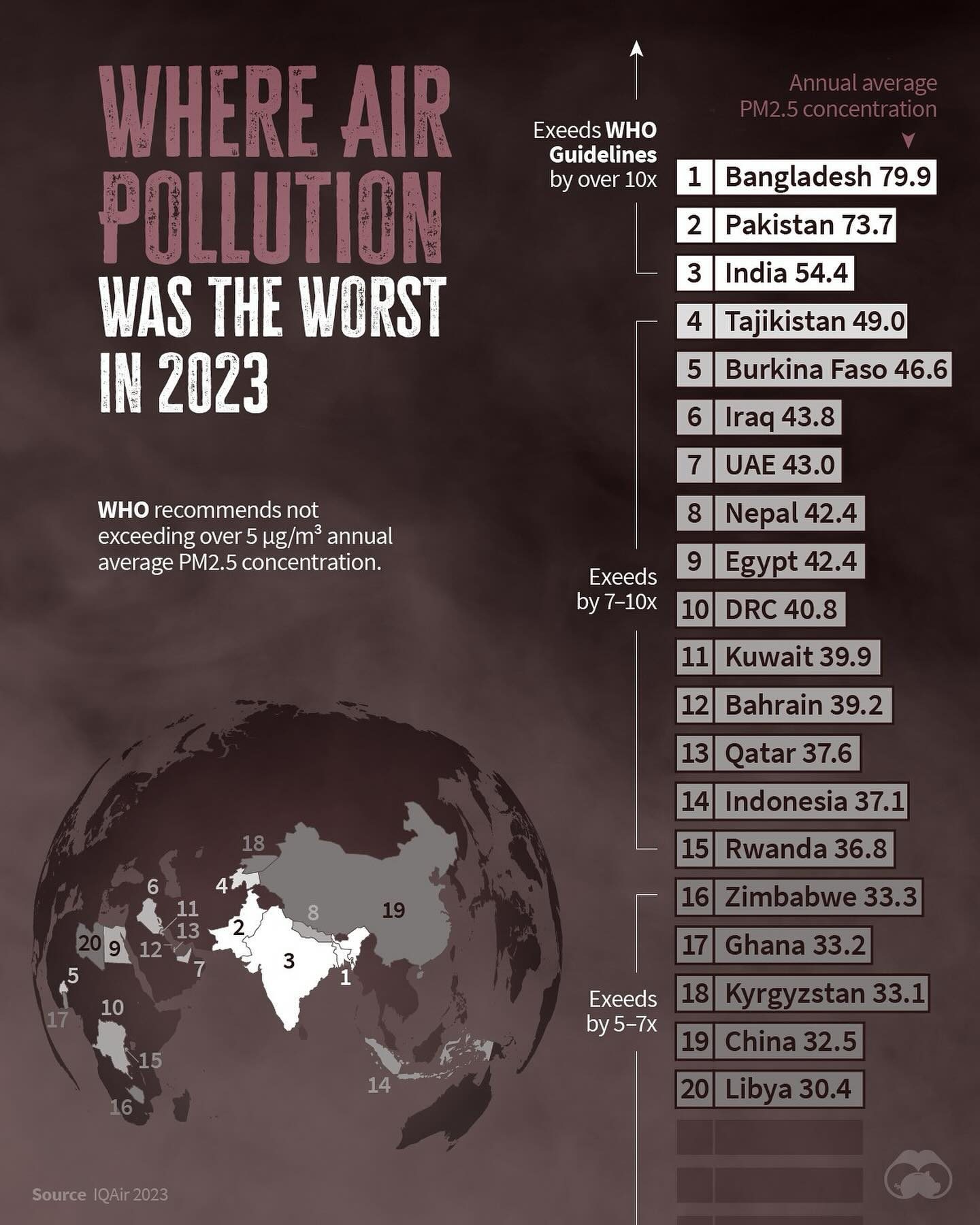
Air Pollution Ranking by PM2.5 Concentration
Air pollution is a pressing global concern, with 97.3% of the world’s population breathing air that exceeds World Health Organization (WHO) guidelines. This analysis explores the most polluted countries by annual average PM2.5 concentration in 2023, providing a visual representation and breaking down the data to understand the severity of the issue.
Why This Matters
Air pollution, particularly PM2.5 (particulate matter with a diameter of 2.5 micrometers or less), poses significant health risks. Exposure to high levels of PM2.5 can lead to respiratory and cardiovascular diseases, reduced lung function, and even premature death. Understanding which countries are most affected helps in identifying regions that require urgent intervention and resource allocation.
Ranking the Most Polluted Countries
Bangladesh
Topping the list, Bangladesh has an annual average PM2.5 concentration of 79.9 µg/m³, significantly exceeding the WHO recommended limit of 5 µg/m³. The country's high pollution levels are attributed to various factors, including industrial emissions, vehicular pollution, and indoor air pollution from cooking and heating.
Pakistan
Pakistan follows closely with an annual average PM2.5 concentration of 73.7 µg/m³. Similar to Bangladesh, the primary sources of pollution include industrial activities, vehicular emissions, and the burning of crop residue, particularly in rural areas.
India
India ranks third with an average PM2.5 concentration of 54.4 µg/m³. The country's pollution crisis is well-documented, with major contributors including industrial emissions, traffic, and crop burning. Delhi, in particular, is notorious for its severe air pollution levels.
Tajikistan, Burkina Faso, and Iraq
Tajikistan, Burkina Faso, and Iraq also feature prominently in the top ten, with annual average PM2.5 concentrations of 49.0, 46.6, and 43.8 µg/m³, respectively. The pollution in these countries can be traced back to a mix of industrial and agricultural activities, as well as urban development and transportation.
Mid-Ranking Countries
Qatar, Kuwait, and Bahrain
Qatar, Kuwait, and Bahrain have average PM2.5 concentrations of 40.8, 39.9, and 39.2 µg/m³, respectively. These countries, despite their wealth and urban development, face significant air pollution issues due to industrial emissions and the use of fossil fuels.
Indonesia, Rwanda, and Zimbabwe
Indonesia, Rwanda, and Zimbabwe have average PM2.5 concentrations of 37.1, 36.8, and 33.3 µg/m³, respectively. These countries' pollution levels are influenced by a combination of industrial activities, vehicular emissions, and environmental degradation.
Lower-Ranking Countries
Kyrgyzstan, China, and Libya
Kyrgyzstan, China, and Libya have average PM2.5 concentrations of 33.1, 32.5, and 30.4 µg/m³, respectively. While these levels are lower than the top-ranking countries, they still exceed WHO guidelines significantly, indicating a need for sustained efforts to improve air quality.
Understanding PM2.5 Concentration
PM2.5 particles are extremely small and can easily penetrate the lungs, entering the bloodstream and causing various health issues. The WHO recommends an annual average PM2.5 concentration of no more than 5 µg/m³. Countries exceeding this limit by 7-10 times face severe environmental and health challenges.
Practical Tips for Reducing Exposure
Monitoring Air Quality
Regularly checking air quality indices can help individuals plan their outdoor activities during times when pollution levels are lower. Many mobile apps and websites provide real-time air quality data, making it easier to stay informed.
Using Air Purifiers
Investing in air purifiers or masks, especially in highly polluted areas, can significantly reduce exposure to PM2.5 particles. Look for purifiers with HEPA filters, which are designed to capture tiny particles efficiently.
Planting Trees
Urban greening initiatives, such as planting trees and creating green spaces, can help mitigate air pollution. Trees act as natural filters, absorbing pollutants and improving air quality in urban areas.
Adopting Clean Energy
Encouraging the use of renewable energy sources like solar and wind power can reduce reliance on fossil fuels, thereby lowering industrial emissions and improving overall air quality.
Important Takeaways
Global Concern
Air pollution is a global issue that affects almost every person on the planet. The ranking of the most polluted countries highlights the urgent need for international cooperation and local initiatives to address this crisis.
Health Implications
Exposure to high levels of PM2.5 can lead to severe health issues, including respiratory and cardiovascular diseases. Reducing exposure through monitoring, air purifiers, and masks is crucial for protecting public health.
Policy and Action
Governments and communities need to implement policies that promote clean energy, reduce industrial emissions, and create green spaces. International collaboration and sharing of best practices can accelerate progress towards cleaner air.
Individual Responsibility
Individuals can also play a role by adopting eco-friendly practices, such as using public transportation, reducing energy consumption, and supporting local initiatives for a cleaner environment.
Conclusion
The ranking of the world’s most polluted countries by annual average PM2.5 concentration in 2023 underscores the severity of the air pollution crisis. Countries like Bangladesh, Pakistan, and India face significant challenges, but so do many others. By understanding the sources and impacts of air pollution, we can take targeted actions to improve air quality and safeguard public health. From individual efforts to government policies, every step counts in the fight against air pollution.
Watch the Reel
Questions readers ask
What are PM2.5 particles and why are they harmful?
PM2.5 particles are tiny particles with a diameter of 2.5 micrometers or less. They are harmful because they can penetrate deep into the lungs and even enter the bloodstream, leading to respiratory and cardiovascular diseases, reduced lung function, and other serious health issues.
Which countries have the highest PM2.5 levels in 2023?
The top ten countries with the highest PM2.5 levels in 2023 are listed in the article. These countries are identified based on their annual average PM2.5 concentration, which helps highlight the regions most affected by severe air pollution.
How does air pollution affect public health?
Air pollution, particularly high levels of PM2.5, is linked to various health issues. These include respiratory diseases like asthma and bronchitis, as well as cardiovascular problems such as heart disease and stroke. Long-term exposure can also lead to premature death.
Why is it important to monitor air pollution levels?
Monitoring air pollution levels is crucial for identifying areas that need urgent intervention. By understanding the severity of air pollution in different regions, policymakers can allocate resources more effectively to implement mitigation strategies and protect public health.
What can individuals do to protect themselves from high PM2.5 levels?
Individuals can take several steps to protect themselves from high PM2.5 levels. These include using air purifiers at home, wearing masks when outdoors, avoiding outdoor activities during peak pollution hours, and staying informed about local air quality reports.
How does the World Health Organization (WHO) define safe air pollution levels?
The WHO defines safe air pollution levels through its guidelines, which recommend that annual mean concentrations of PM2.5 should not exceed 5 µg/m³ to protect public health. Unfortunately, 97.3% of the world’s population is exposed to levels exceeding this guideline.
What are some common sources of PM2.5 air pollution?
Common sources of PM2.5 air pollution include vehicle emissions, industrial activities, biomass burning, and natural sources like wildfires and dust storms. These sources contribute to the high levels of particulate matter in the air, impacting air quality and public health.
Related deep dives
Similar reads based on topic and creator.




Recent articles
Fresh deep dives from the latest Reels we unpacked.




Comments
Be the first to comment.