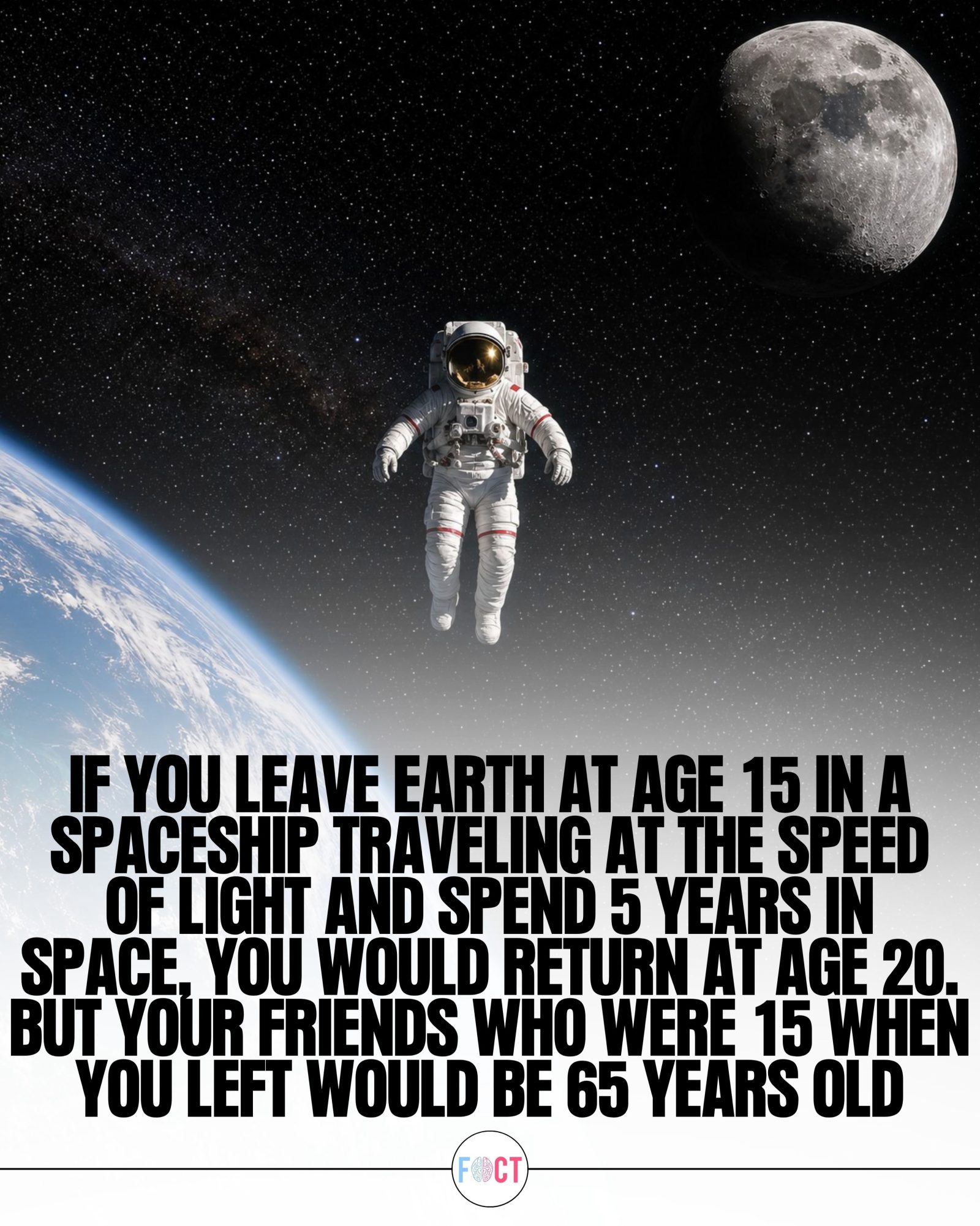
Space Travel Paradox
The thought experiment about leaving Earth at age 15, traveling at the speed of light, and returning at age 20 to find friends significantly older is based on a real scientific concept—time dilation. This phenomenon is predicted by Einstein’s theory of relativity and has been confirmed through various experiments.
Why This Matters
Understanding time dilation is important for comprehending the effects of high-speed travel on time and the implications for space exploration. While it might seem like science fiction, the principles behind it have been rigorously tested and proven. This concept has significant implications for future space missions where travel at relativistic speeds could become a reality.
The Science Behind Time Dilation
Relativity and Time Dilation
Einstein’s theory of relativity introduces the concept of time dilation, which states that time can pass more slowly for objects moving at speeds close to the speed of light. This effect becomes more pronounced as the speed of the object approaches the speed of light. While nothing with mass can actually reach the speed of light, the closer an object gets, the greater the difference between the time experienced by the moving object and the time experienced by a stationary observer.
Experimental Confirmation
Scientists have confirmed the effect of time dilation through various experiments. These experiments involve high-speed particles and extremely accurate atomic clocks. The results consistently show that time passes more slowly for objects in motion. For example, atomic clocks onboard GPS satellites experience time dilation due to their high-speed orbits, and this must be accounted for to ensure accurate positioning on Earth.
The Thought Experiment
The Scenario
The thought experiment involves an astronaut leaving Earth at age 15 in a spaceship traveling at the speed of light. The astronaut spends 5 years in space and returns to Earth at age 20. However, friends who remained on Earth would be significantly older, possibly around 65 years old. This paradox highlights the difference in the passage of time for the astronaut and those on Earth.
Practical Implications
This scenario illustrates the practical implications of time dilation. For space travel, it means that astronauts could potentially age slower than people on Earth, depending on the speed of their travel. This has implications for long-term space missions, where the effects of time dilation could become significant. For example, a mission to a distant star could result in astronauts returning to find that decades or even centuries have passed on Earth.
Practical Tips for Understanding Time Dilation
Learning the Basics
To understand time dilation, it’s helpful to start with the basics of Einstein’s theory of relativity. Familiarize yourself with the concepts of spacetime and how objects moving at different speeds experience time differently. There are many resources available online, including lectures, articles, and even interactive simulations.
Exploring Real-World Examples
Explore real-world examples of time dilation, such as the experiments involving high-speed particles and atomic clocks. Understanding how these experiments work can provide a concrete foundation for grasping the concept of time dilation. For example, the GPS system relies on time dilation corrections to function accurately.
Engaging with Thought Experiments
Engage with thought experiments like the one described earlier. These scenarios can help you visualize the effects of time dilation and understand how it could impact real-world situations. By imagining different scenarios, you can better appreciate the implications of this scientific concept.
Important Takeaways
Time Dilation is Real
Time dilation is not just a theoretical concept; it has been confirmed through numerous experiments. Understanding this phenomenon is crucial for advancing our knowledge of space travel and the nature of time itself.
Implications for Space Travel
The effects of time dilation have significant implications for space travel. As we venture further into the cosmos, the principles of relativity will become increasingly important. Understanding time dilation can help us prepare for the challenges and opportunities that lie ahead in space exploration.
The Role of Relativity
Einstein’s theory of relativity provides a framework for understanding the behavior of time and space. By delving into this theory, we can gain insights into the fundamental laws of the universe and how they impact our everyday lives and future endeavors.
Conclusion
The paradox of space travel and time dilation illustrates the fascinating and complex nature of the universe. By understanding the principles of relativity and the effects of time dilation, we can better prepare for the challenges and opportunities that lie ahead in space exploration. This knowledge not only enriches our understanding of the universe but also paves the way for future advancements in science and technology.
Watch the Reel
Questions readers ask
How does time dilation affect aging in space?
Time dilation causes travelers in space to age slower than people on Earth. This is due to the effects of both high speed and gravitational differences, as predicted by Einstein's theory of relativity. The faster you travel through space, the more pronounced this effect becomes, making time pass more slowly for the traveler compared to someone stationary on Earth.
What is the significance of the speed of light in time dilation?
The speed of light is the ultimate speed limit in the universe, according to Einstein's theory of relativity. As an object approaches this speed, time dilation becomes more significant. This means that for a spaceship traveling at speeds close to the speed of light, time would pass much more slowly for the travelers compared to those on Earth, making space travel years different.
Can time dilation be used for time travel?
In a sense, yes. Time dilation allows for a form of 'time travel' into the future. Traveling at high speeds or being in strong gravitational fields can cause time to pass more slowly for a traveler compared to someone on Earth. However, traveling back in time is not possible according to Einstein's theory of relativity.
What are the practical implications of time dilation for space exploration?
Time dilation has important implications for long-term space missions, such as those involving travel to distant stars or galaxies. Astronauts on such missions would experience less time passing than people on Earth, leading to a difference in time travel. This could result in astronauts returning to find that significantly more time has passed for those who remained on Earth, which could lead to a number of psychological and social challenges.
How has time dilation been confirmed through experiments?
Several experiments have confirmed the effects of time dilation. For example, precise clocks on airplanes and satellites have been used to measure time differences. In addition, experiments with particles traveling at high speeds in accelerators have consistently shown that time moves more slowly for faster-moving particles, supporting Einstein's theory of relativity.
What is the 'twin paradox' in the context of time dilation?
The 'twin paradox' is a famous thought experiment where one twin travels at high speeds into space and returns to find that the other twin, who remained on Earth, has aged more. This thought experiment illustrates the effects of time dilation, where the traveling twin experiences less time passing due to the high-speed travel, making them younger than the twin who stayed on Earth.
Related deep dives
Similar reads based on topic and creator.


Recent articles
Fresh deep dives from the latest Reels we unpacked.




Comments
Be the first to comment.