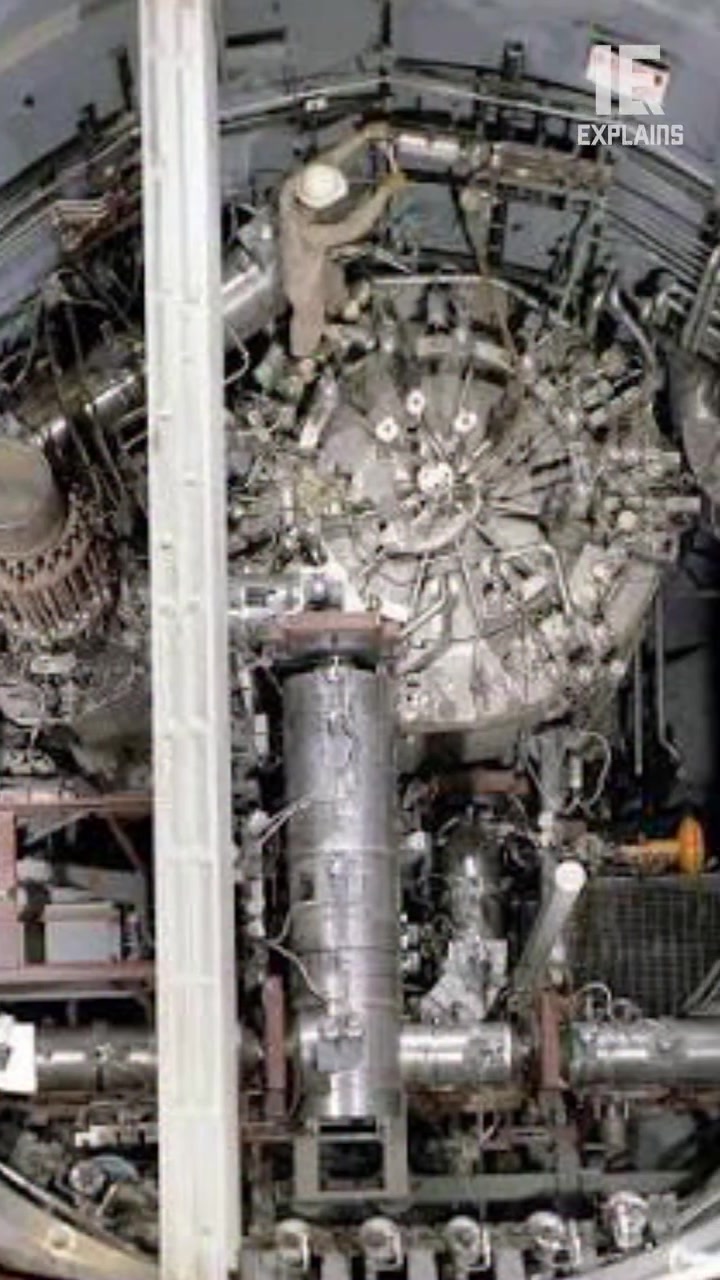
Where is Thorium's Commercial Breakthrough?
Why, when thorium has so much to offer, remain only experimental reactors? The answer begins in the 1960s at Oak Ridge National Laboratory, where physicist Alvin Weinberg led a team that developed the molten salt reactor using thorium. Yet, despite its advantages thorium plants have yet to reach commercialisation.
The Thorium Fuel Cycle
Thorium is a naturally occurring, slightly radioactive metal. It's about three times more abundant than uranium — the element used in today's nuclear reactors. More than 99% of naturally occurring uranium is non-fissile. Thorium is a precursor to uranium-233, a fissile material. The thorium fuel cycle begins when thorium-232 absorbs a neutron. This doesn't split the thorium atom; instead, it turns into thorium-233. Thorium-233 has a half-life of about 22 minutes, decaying into protactinium-233, which then turns into uranium-233. This uranium-233 can sustain a nuclear chain reaction and generate energy. This is how a reactor that "breeds" thorium works. This cycling process ensures that nearly all the thorium can be used as fuel, making it a more efficient fuel source than uranium. Unlike uranium, thorium cannot sustain a nuclear chain reaction on its own—it must be converted into uranium-233 first.
Reasons for Delayed Adoption
How politics impeded physics in Tennessee
In 1965, Weinberg's team at Oak Ridge switched on the Molten Salt Reactor Experiment (MSRE), the first reactor to run on uranium-233 made from thorium. It ran until 1969, proving the concept but not achieving full-scale thorium breeding. The Atomic Energy Commission, however, backed a different design. Despite Weinberg's advocacy for his design, he was pushed out of the lab in 1973.
Challenges with Weathering the Neutron Storm
A breeder reactor must withstand an intense neutron flux. Neutrons hitting thorium-232 only convert it to thorium-233; they do not split it. This means thorium fuel must endure prolonged neutron bombardment without degrading, which poses significant engineering challenges. Today, about 0.7% of mined uranium is the fissile isotope uranium-235. In contrast, thorium-232, the isotope that can turn into a fissile material, makes up nearly 100% of natural thorium. This abundance makes thorium an attractive alternative. While thorium has significant potential, its commercial use remains elusive. This is partly due to the engineering challenges of building a reactor that can withstand the intense neutron flux required to convert thorium into a usable fuel. Additionally, the politics of nuclear energy have historically favored uranium-based designs.
Small Modules and Big Promise
Modern thorium reactors often focus on smaller, modular designs. These reactors can be factory-built and transported to sites, reducing construction time and costs. Additionally, thorium reactors can use fuel more efficiently, potentially extending fuel supplies and reducing waste.
What to Expect in Thorium Nuclears
A common misconception is that thorium reactors are cleaner or safer than conventional reactors. In reality, the primary advantage of thorium is its abundance and potential for more efficient fuel use, but it shares similar safety and waste challenges as uranium reactors. To get a start in thorium, look for experimental or demonstration reactors. These small-scale projects often use thorium in innovative ways, such as in molten salt reactors or other advanced designs. Keeping an eye on regulatory developments and policy shifts can also provide insights into the future of thorium reactors, as government support can significantly impact their deployment.
Watch the Reel
Questions readers ask
What was the significance of the Molten Salt Reactor Experiment (MSRE) at Oak Ridge National Laboratory?
The MSRE, developed by Alvin Weinberg's team, was the first reactor to run on uranium-233 made from thorium. It successfully demonstrated the concept of thorium-based nuclear power, but it didn't achieve full-scale thorium breeding. The experiment proved that thorium could be used as a fuel source, but political decisions at the time led to the abandonment of this promising technology.
How does the thorium fuel cycle work, and why is it more efficient than the uranium cycle?
The thorium fuel cycle starts with thorium-232 absorbing a neutron and converting into thorium-233, which then decays into protactinium-233 and finally into uranium-233. This uranium-233 can sustain a nuclear chain reaction. Thorium is more efficient because nearly all of it can be used as fuel, unlike uranium, where only a small percentage is fissile.
What are the main engineering challenges in developing thorium reactors?
The primary challenge is designing a reactor that can withstand the intense neutron flux required to convert thorium into a usable fuel. Thorium fuel must endure prolonged neutron bombardment without degrading, which poses significant engineering hurdles. Additionally, the technology to efficiently convert thorium into uranium-233 and sustain a nuclear chain reaction is still in development.
Why did the Atomic Energy Commission back a different design than Alvin Weinberg's thorium reactor?
The Atomic Energy Commission backed a different design, likely due to political and economic factors. Despite Weinberg's advocacy for the thorium-based molten salt reactor, the commission favored more conventional uranium-based designs. This decision significantly impacted the development of thorium reactors, pushing them into a state of limbo.
How do modern thorium reactors differ from traditional nuclear reactors in terms of design and efficiency?
Modern thorium reactors often focus on smaller, modular designs that can be factory-built and transported to sites, reducing construction time and costs. These reactors can also use fuel more efficiently, potentially extending fuel supplies and reducing waste. Unlike traditional reactors, which rely on uranium, thorium reactors can breed their fuel from thorium-232.
What are the misconceptions about thorium reactors in terms of safety and cleanliness?
A common misconception is that thorium reactors are inherently cleaner or safer than conventional reactors. While thorium has advantages in terms of fuel efficiency and waste reduction, the primary advantage is its abundance and the potential to extend fuel supplies. The safety and cleanliness of thorium reactors are comparable to those of conventional nuclear reactors.
Related deep dives
Similar reads based on topic and creator.

Recent articles
Fresh deep dives from the latest Reels we unpacked.




Comments
Be the first to comment.