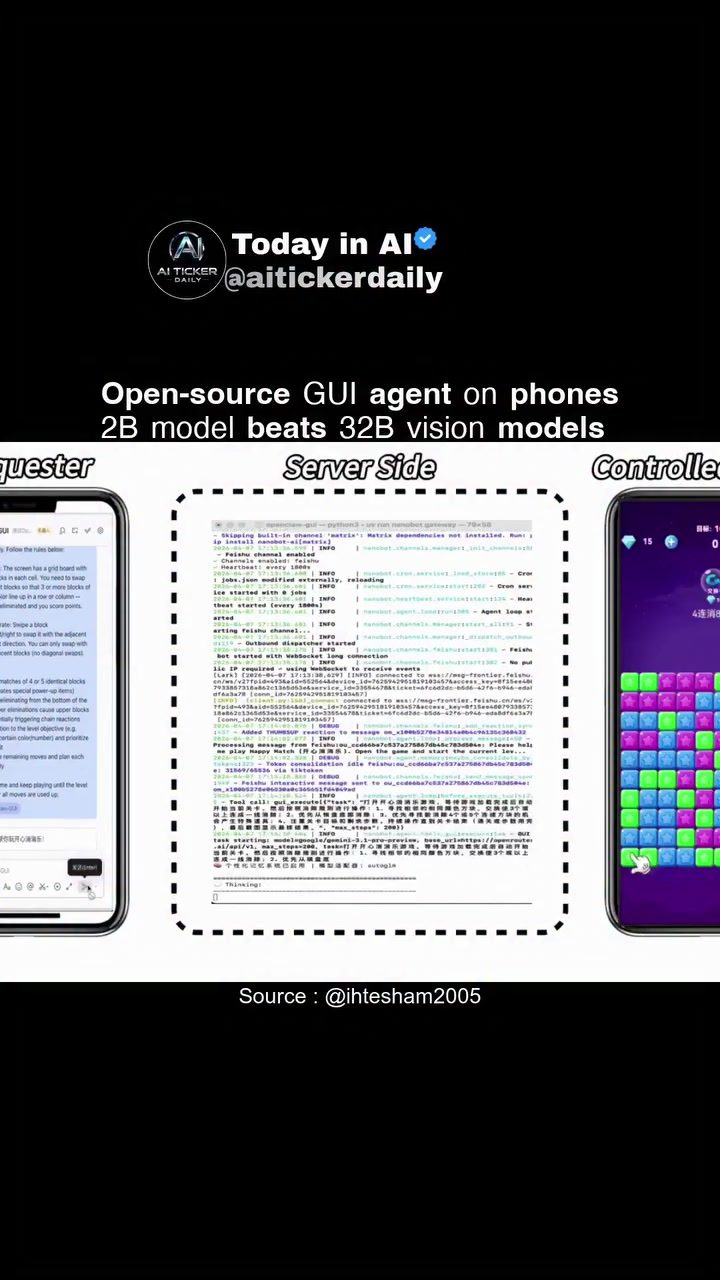
AI-Powered Tetris Gameplay on Smartphones
AI agents are revolutionizing the way we interact with mobile games, and the latest demonstration showcases an open-source GUI agent playing Tetris on a smartphone. This agent, developed by Zhejiang University, is part of the aitickerdailyClawGUI open pipeline. The pipeline focuses on training, evaluating, and deploying AI models on real Android and iOS hardware, not just simulators. This modular stack for GUI agents allows for efficient and effective performance, as seen in the AI's ability to outperform larger models in Tetris gameplay.
Context / Why this Matters
The integration of AI in mobile gaming represents a significant leap forward in technological capabilities. Traditional mobile gaming relies heavily on pre-programmed algorithms and human-designed strategies, which can limit the adaptability and complexity of gameplay. AI agents, on the other hand, can learn and adapt in real-time, making the gaming experience more dynamic and challenging.
Main Discussion
The AI Agent and its Capabilities
The AI agent in this demonstration is a 2B model, which is reported to outperform even larger 32B vision models in GUI/vision benchmarks. This efficiency is a testament to the advancements in AI algorithms and their ability to optimize performance on resource-limited devices like smartphones. The open-source nature of the pipeline allows for community contributions and improvements, making it a valuable resource for developers and researchers in the field.
The Pipeline: Train, Evaluate, Deploy
The aitickerdailyClawGUI pipeline is designed to facilitate the seamless transition from training to deployment. This pipeline ensures that AI models are not only evaluated in controlled environments but also tested and optimized for real-world scenarios. The modular stack allows for the integration of various GUI agents, providing flexibility and adaptability in different gaming contexts.
Efficiency and Performance
One of the key highlights of this AI agent is its efficiency and performance. The 2B model's ability to outperform larger models suggests a significant breakthrough in AI efficiency. This is particularly important for mobile gaming, where computational resources are limited. The AI agent's performance in Tetris gameplay demonstrates its capability to handle complex decision-making processes efficiently.
Real-World Applications
The application of AI in mobile gaming extends beyond just Tetris. The same principles can be applied to other genres, enhancing the overall gaming experience. For instance, AI agents can be used to create more challenging opponents in strategy games, provide adaptive assistance in role-playing games, or even design levels in puzzles. The potential for AI in mobile gaming is vast and continues to grow with advancements in technology.
Practical Tips
Getting Started with AI in Mobile Gaming
For those interested in exploring AI in mobile gaming, the aitickerdailyClawGUI pipeline is a great starting point. Here are some practical tips to get you started:
1. Explore the Open-Source Pipeline: Start by exploring the open-source pipeline and understanding its components. The modular stack allows for customization and adaptation to different gaming scenarios.
2. Review the Documentation: The pipeline comes with comprehensive documentation that provides detailed instructions on training, evaluating, and deploying AI models. Make sure to review this documentation thoroughly to understand the process.
3. Experiment with Different Models: Don't be limited to the 2B model. Experiment with different AI models to see how they perform in various gaming contexts. This will give you a better understanding of the capabilities and limitations of AI in mobile gaming.
4. Contribute to the Community: Being part of an open-source community means you can contribute your findings and improvements. Engage with other developers and researchers to share insights and collaborate on new projects.
Important Takeaways
The demonstration of AI-powered Tetris gameplay on a smartphone underscores several important points:
- Efficiency and Performance: The 2B model's ability to outperform larger models highlights the advancements in AI efficiency, making it suitable for resource-limited devices like smartphones.
- Real-World Applications: The principles demonstrated in Tetris gameplay can be applied to various gaming genres, enhancing the overall gaming experience.
- Open-Source Community: The open-source nature of the aitickerdailyClawGUI pipeline fosters collaboration and innovation, making it a valuable resource for developers and researchers.
Conclusion
AI is transforming the landscape of mobile gaming, and the demonstration of an AI agent playing Tetris on a smartphone is a testament to this transformation. The aitickerdailyClawGUI pipeline from Zhejiang University offers a modular, efficient, and effective solution for integrating AI in mobile gaming. Whether you're a developer, researcher, or an enthusiast, exploring this pipeline can open up new possibilities in the world of mobile gaming. The future of AI in mobile gaming is bright, and with advancements like these, we can expect even more innovative and engaging gaming experiences.
Watch the Reel
Questions readers ask
How does the AI agent from Zhejiang University interact with Tetris on smartphones?
The AI agent analyzes the Tetris game screen in real-time, using its trained models to determine the optimal placement of Tetris pieces. It then interacts with the game's user interface to drop and rotate the pieces, aiming to maximize score and clear lines.
Can the AI Tetris agent be used on both Android and iOS devices?
Yes, the AI Tetris agent is designed to work on both Android and iOS devices. The aitickerdailyClawGUI open pipeline ensures that the AI can be deployed and perform effectively on real hardware from both platforms.
What makes this AI Tetris agent unique compared to traditional mobile gaming algorithms?
Unlike traditional algorithms, this AI agent adapts in real-time, learning from the game environment. It focuses on optimizing gameplay metrics such as score and line clears, making it more dynamic and challenging.
Is the AI Tetris agent's code open source and available for public use?
Yes, the AI Tetris agent is part of the open-source aitickerdailyClawGUI pipeline. This means that the code and models are publicly available, allowing developers and researchers to explore, modify, and build upon the AI's capabilities.
How does the AI agent's performance compare to larger models in Tetris gameplay?
The AI agent demonstrates efficient and effective performance, often outperforming larger models. This is due to the modular stack of the pipeline, which is designed to optimize performance on real mobile hardware.
Can the AI Tetris agent be adapted for other mobile games beyond Tetris?
While the current implementation is for Tetris, the AI pipeline is modular and can be adapted for other mobile games. The flexibility of the aitickerdailyClawGUI pipeline allows for real-time gameplay adaptation and learning, making it a versatile tool for various games.
Related deep dives
Similar reads based on topic and creator.




Recent articles
Fresh deep dives from the latest Reels we unpacked.




Comments
Be the first to comment.