Nikola Tesla's Early X-ray Imaging
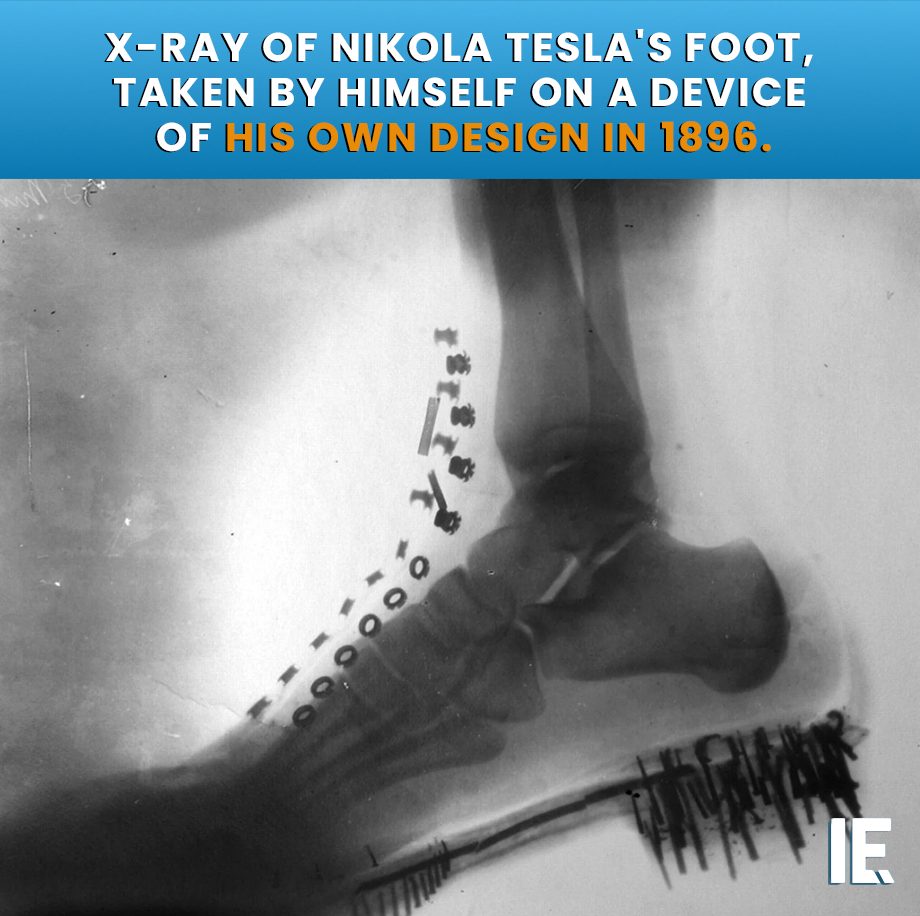
In 1896, Nikola Tesla created a remarkable image using his own vacuum tube to generate X-rays. The image, a shadowgraph, captures a human foot complete with a shoe, providing valuable insights into the early days of medical imaging technology.
The Significance of Tesla's X-ray Imaging
Tesla's work in X-ray imaging is often overshadowed by his more famous inventions, but it stands as a testament to his innovative spirit and technical prowess. Tesla's ability to create X-rays using his own devices, particularly the vacuum tube, highlights his versatility and foresight. At the time, X-ray technology was still in its infancy, and Tesla's contribution to this field is a significant part of the broader history of scientific innovation.
The Vacuum Tube and X-ray Generation
Before delving into Tesla's specific contributions, it's important to understand the role of the vacuum tube. Vacuum tubes are devices that control the flow of electrons in a vacuum. In the context of X-ray generation, these tubes are used to produce high-voltage electrical fields that accelerate electrons. When these electrons strike a target material, they produce X-rays. Tesla's vacuum tube was a crucial component in his early X-ray experiments, enabling him to generate these rays at a distance of 2.5 meters.
Tesla's X-ray Device
Tesla's X-ray device was a self-designed apparatus that allowed him to control the X-ray beam with precision. Unlike other early X-ray devices, Tesla's design incorporated his own vacuum tube, which produced a safer and more direct method of generating X-rays. This technical achievement underscores Tesla's deep understanding of electrical engineering and his relentless pursuit of innovation.
The Distance Factor
The fact that Tesla was able to capture an X-ray image of a foot at a distance of 2.5 meters is noteworthy. Most early X-ray devices required close proximity to the subject, which posed significant risks to the operator and the subject. Tesla's ability to conduct his experiments at a safe distance is a testament to his innovative approach and the effectiveness of his vacuum tube design. This innovation significantly improved the safety of X-ray imaging, paving the way for future advancements in medical imaging technology.
Historical Context
The year 1896 was a pivotal period for the development of X-ray technology. Wilhelm Conrad Röntgen, a German physicist, had only recently discovered X-rays in 1895, and his groundbreaking work laid the foundation for medical imaging. Tesla, building on this new knowledge, immediately recognized the potential of X-rays and began experimenting with his own devices. His work in this field, though often overlooked, was crucial in advancing the practical applications of X-ray technology.
Practical Tips for Understanding Early X-ray Imaging
Tesla's pioneering work in X-ray imaging offers several practical insights for those interested in the history and technology of medical imaging.
1. Understanding Vacuum Tubes
For anyone interested in the history of technology, understanding vacuum tubes is essential. These devices were the cornerstone of early electronics and played a crucial role in the development of various technologies, including X-ray imaging. Researching the structure and function of vacuum tubes can provide a deeper appreciation for their significance in early scientific advancements.
2. Experimentation and Innovation
Tesla's work serves as an excellent example of the importance of experimentation and innovation. By continually experimenting with his designs, Tesla was able to make significant advancements in the field of X-ray imaging. This approach can be applied to various fields, encouraging continuous learning and development.
3. Historical Research
For those interested in the history of science and technology, studying early advancements in X-ray imaging provides valuable context. Learning about the pioneers in this field, including Nikola Tesla and Wilhelm Conrad Röntgen, offers a deeper understanding of how modern medical imaging technologies have evolved.
4. Safety in Scientific Research
Tesla's emphasis on safety in his experiments is another valuable lesson. His ability to conduct X-ray imaging at a safe distance highlights the importance of prioritizing safety in scientific research. This principle is essential in any scientific endeavor, ensuring that innovations are developed in a responsible and ethical manner.
Key Takeaways
Tesla's early work in X-ray imaging offers several important insights:
- Tesla's vacuum tube design was a significant advancement in early X-ray technology, allowing for safer and more controlled X-ray generation.
- The ability to conduct X-ray imaging at a distance of 2.5 meters underscores Tesla's innovative approach and technical expertise.
- Understanding the historical context of early X-ray imaging provides a deeper appreciation for the development of modern medical imaging technologies.
- Prioritizing safety in scientific research is crucial, as demonstrated by Tesla's approach to his experiments.
Conclusion
Nikola Tesla's contributions to X-ray imaging, particularly his innovative vacuum tube design and pioneering experiments, are a significant part of the history of science and technology. His work not only advanced the field of medical imaging but also demonstrated the importance of experimentation, innovation, and safety in scientific research. Understanding Tesla's early advancements in X-ray imaging provides valuable insights into the evolution of medical imaging technology and the innovative spirit of one of history's most influential figures.
Watch the Reel
Questions readers ask
What was the significance of Nikola Tesla's 1896 X-ray footage?
Tesla's 1896 X-ray footage of a human foot was significant because it demonstrated his ability to generate X-rays using his own innovative vacuum tube. This early work in medical imaging showcased his technical skills and contributed to the broader development of X-ray technology.
How did Tesla create his X-ray images?
Tesla used a self-designed vacuum tube to generate X-rays for his 1896 images. He was able to capture a shadowgraph of a human foot, including the shoe, which provided early insights into the potential of X-ray imaging technology.
Why is Tesla's X-ray work often overlooked?
Tesla's contributions to X-ray imaging are sometimes overlooked due to the fame of his other inventions, such as the alternating current (AC) electrical system and his work on wireless technology. However, his early X-ray experiments were a notable part of his innovative career and the broader history of scientific progress.
What was the state of X-ray technology in 1896?
In 1896, X-ray technology was still in its early stages. Tesla's work during this time helped advance the field by demonstrating the potential of X-ray imaging for medical purposes. His use of a vacuum tube to generate X-rays was a pioneering step in the development of this technology.
What is a shadowgraph, and how did Tesla use it?
A shadowgraph is an early form of an X-ray image that captures the outline of an object. Tesla utilized this technique to create his 1896 X-ray footage, capturing the silhouette of a human foot within a shoe. This method provided a clear, if basic visual of the internal structure of the foot.
What can we learn from Tesla's 1896 X-ray device?
Tesla's 1896 X-ray device, particularly his vacuum tube, offers insights into the early design and functionality of X-ray technology. Studying his device helps us understand the foundations of medical imaging technology and the innovative approaches Tesla took to push the boundaries of scientific advancement.
Why is Tesla’s 1896 X-ray imaging considered innovative?
Tesla's X-ray imaging from 1896 is considered innovative because he developed his own vacuum tube to generate X-rays, highlighting his technical skills and creativity. This work not only advanced medical imaging but also demonstrated his ability to innovate in multiple scientific fields.
Related deep dives
Similar reads based on topic and creator.




Recent articles
Fresh deep dives from the latest Reels we unpacked.




Comments
Be the first to comment.