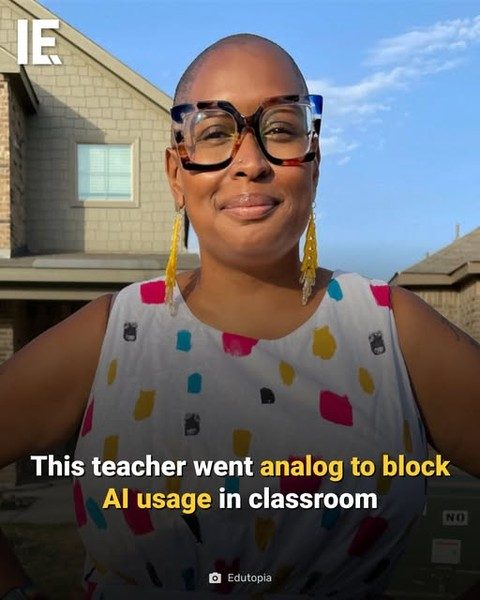
English Teacher Swaps AI Tools for Handwritten Work
English teacher Chanea Bond at Southwest High School in Fort Worth, Texas, has made a bold move to keep students engaged and thinking independently. She decided to block AI tools from her classroom by replacing laptops with pencils, notebooks, and handwritten assignments. This approach reflects a broader discussion in education as AI becomes more prevalent. While many schools are embracing AI to personalize learning, Bond chose to focus on foundational skills, aiming to help students sharpen critical thinking and writing skills that technology alone can’t teach.
Why this matters
AI technology has made significant strides in personalizing learning, offering tools like immediate feedback, adaptive learning platforms, and intelligent tutoring systems. While these tools can enhance the learning experience, there are concerns about their over-reliance. Bond’s decision to go analog highlights a crucial aspect of education: the importance of building fundamental skills.
Main discussion
The rise of AI in education
AI in education has transformed the way students learn. AI-powered tools can provide immediate feedback, offer personalized learning paths, and automate grading, thus reducing the workload on educators. Teachers can now spend more time on instructional design and less on repetitive tasks. However, this shift also brings challenges, particularly concerning the over-reliance on technology and the potential loss of foundational skills.
The analog approach
Bond’s switch to analog methods, particularly handwritten work, aims to foster a deeper understanding and retention of material. When students write by hand, they are more engaged and less likely to outsource their thinking to AI tools. Handwritten work often involves more cognitive effort, leading to better comprehension and recall. This is in contrast to typing, which can lead to faster note-taking but less meaningful processing.
The science behind handwritten notes
Research has shown that writing by hand can improve memory retention and cognitive development. Handwritten notes help students process information more deeply, leading to better comprehension and retention. Furthermore, the tactile experience of writing can enhance learning.
Critical thinking and writing skills
Beyond memory retention, Bond emphasizes the importance of critical thinking and writing skills. Handwritten assignments encourage students to think critically, refine their writing, and express their ideas clearly. These skills are essential for academic and professional success, and they are not easily replaced by technology.
Building foundational skills
Handwriting develops fine motor skills, which are crucial for early childhood development. It also helps with letter recognition, spelling, and vocabulary. For older students, handwriting can improve hand-eye coordination, cognitive processing, and memory. By focusing on handwritten work, Bond ensures that her students build a strong foundation, which is essential for future academic and professional success.
Journaling and writing assignments
Bond's approach includes starting every class with journaling and assigning nearly all writing by hand. Journaling offers a reflective space for students to process their thoughts and ideas, fostering a deeper understanding of the material. Handwritten writing assignments encourage students to articulate their thoughts clearly and critically, improving their writing and analytical skills.
The broader debate in education
Bond’s decision reflects a broader debate in education. As AI becomes more prevalent, educators are grappling with how to integrate technology without compromising fundamental skills. While AI can personalize learning, it can also lead to over-reliance and a lack of critical thinking.
Balancing technology and traditional methods
The integration of AI in education raises important questions about balancing technology and traditional methods. On one hand, AI can enhance learning by providing personalized feedback and adaptive learning paths. On the other hand, it can lead to over-reliance, resulting in a lack of foundational skills. Bond’s approach offers a solution by focusing on handwritten work, which encourages critical thinking and independent learning.
Practical tips for integrating analog methods
Encourage handwritten notes
Encourage students to take handwritten notes during lectures and discussions. This can help them process information more deeply, leading to better comprehension and retention. It's important to set aside dedicated time for handwriting, ensuring students engage with the material fully.
Incorporate journaling
Include journaling in your teaching routine. Journaling allows students to reflect on their thoughts and ideas, fostering a deeper understanding of the material. It can be a useful tool for encouraging critical thinking and articulation of thoughts.
Assign handwritten assignments
Assign handwritten assignments to help students develop their writing and critical thinking skills. Handwritten work often involves more cognitive effort, leading to better comprehension and retention. Ensure that the assignments are varied and challenging, encouraging students to think critically and express their ideas clearly.
Important takeaways
Bond’s decision to go analog in her classroom highlights the importance of balancing technology and traditional methods in education. While AI can personalize learning, it is essential to build foundational skills through handwritten work and critical thinking. Encouraging students to take handwritten notes, incorporate journaling, and assign handwritten assignments can help them develop these skills, preparing them for academic and professional success.
Conclusion
AI technology has revolutionized education, offering tools for personalized learning and immediate feedback. However, it is crucial to balance technology with traditional methods to ensure that students build foundational skills. Bond’s approach of swapping laptops for pencils and notebooks offers a practical solution, emphasizing the importance of handwritten work and critical thinking. By focusing on analog methods, educators can help students develop essential skills, preparing them for future academic and professional success.
Watch the Reel
Questions readers ask
Why did Chanea Bond decide to ban AI tools in her classroom?
Chanea Bond, an English teacher at Southwest High School in Fort Worth, Texas, chose to ban AI tools to encourage students to think independently and develop strong writing skills. She believes that handwriting and analog learning can help students build critical thinking abilities that technology might not foster.
What are the benefits of handwriting in learning?
Handwriting can enhance memory retention, improve fine motor skills, and stimulate brain activity. It also encourages students to process information more deeply, which can lead to better understanding and recall. Additionally, handwriting can help students develop a personal connection to their work, fostering a sense of ownership and pride in their assignments.
How does Chanea Bond's approach differ from other teachers' methods?
While many teachers embrace AI tools for personalized learning, immediate feedback, and adaptive learning platforms, Chanea Bond has opted for a more traditional approach. She focuses on handwriting and independent thinking, aiming to develop foundational skills that she believes are not fully addressed by AI tools. She replaces laptops with pencils and notebooks to encourage more thoughtful and engaged learning.
Is handwriting still relevant in today's digital age?
Yes, handwriting remains relevant as it helps develop essential skills such as fine motor skills, cognitive processing, and emotional expression. While digital tools offer many advantages, they may not fully replace the benefits that come from physical writing, making handwriting an important component of a well-rounded learning experience.
What are the potential drawbacks of relying too heavily on AI in the classroom?
Over-reliance on AI in the classroom can potentially hinder the development of independent thinking and writing skills. Students might become dependent on AI tools for answers and feedback, which could limit their ability to process information critically and creatively. Additionally, excessive use of technology can lead to decreased attention spans and reduced focus.
What are some of the challenges in implementing a handwriting-focused approach in the classroom?
One of the main challenges is the resistance from students who are accustomed to digital tools and may find handwriting slow and cumbersome. Teachers might also face logistical challenges in managing handwritten assignments, such as grading and storage. However, with consistent encouragement and clear communication of the benefits, teachers can help students adapt to and appreciate the value of handwriting.
How can teachers balance technology and analog learning in the classroom?
Teachers can balance technology and analog learning by integrating both approaches thoughtfully. For instance, they can use digital tools for certain tasks, such as research and data analysis, while encouraging handwriting for reflective writing and creative tasks. This hybrid approach allows students to benefit from the strengths of both methods, fostering a well-rounded learning experience.
Related deep dives
Similar reads based on topic and creator.


Recent articles
Fresh deep dives from the latest Reels we unpacked.




Comments
Be the first to comment.