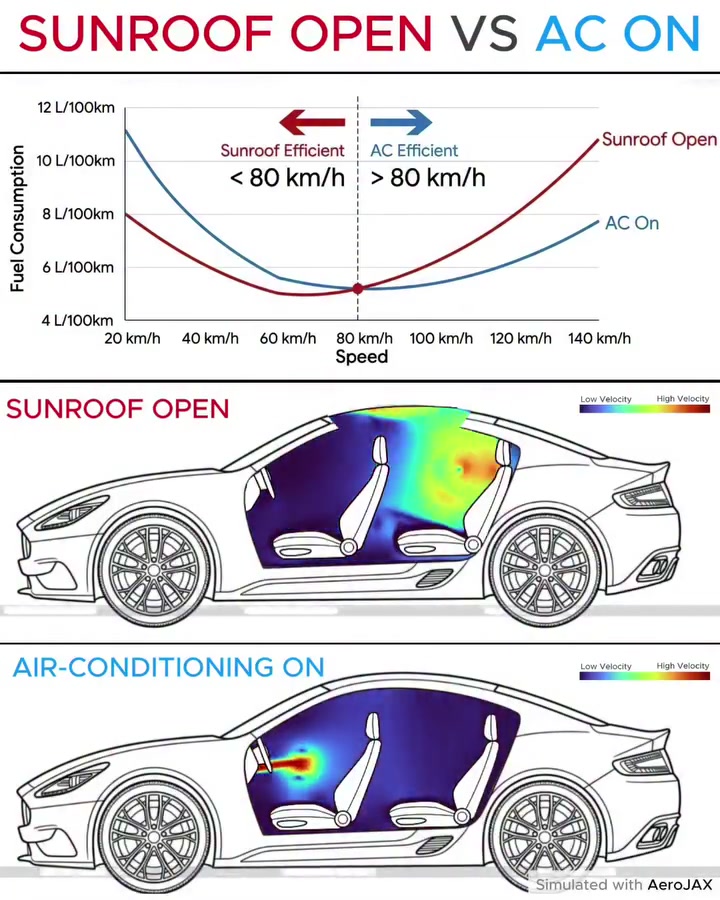
Ever wonder if you should roll down the windows or turn on the air conditioning to save fuel? Driving with the sunroof open can save up to 2–4 liters fuel per 100 kilometers. At lower speeds, a car's efficiency benefits from scable ventilation. Above 80 km/h, the aerodynamic drag of an open sunroof hurts fuel economy.
The Dry Science of Driving Comfortably
AeroJAX ran simulations for a car driving with the sunroof open versus the air conditioning on. Fuel economy depends on speeds, with the sunroof outpacing AC above 80 km/h. The sunroof takes advantage of natural ventilation at lower speeds. The difference lies in airflow and aerodynamic drag: The sunroof lets outdoor air bloom in the car over the roof and out back. The air conditioning, meanwhile, conserves the air inside the car and harnesses the engine power to pump fresh air into the vehicle. Heat map visualizations of the car's interior show notable disparities in temperature. At lower speeds, the sunroof distribution allows heat to seep through at a lesser degree of dispersion.
Climate Change and the Road Ahead
Drivers want to be comfortable and eco-conscious. Fuel efficiency matters. Natural ventilation like an open sunroof is worth exploring. Drivers have been weighing the costs of energy and comfort for decades. Fuel prices affect households worldwide. Energy conservation is crucial. Speed choice and wind speed buffs both make a difference. Up to 10% of fuel consumption relies on airflow efficiency.
The Tipping Point of Highway Drag
How aerodynamic drag kills fuel efficiency. A car's fuel consumption increases with more airflow turbulence. We can break down this drag:
Breaking 80 km/h
AeroJAX's simulation showed a clear break at 80 km/h. At 70 km/h, it advised a sunroof energy advantage of 10 L/100km and above. The slight wind noise against a driver's ears signals a green light for eco-friendliness.
Air Conditioning at High Velocities
The visualizations showed that 80 km/h was a tipping point for efficiency. After 80 km/h, air conditioning becomes more fuel-efficient. AeroJAX confirms AC uses less power when rolling above 80 km/h. Fuel efficiency during a highway drive with AC on costs 12 L/100km at lower speeds. This helps AC overpower the sunroof efficiency and breezes past the sunroof. At 100 km/h, a 14–2 L/100km gap opens. Air conditioners maintain a stable balance.
Heat Maps in the Rear
Heat maps showed a different distribution of interior heat when sunroofs were open versus when the AC was on. The sunroof cools the car from the top and lets the heat flow freely. Another visual angle works well for drivers. At the rear, above 80 km/h, the AC should be enchanted to cool the car. Drivers need to see the transparent advantage of AC above that tipping point.
Fuel Efficiency of Smooth Roads
On smoother roads, the sunroof is the best option. The aerodynamic drag is lessened. The smoothness reduces drag, and the sunroof comes into play. Zack, the driver, can save fuel by opening the sunroof when driving on smooth roads.
Artificial vs Natural Cooling
The sunroof versus AC debate is also one of artificial versus natural. The mind might recoil from opening the sunroof during the summer. With the sunroof closed, drivers are using AC. The sunroof should be open when the weather is comfortable. Both options should be used based on the weather. AeroJAX showed how drivers can save fuel by using sunroofs during cooler months. The sunroof is more fuel-efficient than AC. However, during summer, drivers should turn on the AC for better fuel efficiency.
Car Comfort in a Changing Climate
Drivers have more choices to save fuel. Better tires that are designed to retain a more stable temperature. There are, however, other solutions.
- Avoid Idling: Idling can waste a lot of fuel. Turn off the engine when idling, and you'll save time and fuel.
- Maintain Tire Pressure: Check your tire pressure regularly. Low tire pressure can increase fuel consumption by up to 3%. Maintain the correct tire pressure to save fuel.
- Plan Your Route: Plan your route to avoid traffic jams and congestion. The fewer stops you make, the less fuel you'll use.
- Drive Smoothly: Accelerate smoothly and avoid sudden braking. Sudden braking can increase fuel consumption by up to 40%.
- Use Cruising Control: Cruise control can help maintain a constant speed. Maintaining a constant speed can help save fuel by reducing the need to accelerate and brake. The more power the car needs, the more fuel it will use.
- Avoid Heavy Loads: Avoid carrying heavy loads in your car. The more weight you carry, the more fuel you'll use.
- Avoid Extended Use of Air Conditioning: Air conditioning can increase fuel consumption by up to 25%. Use air conditioning sparingly to save fuel.
- Regular Maintenance: Regular maintenance of your car can help improve fuel efficiency. Regular maintenance can help keep your car running smoothly and efficiently. Change the oil when necessary, let the car have optimal air flow, and proper tire pressure.
- Sunroof Efficiency: Use the sunroof for cooling when possible. The sunroof is more fuel-efficient than air conditioning.
The Cultural Shift to Carbon-Efficient Driving
The debate between sunroofs and air conditioning is only one example of the tension between driver comfort and fuel efficiency. The answer is more complicated than technology. But as consumers, the more we understand the challenges, the better we can tackle them. The fuel footprint is getting smaller.
Watch the Reel
Questions readers ask
How does the sunroof affect a car's fuel efficiency at different speeds?
At lower speeds, below 80 km/h, driving with the sunroof open can save up to 2–4 liters of fuel per 100 kilometers due to natural ventilation. However, at higher speeds, above 80 km/h, the aerodynamic drag caused by the open sunroof can decrease fuel efficiency, making it less advantageous than using the air conditioning.
Why does air conditioning become more fuel-efficient than an open sunroof at high speeds?
At high speeds, the aerodynamic drag from an open sunroof increases fuel consumption. Air conditioning, on the other hand, conserves the air inside the car and uses the engine to pump in fresh air, which is more efficient than dealing with the increased drag from an open sunroof.
What is the tipping point where air conditioning becomes more fuel-efficient than an open sunroof?
AeroJAX's simulations show that 80 km/h is the tipping point. Below this speed, an open sunroof is more fuel-efficient. Above 80 km/h, using the air conditioning becomes more fuel-efficient due to reduced aerodynamic drag.
How does the type of road affect the fuel efficiency of using a sunroof?
Smooth roads reduce aerodynamic drag, making an open sunroof a more fuel-efficient choice. On rougher roads, the increased drag might negate some of these benefits, but the sunroof still offers natural ventilation.
Can I save fuel by using the sunroof on the highway?
No, using the sunroof on the highway (above 80 km/h) is not fuel efficient. At these speeds, the aerodynamic drag caused by the open sunroof increases fuel consumption. It's more fuel-efficient to use the air conditioning on highways.
How does the sunroof cool the car differently than the air conditioning?
The sunroof cools the car from the top, allowing heat to flow freely and naturally ventilate the interior. In contrast, the air conditioning conserves the air inside the car and pumps in cool air, maintaining a more controlled and stable temperature.
How much fuel can I save by using the sunroof at lower speeds?
At lower speeds, below 80 km/h, you can save up to 2–4 liters of fuel per 100 kilometers by using the sunroof. This is due to the natural ventilation and reduced need for the air conditioning, which consumes engine power.
Recent articles
Fresh deep dives from the latest Reels we unpacked.




Comments
Be the first to comment.