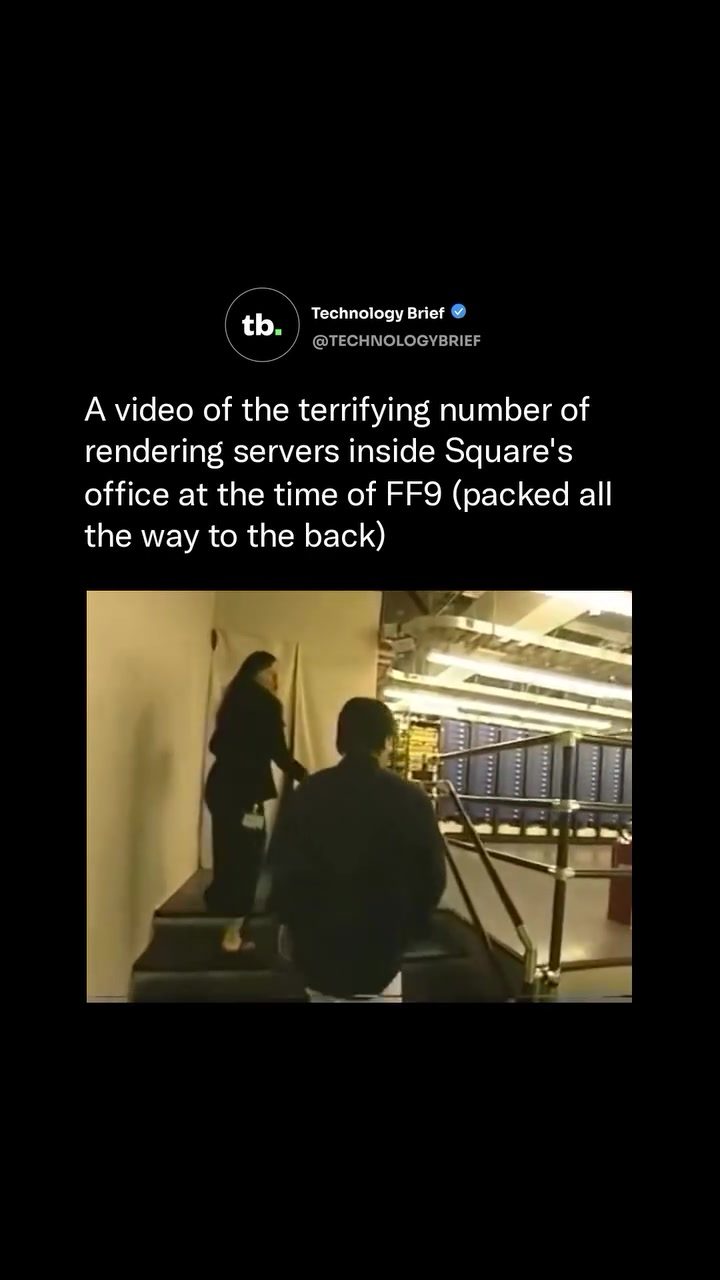
Massive Render Farms: The Square NEREUS Render Farm
Square's NEREUS render farm, built in 1997, was an engineering marvel that pushed the boundaries of what was possible in video game graphics. This dedicated render farm was constructed to produce the CGI cutscenes for the groundbreaking game Final Fantasy VII. The servers were housed in a densely packed server room, filling an entire corridor of rack units within Square's offices. These servers ran continuously to process the game’s groundbreaking pre-rendered graphics and full-motion video sequences.
Context: The Power of Render Farms
In the late 1990s, video games were undergoing a transformative phase. With the release of the PlayStation, developers were able to push the graphical boundaries of what was possible within a game. Square, the developer behind the Final Fantasy series, was no exception. The NEREUS render farm was a testament to their commitment to producing high-quality, cinematic graphics for their games.
The NEREUS Render Farm
The Scale and Scope
The NEREUS render farm was no small undertaking. It consisted of numerous rendering servers that filled an entire corridor of rack units, showcasing the immense scale of the project. The sheer number of servers required a massive budget, even by Hollywood standards. Each server was dedicated to rendering the frames that would make up the game's cutscenes, allowing for smooth, high-quality visuals that were unprecedented at the time.
The Technology Behind It
Rendering servers at that time were highly specialized machines designed to handle the complex calculations required to generate high-quality graphics. The NEREUS render farm was a massive network of these servers, all working together to process the vast amount of data necessary for the game’s cutscenes. These servers were capable of running calculations around the clock, ensuring that the development process was not slowed down by the rendering process.
Impact on Final Fantasy VII
Final Fantasy VII, released in 1997, was a massive success, selling over 15 million copies worldwide. The game's success can be largely attributed to its innovative gameplay, story, and groundbreaking graphics. The NEREUS render farm played a critical role in the game's cinematic presentation, allowing for full-motion video sequences and high-quality CGI cutscenes.
Why This Matters
The NEREUS render farm was more than just a tool for Square to create a game. It was a symbol of the company’s dedication to pushing the boundaries of what was possible in video game development at the time. The render farm allowed Square to create a game that not only met but exceeded the expectations of players worldwide. The sheer scale of the project showed the company’s commitment to innovation and excellence.
Practical Tips
While the NEREUS render farm was a massive undertaking, it offers several practical lessons for modern game developers:
Invest in Quality Rendering Hardware
High-quality rendering hardware is essential for creating high-quality graphics. Investing in powerful rendering servers can significantly improve the visual quality of your game.
Plan for Scalability
Rendering large amounts of data requires a significant amount of processing power. Planning for scalability ensures that you have the necessary resources to handle the rendering process efficiently.
Continuously Improve
The technology used in the NEREUS render farm was cutting-edge for its time, but it wasn’t the final word in rendering technology. Game developers should always be looking for ways to improve their rendering capabilities and stay ahead of the curve.
Important Takeaways
- The NEREUS render farm was a groundbreaking project that allowed Square to create a game with unprecedented graphical fidelity.
- Investing in high-quality rendering hardware and planning for scalability are essential for creating high-quality games.
- The NEREUS render farm's success demonstrates the importance of continuously improving and pushing the boundaries of what is possible.
Conclusion
The NEREUS render farm was a critical component in the creation of Final Fantasy VII, one of the most influential games in video game history. Its massive scale and innovative design allowed Square to create a game that stood out from its contemporaries. The lessons learned from the NEREUS render farm continue to inform modern game development, reminding us of the importance of innovation, scalability, and continuous improvement.
Watch the Reel
Questions readers ask
What was the primary purpose of the NEREUS render farm?
The NEREUS render farm was specifically designed to create the pre-rendered CGI cutscenes for Final Fantasy VII. It allowed Square to produce high-quality, cinematic visuals that significantly enhanced the game's storytelling. The farm's dedicated servers ensured that the graphics were processed efficiently, meeting the demanding requirements of the game's developers.
Why was the NEREUS render farm considered groundbreaking in 1997?
The NEREUS render farm was groundbreaking because it represented a massive leap in video game graphics technology. By utilizing a network of servers to process complex CGI sequences, Square was able to achieve a level of visual fidelity that was unparalleled at the time. This innovation set new standards for video game visuals and paved the way for future advancements.
How did the NEREUS render farm impact the development of Final Fantasy VII?
The NEREUS render farm played a crucial role in the development of Final Fantasy VII by enabling the creation of high-quality, pre-rendered CGI cutscenes. These cutscenes, which featured detailed characters, environments, and effects, became a hallmark of the game and contributed significantly to its overall impact on the gaming industry.
What kind of technology did the NEREUS render farm use?
The NEREUS render farm relied on a network of servers housed in a dedicated server room. These servers were continuously running to process the complex graphics and full-motion video sequences required for Final Fantasy VII. The farm's technology allowed for the efficient rendering of high-quality visuals that would have been impossible with standard gaming hardware at the time.
How did the NEREUS render farm influence the gaming industry?
The NEREUS render farm influenced the gaming industry by demonstrating the potential of render farm technology in producing cinematic visuals. By creating the stunning CGI cutscenes for Final Fantasy VII, Square showed that games could achieve a level of visual storytelling previously seen only in films. This inspired other developers to explore similar technologies, leading to a new era of cinematic gaming.
What challenges did Square face with the NEREUS render farm?
Building and operating the NEREUS render farm posed significant challenges for Square. The servers required a dedicated space and continuous power, which led to the construction of a densely packed server room. Additionally, managing the sheer volume of data and processing power needed to render the game's graphics was a considerable task.
Related deep dives
Similar reads based on topic and creator.




Recent articles
Fresh deep dives from the latest Reels we unpacked.




Comments
Be the first to comment.