The global frontier
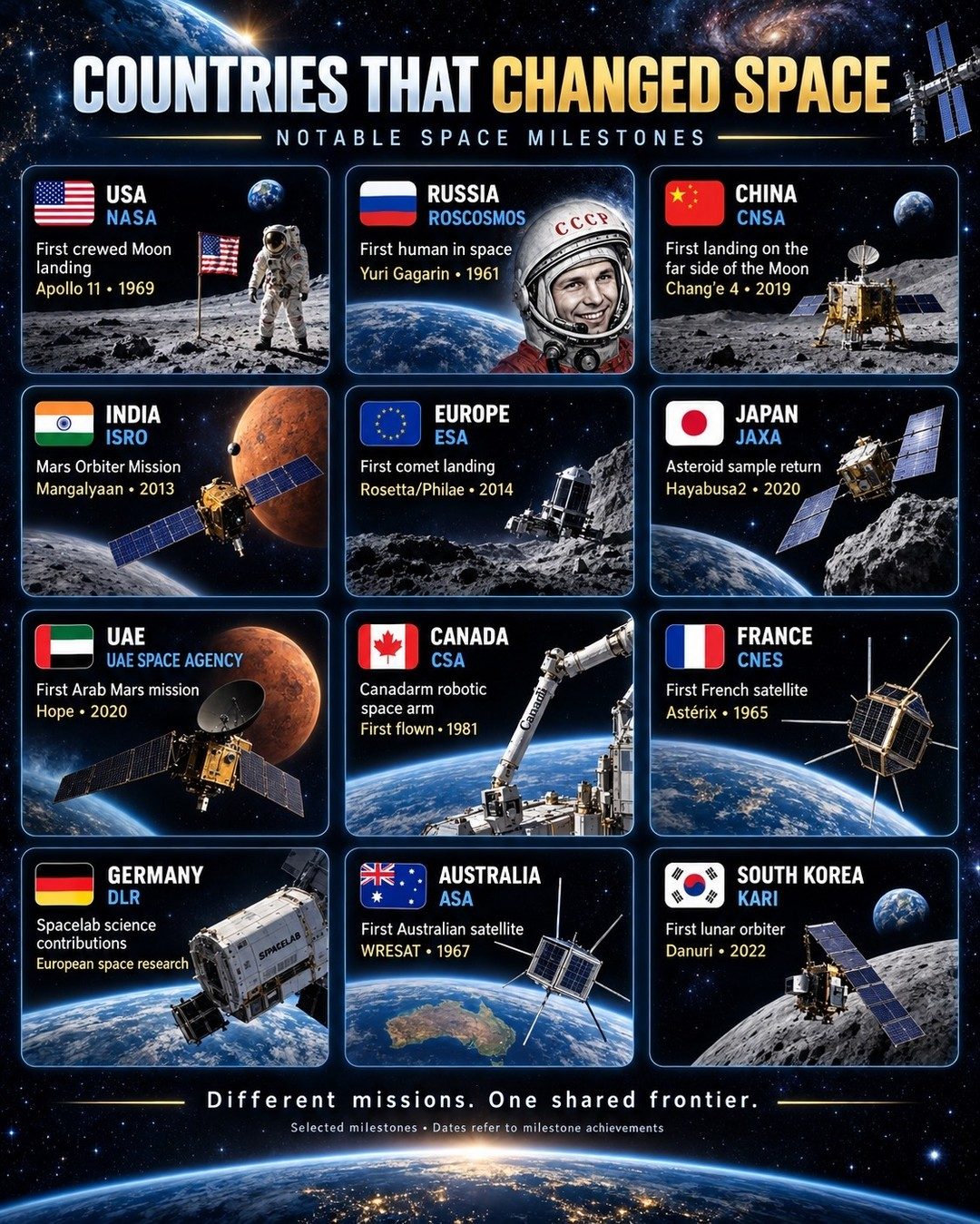
Space exploration is global. We do not venture into the cosmos alone, or in a single language, or toward a single destination. Nations advance in space craftsmanship through collective hardship and triumph. Every satellite launched binds the world together in a flattened, unaided spirit. The infographic exhibits a cadre of twelve nations — USA, Russia, China, India, and others — each with its own extraordinary achievement. The USA launched the first crewed mission to the Moon in 1969; Russia ushered in the space age 20 years earlier with the first human in orbit; ISRO, the Indian Space Research Organization, launched a lunar orbiter in 2008. The European Space Agency has contributed to the Mars Express and Rosetta missions; France and Germany have set their sights on Mars. The UAE makes its mark with satellites; India's space agency achieved the first mission to the lunar South Pole; Australia launches satellites and monitors space debris; Japan rover the asteroid Ryugu. From human spaceflight to lunar and asteroid exploration, each nation's space agency has been integral to our collective efforts, displaying unparallelled international cooperation. While achieving original advancements, they also support broader scientific inquiry and understanding. The UAE’s Hope mission to Mars is the first Arabian space programme to reach Mars’ orbit, obtaining a holistic view of the Martian atmosphere.
Collectives of the cosmos
Each country’s unique achievements are not just advanced technology or scientific discovery; they are also symbols of determination, creativity, and ambition. They serve as an inspiration and motivation to the entire globe, not just in their country. This infographic showcases the significant work of different countries. The outcome of these initiatives furthered our collective understanding of Mars, asteroids, and our own Moon. Each of these nations has contributed significantly to the progression of space exploration. China's first-crewed space program consisted of Discovering the far side of the Moon; CNSA rockets, render the first soft landings on both sides of the lunar surface. Australia's WERSA is included for testing a hypersonic engine; furthering the human spaceflight — into the solar system. The spirit of space exploration is a more interconnected, more interdependent world. Both collective scientific knowledge and national prestige are at stake. Until now, space agencies have worked towards their own goals; but as space missions become more complex and costly, new avenues for cooperation are being explored. This global collaborative effort highlights the shared frontier of space exploration.
The globalization of space
Space is more accessible than ever to more. Space exploration doctrine evolves to celebrate international collaboration, frequently conducted across borders. As demanding missions to Mars and beyond become feasible, nations are increasingly likely to partake in joint ventures. Examples include the International Space Station, Cassini-Huygens, and the James Webb Space Telescope. and the Apian Tania working with NASA’s Perseverance rover. As the frontiers of space travel are pushed further, nations are seeking to share both cost and risk. The collective achievements of these countries are emblematic of the technological and scientific advancements in space exploration. International partnerships have fostered scientific advances and humanitarian benefits, such as Earth observation and climate monitoring. The largest and most complex global effort to date was the Apollo project, which involved collaboration with international partners and 400,000 personnel.
Spinning off space
The spin-offs from space exploration are an underappreciated art form — often life-saving technology first developed for space has been adapted for earthly use. Some examples include satellite navigation for GPS, 3D headsets, and pacemakers. There are more, from water purification and solar panels to athletic shoes and memory foam. The process of creating these technologies demands creativity and ingenuity. The technologies developed for space exploration have been adapted for use in fields such as medicine, agriculture, and environmental science. This underscores the interconnectedness of various sectors in driving innovation and contributing to human welfare.
Watch the Reel
Related deep dives
Similar reads based on topic and creator.



Recent articles
Fresh deep dives from the latest Reels we unpacked.


Comments
Be the first to comment.