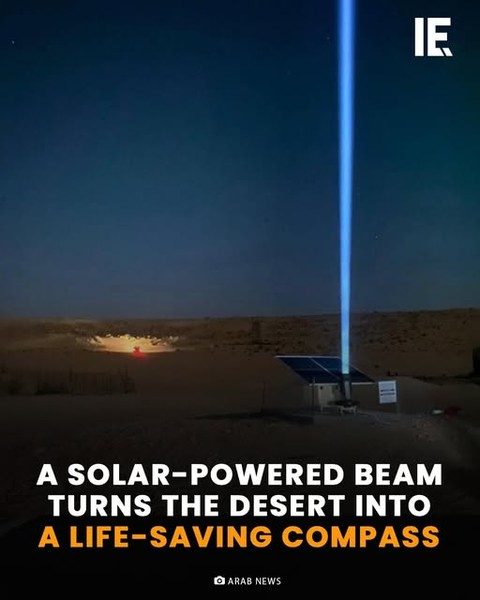
Solar Beams in the Desert: A Life-Saving Compass
In the vast expanse of Saudi Arabia’s Nafud Desert, solar-powered laser beacons serve as critical guides for lost travelers, directing them to essential water sources. This innovative project combines renewable technology with survival engineering, offering a unique solution to the challenges of desert navigation.
Context / Why This Matters
The Nafud Desert, spanning over 77,000 square kilometers, presents a formidable environment for travelers. Without access to reliable navigation tools, individuals can quickly find themselves disoriented and vulnerable to the harsh desert conditions. The solar-powered laser beacons, designed by explorer Mohammad Fohaid Al-Sohaiman, address this issue by providing a sustainable and effective navigation aid. The beacons use solar energy to emit visible night signals, marking the locations of wells across the remote terrain. This not only aids travelers but also highlights the potential for integrating renewable energy solutions in critical survival scenarios.
Main Discussion
The Technology Behind the Beacons
Solar-powered laser beacons utilize the abundant sunlight in desert regions to generate the energy needed to power the lasers. During the day, solar panels capture and store energy, which is then used to emit a bright, visible beam of light at night. This beam serves as a guiding light, helping travelers navigate towards water sources marked by wells.
The design of the beacons ensures that they are robust and reliable, capable of withstanding the extreme conditions of the desert. The visible night signals emitted by the beacons create a 'life-saving compass', aiding travelers in finding their way to safety.
The Design and Implementation
The implementation of these beacons involves careful planning and strategic placement. Designed by explorer Mohammad Fohaid Al-Sohaiman, the beacons are distributed across the desert to mark the locations of vital water sources. By blending renewable tech with survival engineering, these beacons offer a unique solution to the challenges of desert navigation.
The integration of solar energy into the design makes the beacons environmentally friendly and reduces the need for fossil fuels. This not only helps in conserving the environment but also ensures that the beacons remain operational without the need for frequent maintenance or refueling.
The Impact on Surviving in the Desert
The solar-powered laser beacons have a significant impact on the survival of travelers in the desert. By providing a reliable navigation aid, they help reduce the risk of disorientation and dehydration. This is particularly important in a desert environment where water sources can be sparse and difficult to find.
The visibility of the night signals also ensures that travelers can easily locate the beacons, even in low-light conditions. This makes the beacons a valuable resource for travelers, especially those who may not be familiar with the terrain.
Practical Tips
If you find yourself traveling in desert regions, it is essential to be prepared with the right tools and knowledge. Here are some practical tips to help you navigate safely:
Plan Your Route in Advance
Before embarking on a journey through the desert, plan your route carefully. Identify key landmarks and water sources along your path. This will help you stay on track and ensure you have access to essential resources.
Carry a Map and Compass
A reliable map and compass are crucial tools for desert navigation. Even with modern GPS technology, it is essential to have a physical map as a backup. Knowing how to use a compass can also help you navigate when visibility is poor, such as during sandstorms or at night.
Stay Hydrated
Dehydration is a significant risk in desert environments. Ensure you carry enough water and know where to find additional sources along your route. The solar-powered laser beacons can guide you to these sources, ensuring you stay hydrated.
Be Aware of Your Surroundings
Stay alert and attentive to your surroundings. Pay close attention to any visible landmarks or signs, such as the solar-powered laser beacons, that can help you navigate. Avoid venturing off your planned route without a clear sense of direction.
Communicate Your Plans
Before setting out, inform someone of your travel plans, including your intended route and expected return time. This can be crucial in case of an emergency, as search and rescue teams will have a better idea of where to look for you.
Use Renewable Tech
When possible, utilize renewable technology to reduce your impact on the environment. Solar-powered devices, such as the laser beacons, can be valuable tools for desert travelers, providing energy-efficient solutions for navigation and survival.
Important Takeaways
- The solar-powered laser beacons in the Nafud Desert serve as a critical navigation aid for travelers, guiding them to essential water sources.
- The integration of renewable energy solutions, such as solar power, makes the beacons environmentally friendly and reduces the need for fossil fuels.
- Travelers can enhance their safety by planning their route, carrying essential tools, staying hydrated, being aware of their surroundings, communicating their plans, and utilizing renewable technology.
- The beacons demonstrate the potential for combining renewable tech with survival engineering to address the challenges of desert navigation.
Conclusion
Solar-powered laser beacons offer a sustainable and effective solution to the challenges of desert navigation. By guiding travelers to vital water sources and providing a visible navigation aid, these beacons enhance safety and reduce the risks associated with traveling in remote desert environments. Whether you are an experienced explorer or a first-time traveler, understanding and utilizing these innovative technologies can significantly improve your chances of navigating the desert safely.
Watch the Reel
Questions readers ask
How do the solar beacons in the Nafud Desert function?
The solar beacons in the Nafud Desert are powered by solar energy and activated during nighttime. They emit visible laser signals that guide lost travelers to nearby water sources, ensuring they can find essential resources even in the dark.
Who developed the solar-powered laser beacons in Saudi Arabia?
The solar-powered laser beacons were designed by explorer Mohammad Fohaid Al-Sohaiman. His goal was to provide a sustainable and effective solution to the challenges of desert navigation, particularly in the vast and harsh Nafud Desert.
What makes the solar beacons a crucial tool for desert survival?
The solar beacons are crucial for desert survival because they offer a reliable navigation aid in an environment where traditional methods can fail. By providing a visible night signal, they help travelers locate water sources, which are vital for survival in the desert.
How large is the area covered by the solar beacons in the Nafud Desert?
The Nafud Desert spans over 77,000 square kilometers, and the solar beacons are strategically placed to cover this expansive and challenging terrain. This ensures that travelers, regardless of their location within the desert, have access to guidance towards water sources.
What challenges do travelers face in the Nafud Desert?
Travelers in the Nafud Desert face significant challenges, including disorientation due to lack of landmarks, harsh environmental conditions, and the risk of dehydration. The solar beacons mitigate some of these challenges by providing clear navigational cues to crucial water sources.
Can the solar beacons be used during the day?
The solar beacons are designed to be most effective at night, providing visible signals that guide travelers towards water sources. However, during the day, the solar panels charge the system, ensuring it is ready for nighttime operation.
What is the significance of solar energy in the desert survival system?
Solar energy is significant because it provides a renewable and sustainable power source in a region where traditional power sources may be limited or unavailable. By harnessing solar power, the beacons ensure a continuous and reliable operation, making them an essential tool for desert navigation.
Related deep dives
Similar reads based on topic and creator.


Recent articles
Fresh deep dives from the latest Reels we unpacked.




Comments
Be the first to comment.