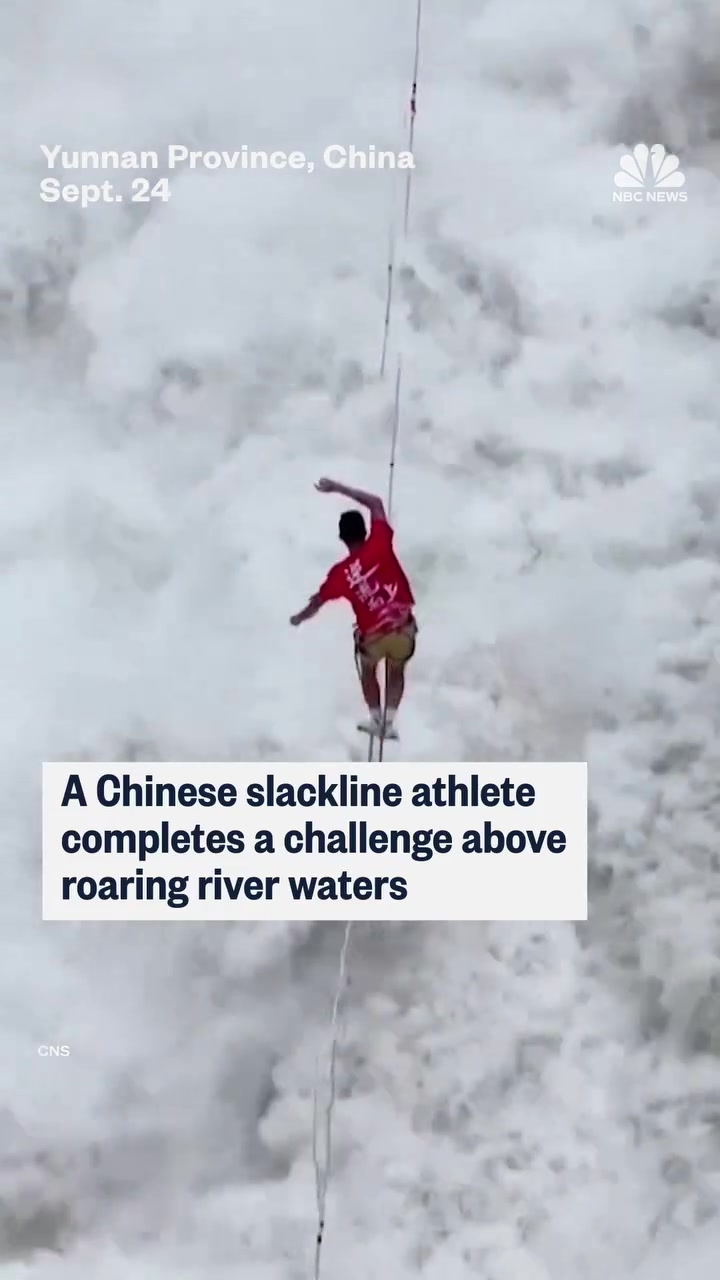
Sixty miles upriver from a city of golden Buddhas, the Jinsha River thunders, slicing Yunnan Province, China. On September 24, the waterway became a plank for a Chinese athlete to walk across. On one journey over 109 yards, Shi Hailin showed what a man was made of and what his sport was capable of.
The art of a long walk: what is slackline athletics?
Slacklining is a balancing act; it combines elements of yoga, rock climbing, and extreme parkour. Slackliners begin with a nylon strap pulled tight between two points. At the start, the slackline isn't as taut as one might think: Before walking on it, the line usually droops in the middle. Slacklining has a wide range of disciplines, from gracefully balanced walks to gymnastics 20 feet above the forest floor. The Chinese slackline athlete, Shi Hailin, practices highlining: a challenging, and sometimes deadly, offshoot of slacklining that involves balancing on a thin line above a deep, rushing river. Increasingly popular throughout the world, the sport has grown from a fringe pastime to an extreme sport that sports enthusiasts recognize. Slacklining requires few tools, but it demands patience and self-discipline. Adept slackliners can cross a highline with the grace of a ballet dancer, while novices may struggle to keep themselves stable on a lowline. To learn slacklining, a novice must understand that "This sport is a journey. You learn a little each time you try a line. It’s particularly rewarding when you finally master the line you want." Shi Hailin walked the line on September 24, 2023.
Cultural currents and the risks of slacklining
In China, Shi Hailin is known as one pioneer of slackline athletics, and the recent journey at the Jinsha River fuels that reputation. Shi is not the only extreme sportsman who has taken a zany approach to workouts out. And Shi's journey highlights more than just the extreme lengths an athlete will take to walk a tight rope. It's also a testament to the culture of risk that extreme athletes embrace, and it introduces an important question: How far can—and should—sports like slacklining go? Other slacklining daredevils can be reminded of the sport's humble roots, where the experience of walking a thin line between two trees had more to do with building patience than showcasing skill. A self-proclaimed “fearless spirit," Shi may underestimate the risks involved, risks that make slacklining less of a sport and more of a dare. The extreme danger of slacklining seen at the Jinsha demands awareness and preparation from all involved. The thrill of watching someone walk over a river begs us to forget the danger: The challenge can be a gamble, and Shi would win a lot and lose quite a bit.
The destination and the journey
Against the current, knowing the line.
The distance of a slackline is crucial to consider, and many skilled slackliners begin with a longer line then shorter and more challenging lines. Shi Hailin traversed a 109-yard stretch of slackline spanning the Jinsha River. Shi's journey was a daring, yet documented feat; the proximity of the chinois sportsman to the ground, the stability of the line, and the overall intensity of the drop are evidence of Shi's mastery. At present, 109 yards is not the longest slackline. The current world record for the longest highline walk is 2,287 meters. But the duration of a slackline has less to do with how far it stretches, as with how difficult it is to balance on it. This makes a slackline's base—its anchor points—critical.
Building a line: topography and technique
Slackliners always have to be on the lookout for a suitable place to build a line. Slacklining involves considering factors present in the terrain, such as the depth of the water, the difference between high and low tide, the width of the river, the material of the riverbanks, and the rocks that are slightly submerged. The weather and the equipment are important, too. Shi Hailin navigated a 109-yard stretch of slackline on September 24, 2023. He mastered a highline walk on the closest point. The Jinsha River’s flow is fast and strong. The river is so strong that Shi Hailin had to keep moving to avoid being pulled under. Then, the slacklining material and its installation is vital. To keep the line tight, slackliners must calibrate the tension precisely, and an incorrectly positioned highline can be dangerous. Finally, slackliners have to gauge the line’s slope, because a line that slopes downward is easier to traverse the opposite direction.
A bold journey with Chinese cultural context
Those who have seen the footage of the feat still cannot help but marvel at the sight of a Chinese slackline athlete balancing high above a river with current that jumps with a wide current. The combination of the protracted silence of the balancing act and the thunderous river below creates a daredevil atmosphere. The experience of the entire journey is a very intense one, with spectators talking about it for hours and days.
If your head is not in the game, do not walk the line
If you're thinking of trying slacklining, begin by taking a few measured steps. There is a crucial distinction between skills, the discipline of balance achieved through training, and real natural talent. Begin by walking a lowline, ideally with the guidance of an expert. Gradually progress to a higher, longer line; take nothing for granted, and remember that the sport is not just about the destination, but the journey.
- Location: Make sure you are in a safe, controlled, and legal environment to build and walk a slackline. Consider using equipment like padding or a harness.
- Practice: Start with a slackline close to the ground, then move higher, and longer.
- Equipment: Make sure you buy a high-quality slackline kit, including straps, rats, and anchors.
- Advice: There are a lot of ways to test your own slacklining skills. Find a mentor and practice on slopped tracks.
Your first step – be careful be well-versed in the purpose, and it will be a stable ground for your future slackline journey.
The air above the Jinsha River is still thick with adrenaline. But adventure is not about trying to get your heart racing all the time. Shi Hailin is living proof of the saying, “If you can walk on a line, you can walk anywhere.”
Watch the Reel
Questions readers ask
What exactly is slacklining, and how is it different from tightrope walking?
Slacklining is a sport that involves walking on a nylon strap or webbing that is anchored between two points, unlike tightrope walking, which uses a rigid wire or rope. The slackline isn’t as taut as a tightrope, and it typically droops in the middle, requiring more balance and control. It combines elements of yoga, rock climbing, and parkour, and can be done at various heights and under different conditions, including over deep, rushing rivers.
What makes Shi Hailin's 109-yard walk over the Jinsha River so impressive?
Shi Hailin's 109-yard walk is impressive due to the extreme conditions and high risk involved. The Jinsha River is known for its powerful currents, and the height and length of the slackline add significant challenges. Shi's ability to maintain balance and control under these conditions showcases his exceptional skill and experience in highlining.
What are the risks associated with highlining, as seen in Shi Hailin's feat?
Highlining, especially over a river like the Jinsha, involves significant risks. The primary dangers include falling into the water, which can be deadly due to the river's powerful currents. Additionally, the mental and physical strain of maintaining balance on a thin line at such heights can be intense. Proper preparation, awareness, and experience are crucial for managing these risks.
How did Shi Hailin prepare for his daring walk over the Jinsha River?
While the article doesn’t detail Shi Hailin's specific preparation, it’s clear that his extensive experience in slacklining and highlining played a significant role. Adept slackliners like Shi typically build up to longer and more challenging lines, honing their skills and mental resilience over time. The journey over the Jinsha was a testament to his dedication and mastery of the sport.
What is the cultural significance of Shi Hailin's feat in China?
In China, Shi Hailin is recognized as a pioneer of slackline athletics. His daring walk over the Jinsha River not only fuels his reputation but also highlights the culture of risk and extreme sports in the country. His feat serves as an inspiration for others to push their limits and embrace the challenges of extreme sports.
How does the experience of slacklining differ for beginners and experienced practitioners?
For beginners, slacklining can be a challenging and humbling experience, often involving a lot of falls and struggles to maintain balance. As practitioners gain experience, they learn to appreciate the journey and the incremental progress they make with each attempt. Experienced slackliners, like Shi Hailin, can traverse highlines with grace and precision, showcasing the sport's true beauty and rewarding nature.
Is slacklining gaining popularity worldwide, and if so, why?
Yes, slacklining is gaining popularity worldwide. Its appeal lies in the combination of physical challenge, mental focus, and the sense of accomplishment that comes with mastering a line. The sport requires few tools and can be practiced in various settings, making it accessible to many. Additionally, the thrill and spectacle of highlining, as seen in Shi Hailin's feat, contribute to its growing recognition as an extreme sport.
Related deep dives
Similar reads based on topic and creator.
Recent articles
Fresh deep dives from the latest Reels we unpacked.

Comments
Be the first to comment.