3D Scene Reconstruction
3D scene reconstruction is a powerful technique used in various fields, from gaming and virtual reality to urban planning and autonomous vehicles. Recent advancements in software like Scal3R have pushed the boundaries of what's possible, enabling the creation of detailed 3D environments from a single forward camera pass. This approach not only simplifies the data capture process but also ensures global consistency across vast distances.
Context / Why this matters
In the realm of 3D reconstruction, achieving large-scale, accurate, and consistent results has long been a challenge. Traditional methods often require multiple camera angles, complex setups, and extensive post-processing. However, software solutions like Scal3R are changing the game by leveraging artificial intelligence to streamline the process. This matters because it opens up new possibilities for applications that require real-time, high-precision 3D modeling, such as urban planning, autonomous driving, and immersive gaming experiences.
Main discussion
The Scal3R Approach
Scal3R, developed by extending VGGT (a vision-based global transformation model), introduces a novel approach to 3D scene reconstruction. By incorporating test-time training layers, the software can adapt to different environments on the fly, ensuring that the geometry remains stable even across very large scenes. This is achieved by splitting long image sequences into smaller, more manageable chunks. Each chunk is processed to compute adaptation gradients, which are then averaged to maintain consistency throughout the entire scene.
The Demonstration
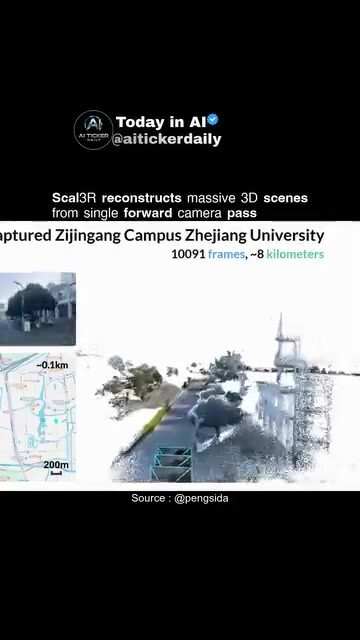
To showcase its capabilities, Scal3R was used to reconstruct a 3D scene from footage captured on the Zijingang Campus of Zhejiang University. The demonstration highlights the software's ability to handle vast distances, with the reconstructed environment spanning up to 5.5 kilometers. The process utilized 10,091 frames, illustrating the software's efficiency in processing large datasets. Throughout the demonstration, a map was displayed alongside the 3D reconstruction, providing a visual reference and enhancing the viewer's understanding of the scale and accuracy of the reconstruction.
Technical Insights
The demonstration used a single forward camera pass, simplifying the data capture process significantly. This method not only saves time but also reduces the complexity of the setup, making it more accessible for a wider range of applications.
Distance and Frame Utilization
The reconstructed 3D scene showed distances ranging from 0.0 kilometers to 5.5 kilometers. This extensive range demonstrates the software's capability to maintain high levels of detail and consistency over long distances. The use of 10,091 frames further underscores the software's ability to handle large datasets effectively, ensuring that no detail is lost in the final reconstruction.
Global Consistency
One of the key strengths of Scal3R is its ability to maintain global consistency. By averaging the adaptation gradients computed per chunk, the software ensures that the geometry remains stable and accurate, even as the camera moves through the scene. This results in a seamless and immersive 3D reconstruction, free from the inconsistencies that often plague traditional methods.
Practical tips
For those looking to implement 3D scene reconstruction in their projects, here are some practical tips:
Choose the Right Software
When selecting software for 3D scene reconstruction, consider solutions that offer test-time training layers and adaptive algorithms. These features are crucial for maintaining consistency and accuracy in large-scale reconstructions. Scal3R is one such example, known for its ability to handle vast distances and large datasets effectively.
Prepare Your Footage
Ensure that your footage is captured with a single forward camera pass. This not only simplifies the data capture process but also makes it easier to process the footage using software like Scal3R. High-quality footage will result in a more detailed and accurate 3D reconstruction.
Utilize a Map
Incorporating a map alongside your 3D reconstruction can provide valuable context and enhance the viewer's understanding of the scene. This is particularly useful for applications in urban planning, where understanding the spatial relationships between different elements is crucial.
Take Your Time
3D scene reconstruction is a complex process that requires careful attention to detail. Don't rush through the steps. Ensure that each frame is processed accurately and that the final reconstruction maintains global consistency.
Important takeaways
3D scene reconstruction is a cutting-edge technology with broad applications. Software like Scal3R is revolutionizing the field by simplifying the data capture process and ensuring global consistency. The demonstration on the Zijingang Campus of Zhejiang University showcases the software's capabilities, handling vast distances and large datasets with ease. By following practical tips and utilizing the right tools, anyone can harness the power of 3D scene reconstruction for their projects.
Conclusion
With advancements in software like Scal3R, 3D scene reconstruction has become more accessible and efficient than ever before. By leveraging artificial intelligence and adaptive algorithms, this technology is poised to transform various industries, from gaming and virtual reality to urban planning and autonomous vehicles. Whether you're a seasoned professional or just starting out, understanding the principles and applications of 3D scene reconstruction can open up new possibilities and enhance your projects.
Watch the Reel
Questions readers ask
What makes Scal3R's 3D scene reconstruction unique?
Scal3R stands out by enabling 3D environment creation from a single forward camera pass, unlike traditional methods that require multiple camera angles and complex setups.
How does Scal3R ensure global consistency in large-scale 3D reconstructions?
Scal3R maintains global consistency across vast distances by leveraging AI to streamline the 3D modeling process, ensuring that data captured remains accurate and coherent over large areas.
What are the key applications of Scal3R's 3D scene reconstruction technology?
Scal3R's technology is applied in various fields, including urban planning for creating detailed 3D city models, autonomous driving for generating high-precision 3D maps, and immersive gaming for developing realistic 3D environments.
Can Scal3R's 3D scene reconstruction process be done in real-time?
Yes, Scal3R supports real-time 3D modeling. Its AI-driven approach allows for high-precision 3D reconstruction as data is captured, making it ideal for applications requiring immediate results.
How does Scal3R simplify the 3D data capture process?
Scal3R simplifies 3D data capture by using a single forward camera pass, reducing the need for multiple cameras or extensive post-processing. This makes the process more efficient and accessible.
What role does AI play in Scal3R's 3D scene reconstruction?
AI is central to Scal3R's functionality, enabling real-time, high-precision 3D modeling. It streamlines the reconstruction process, ensuring accurate and consistent results, even in complex environments.
How can Scal3R benefit urban planning?
Scal3R aids urban planning by providing detailed and accurate 3D models of urban environments, which can be used for better city design, infrastructure development, and environmental impact assessments.
Related deep dives
Similar reads based on topic and creator.
Recent articles
Fresh deep dives from the latest Reels we unpacked.




Comments
Be the first to comment.