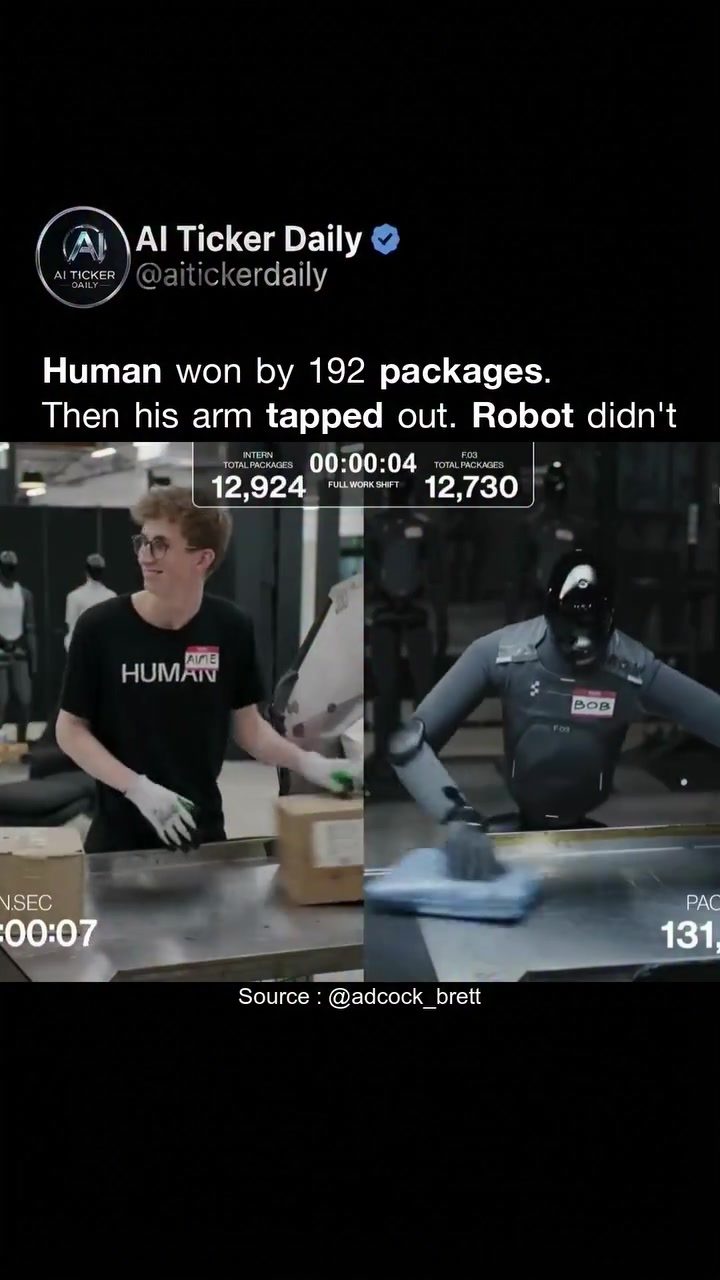
The Human vs. Robot Packaging Challenge
The competition between human and robot packaging abilities has long been a topic of debate, but a recent video showcased a dramatic face-off between the AI TICKER F.03 and a top human package sorter, Aime. The results were a stark reminder of the evolving capabilities of automated packaging machines.
Why this Matters
The packaging industry is constantly seeking ways to increase efficiency and reduce errors. Automation in packaging offers a solution that can outperform human capabilities in speed, consistency, and endurance. The challenge between Aime and F.03 highlights the potential for robots to transform this sector, making it crucial to understand the strengths and limitations of both humans and machines in such tasks.
Main Discussion
The Packaging Challenge
The match pitted a renowned human package sorter, Aime, against an advanced packaging robot, F.03. The challenge was simple: who could pack the most packages in the shortest amount of time? The results were surprising, with Aime managing to pack 12,924 packages at an average speed of 2.79 seconds per package, while F.03 packed 12,732 packages at 2.83 seconds per package. Aime won by a narrow margin of 1.5%, but the true significance lies in the endurance and resilience of the robots.
Human Limitations
While Aime's performance was impressive, the human body eventually succumbed to fatigue. After the intense packaging session, Aime reported significant discomfort in his left forearm, which was so strained that he could barely move it. This highlights one of the most significant limitations of human workers: the body's susceptibility to fatigue, injury, and the need for rest.
Robot Performance
In stark contrast, F.03 showed no signs of fatigue or injury. The robot’s ability to maintain its performance level without interruption sets it apart. Unlike humans, robots do not experience the same biological limitations, making them ideal for continuous, repetitive tasks. Additionally, robots can be prepped for the next shift immediately, ensuring that production lines remain uninterrupted.
Endurance and Efficiency
One of the most critical insights from this challenge is that robots do not need to outperform humans in speed to be effective. They simply need to outlast them. Humans, with their biological limits, inevitably reach a point of fatigue, while robots, with their mechanical design, can operate without pause. This endurance factor is crucial in industries where continuous operation is essential for meeting high demand and maintaining efficiency.
Practical Tips for Packaging Efficiency
Implementing Robotic Systems
For businesses looking to improve their packaging efficiency, implementing robotic systems can be a game-changer. Robots can handle repetitive tasks with precision and speed, reducing the risk of human error and increasing overall productivity. However, it’s essential to choose the right robotic system that aligns with the specific needs of the packaging process.
Combining Human and Robot Work
While robots offer significant advantages, they are not a complete replacement for human workers. Instead, combining the strengths of both can create a more efficient and productive work environment. Humans can focus on tasks that require problem-solving and decision-making, while robots handle repetitive, high-volume tasks.
Training and Adaptation
Any transition to automated systems requires a period of training and adaptation. Workers need to be trained on how to operate and maintain the new equipment, and the company must adapt its workflows to integrate the robotic systems effectively. This process can be challenging but is essential for long-term success.
Important Takeaways
The Human vs. Robot Packaging Challenge highlights several key takeaways:
- Robots can outlast humans in repetitive tasks, making them ideal for continuous operation.
- Human workers still play a crucial role in tasks that require decision-making and problem-solving.
- The future of packaging efficiency lies in integrating both human and robotic capabilities to create a balanced, productive work environment.
Conclusion
The competition between Aime and F.03 was more than just a test of speed and efficiency; it was a demonstration of the future of automation in the packaging industry. While humans can still outperform robots in specific scenarios, the robots' ability to endure without fatigue makes them a valuable asset in any packaging operation. As the technology continues to evolve, the role of robots in the packaging industry is set to become even more significant, transforming how we think about efficiency and productivity.
Watch the Reel
Questions readers ask
How did the F.03 robot compare to the human sorter, Aime, in the packaging challenge?
The F.03 robot demonstrated remarkable endurance, showing no signs of fatigue throughout the challenge. While Aime won by a narrow margin of 1.5%, the robot's consistent performance underscored the potential of automated packaging to outperform humans in prolonged tasks.
What are the primary benefits of automated packaging?
Automated packaging offers several advantages, including increased speed and consistency in sorting and packaging tasks. Robots can work continuously without breaks, reducing the impact of human fatigue. They also minimize errors, leading to more reliable outcomes in packaging processes.
What does the future hold for the packaging industry with the advancement of robot sorters like F.03?
As robots like F.03 continue to advance, the packaging industry is likely to see a shift towards greater automation. This trend could lead to improved efficiency, reduced labor costs, and enhanced productivity. However, it may also require workforce adjustments to integrate and manage these automated systems effectively.
How did the challenge between Aime and F.03 highlight the strengths of robots in packaging?
The challenge revealed that robots excel in tasks requiring sustained performance and precision. Unlike Aime, who showed signs of fatigue, F.03 maintained a consistent level of performance, demonstrating the robot's ability to endure long work periods without a decline in productivity.
What are some of the limitations of human sorters in the packaging industry?
Human sorters, while highly skilled, are subject to fatigue and variability in performance. Factors such as prolonged work hours, repetitive tasks, and the need for breaks can affect their efficiency and consistency, making them less reliable for continuous, high-volume packaging tasks.
What specific advantages does F.03 offer that could benefit the packaging industry?
F.03 offers several benefits, including the ability to work continuously without breaks, high speed, and consistent performance. These attributes make F.03 an ideal solution for industries where speed and precision are crucial, and where human fatigue could compromise the packaging process.
What can packaging companies learn from the performance of F.03 in the challenge?
The performance of F.03 in the challenge highlights the importance of investing in automated packaging solutions. Companies can learn about the reliability and efficiency that robots bring to the packaging process, helping them make informed decisions about adopting automation to enhance their operations.
Related deep dives
Similar reads based on topic and creator.




Recent articles
Fresh deep dives from the latest Reels we unpacked.




Comments
Be the first to comment.