Analog TV Reception
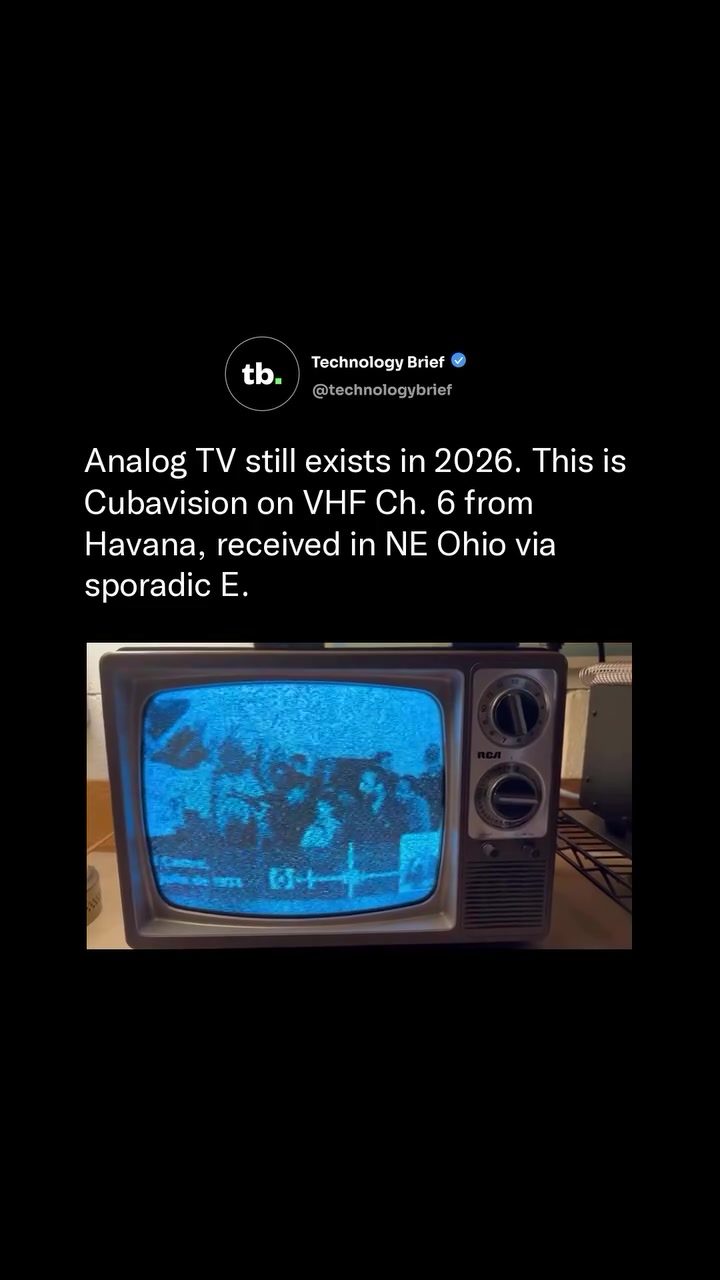
Analog TV broadcast signals haven’t completely disappeared in 2026. Cubavision, Cuba’s state TV broadcaster, continues to transmit on analog VHF Channel 6 from Havana. Remarkably, this signal was picked up in Northeast Ohio, roughly 1,100 miles away. This wasn't through a satellite or internet stream, but rather by pure atmospheric luck. The phenomenon responsible for this long-distance reception is known as sporadic E propagation.
Why This Matters
Understanding how analog TV signals can still travel such vast distances offers insight into the complexities of radio wave propagation. Although digital technology has largely replaced analog broadcasts, the persistence of analog signals and the conditions that allow them to travel far beyond their typical range is a fascinating aspect of modern broadcasting.
How Analog TV Signals Travel Long Distances
Sporadic E Propagation
Sporadic E propagation is a natural phenomenon that allows VHF signals to travel much farther than they normally would. Dense patches of ionized plasma form in the E layer of the ionosphere, about 90 to 120 kilometers above the Earth’s surface. These patches act like a mirror, bouncing the VHF signals back down to the Earth’s surface, far beyond their normal range.
Normal vs. Enhanced Conditions
Under normal conditions, a VHF broadcast might only reach about 50 miles. However, during a sporadic E event, the same signal can travel between 600 to 1,400 miles. This effect is unpredictable and can last from minutes to a few hours, with a higher likelihood of occurrence during the summer months.
This phenomenon is not limited to TV broadcasts; it can also affect other forms of VHF communication, such as amateur radio and military communications.
Geographic and Technological Factors
Because the United States switched off analog TV in 2009, VHF channels are now mostly empty here, which makes it easier to pick up foreign analog signals when conditions align. For example, Cuba, which still runs analog broadcasts, becomes one of the more common catches for hobbyists in the eastern U.S. during sporadic E season.
Conditions for Reception
Equipment
An old RCA television was used to receive the Cubavision signal. This highlights how even outdated equipment can still be useful under the right atmospheric conditions. The television displayed static and a distorted image, indicating the signal was weak but detectable.
Atmospheric Conditions
Atmospheric conditions play a crucial role in the reception of long-distance analog TV signals. The presence of dense patches of ionized plasma in the E layer of the ionosphere is essential for sporadic E propagation. These conditions are more likely to occur during the summer months, making this the prime time for hobbyists to attempt to capture distant signals.
Location
The location of the reception is also significant. Northeast Ohio, being in the eastern United States, is more likely to pick up signals from Cuba due to its geographical proximity and the typical direction of atmospheric conditions.
Practical Tips for Hobblysts
If you’re interested in catching long-distance analog TV signals, here are some practical tips:
Monitor During Sporadic E Season
Sporadic E season typically peaks during the summer months, so this is the best time to try and catch distant signals.
Use VHF Equipment
Ensure you have the right equipment. VHF antennas and receivers are essential for picking up these signals. An old RCA television, for example, can still be useful for this purpose.
Stay Updated on Atmospheric Conditions
Keep an eye on atmospheric conditions. Websites and apps that monitor ionosphere activity can provide valuable insights into when conditions are right for sporadic E propagation.
Experiment with Different Channels
Try tuning into different VHF channels. With the U.S. having mostly empty VHF channels, there’s a higher chance of picking up signals from other countries.
Important Takeaways
Analog TV signals can still travel long distances under the right atmospheric conditions. Understanding sporadic E propagation can help hobbyists and enthusiasts pick up distant signals.
The phenomenon of sporadic E propagation is unpredictable and influenced by various factors, including the presence of ionized plasma in the E layer of the ionosphere and the direction of atmospheric conditions. Proper equipment and timing are crucial for successful reception.
Conclusion
Sporadic E propagation is a fascinating phenomenon that allows analog TV signals to travel far beyond their normal range. With the right equipment and atmospheric conditions, it’s still possible to pick up signals from distant locations. Whether you’re a hobbyist or just curious about the science behind radio wave propagation, understanding and experiencing sporadic E can be both exciting and educational.
In an era dominated by digital technology, the persistence of analog signals and the conditions that allow them to travel long distances offer a unique glimpse into the interconnectedness of our world.
Watch the Reel
Questions readers ask
What is the phenomenon that allowed Cuban TV signals to be received in Ohio in 2026?
The phenomenon is called sporadic E propagation. It is a natural occurrence where radio waves are bent and refracted by layers of the Earth's atmosphere, allowing signals to travel much farther than they typically would.
Which channel does Cubavision transmit on?
Cubavision transmits on analog VHF Channel 6 from Havana. This analog signal was picked up in Northeast Ohio in 2026.
How far is it from Havana, Cuba, to Northeast Ohio?
The distance from Havana, Cuba, to Northeast Ohio is approximately 1,100 miles, making the reception of the Cuban TV signal in Ohio quite remarkable.
Why is the reception of Cuban TV signals in Ohio significant?
The reception of Cuban TV signals in Ohio is significant because it highlights the enduring complexities of radio wave propagation and the conditions that can allow analog signals to travel vast distances, even in an era dominated by digital technology.
What does it mean to receive analog TV signals in 2026?
Receiving analog TV signals in 2026 means capturing old-school broadcast signals, like the ones from Cubavision on VHF Channel 6. It's a reminder of the analog era, long after most broadcasts have switched to digital.
Can I still receive analog TV signals in my area?
The ability to receive analog TV signals depends on various factors, including the presence of local analog broadcasters, atmospheric conditions, and your antenna setup. If you're interested in picking up analog signals, use a VHF antenna to improve your chances.
What equipment do I need to receive long-distance TV signals like those from Cuba?
To receive long-distance TV signals, you will need a high-quality antenna designed for the appropriate frequency band. A VHF antenna is suitable for picking up signals like the ones from Cubavision. Additionally, a good receiver or TV with strong analog capabilities will be necessary.
Related deep dives
Similar reads based on topic and creator.




Recent articles
Fresh deep dives from the latest Reels we unpacked.




Comments
Be the first to comment.