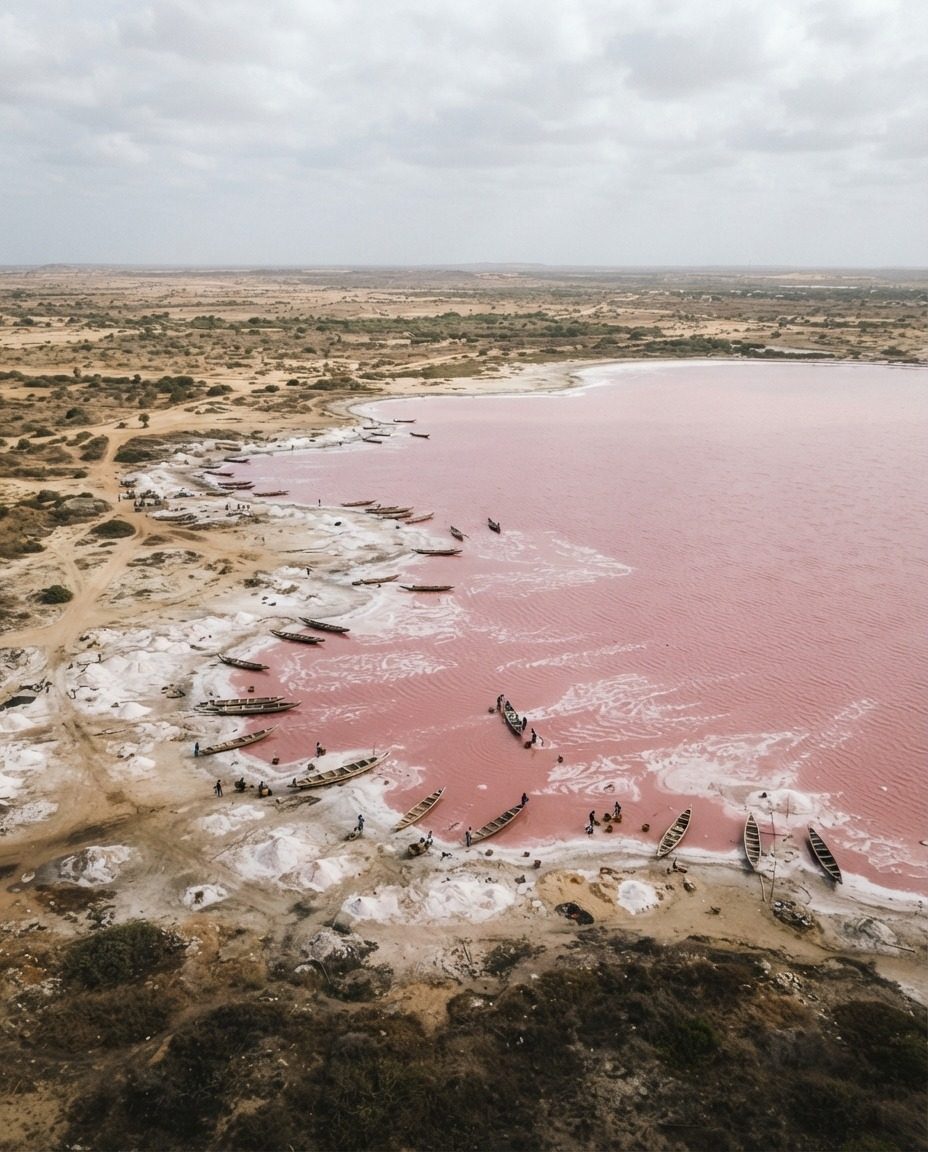
Color of a distant planet
What is colossal — really impressive — about the Pink Lake Landscape is not its isolation, which is a given. Nor is it even the people tiny and silhouetted against the vast expanse. It is the lake's color, which defies common sense and common expectations. The lake's pink hue is likely a result of algae or microorganisms, which flourish in the saline waters. It's a phenomena found in only a handful of places, namely Western Australia, San Francisco Bay, and a few more scattered locations. This is not a red lake, like Sunset Crater, which is colored by iron. Nor is it a lake of algae blooms, which turn waters into verdant greens. These are pink lakes, and, with scarce exceptions, they are not in a temperate region. Remarkably, the phenomenon that defies our common expectations is actually a product of salt. This is a saline lake. The salinity in the water can actually inhibit the growth of typical green algae. It’s an incredible shift away from the green we all expect. Much like the Green Lakes in Wisconsin, which are instead colored blue. The commonalities between the Pink Lake with algae blooms are similar to the Green Lakes, which are crystal clear blue, and not green at all. The salty water spurs a different kind of algae, which react to the environmental triggers and bring the pink to the surface.
Salt and sunlight
Unlike the green algae, that can’t compete with the salinity, the species that turn the Pink Lakes pink are halophilic, meaning they thrive in high-salt environments. As the water evaporates, the salinity increases and the concentration of these organisms becomes more intense. Phenomena like these may look like a distant planet — but they are real. The main components driving this are the salt and sunlight. As well as something else. It’s worth noting saltwater lakes require a lot of sunlight in order to produce the unique color. That’s because the green algae in fresh waters, and the green algae that are intuitive to us, require light in order to function, albeit in a different way. The green algae here in pink waters need to fight against the salinity. And as the shallower lakes evaporate, they actually become more concentrated and colorful.
Watch the Reel
Related deep dives
Similar reads based on topic and creator.




Recent articles
Fresh deep dives from the latest Reels we unpacked.




Comments
Be the first to comment.