The Physical Limits of Machines
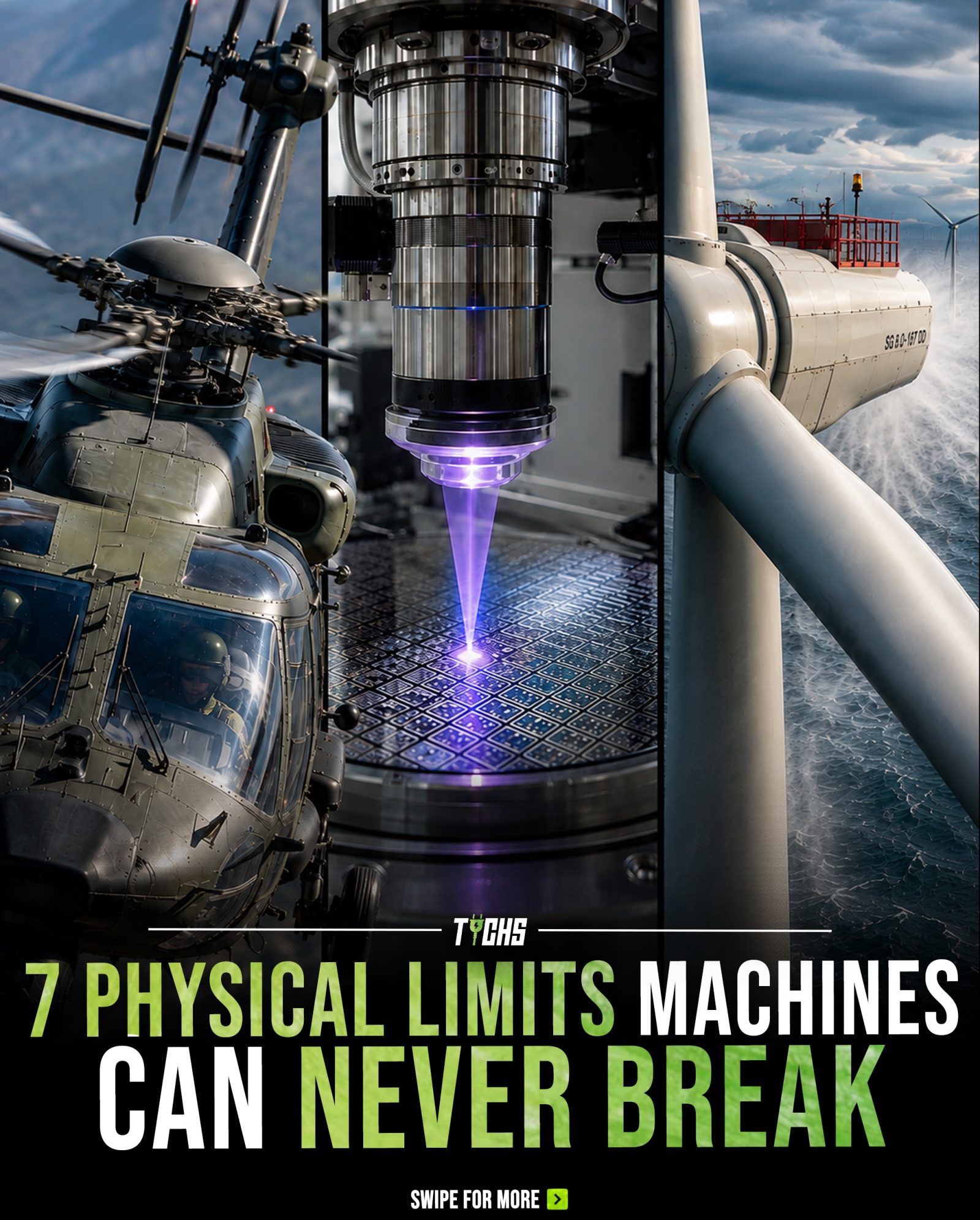
Machines, from wind turbines to industrial lasers, represent the pinnacle of human engineering. Yet, even the most advanced designs must contend with fundamental physical limits. These constraints, rooted in thermodynamics, fluid dynamics, mechanics, and material science, impose boundaries that no amount of innovation can overcome. Here, we delve into some key physical limits that govern the operation of machines.
Why This Matters
Understanding these physical limits is crucial for engineers, scientists, and anyone interested in the intricate interplay between design and natural law. Whether it's the efficiency of a turbine or the speed of a helicopter, these boundaries shape the capabilities and constraints of modern technology. Recognizing these limits helps in optimizing performance and pushing the boundaries of what is possible within the realm of physics.
Key Physical Limits
Carnot and Betz Limits
Thermodynamics plays a pivotal role in defining the efficiency of machines. The Carnot limit, for instance, governs the maximum efficiency of heat engines, such as those used in power plants. This limit is based on the principle that no heat engine can be more efficient than a reversible engine operating between the same temperature extremes. Similarly, the Betz limit, also known as Betz's law, sets a theoretical upper boundary for the power that can be extracted from wind by a wind turbine. These limits underscore the fundamental constraints imposed by the laws of thermodynamics.
Rocket Equation
In the realm of aerospace, the rocket equation is a cornerstone. It describes the motion of vehicles that expel mass to accelerate, such as rockets. The equation reveals that to achieve higher velocities, a rocket must expel a significant portion of its mass as exhaust. This constraint means that there is an inherent limit to the payload a rocket can carry to a given destination, regardless of the efficiency of its design.
Retreating Blade Stall
In aviation, helicopters face a unique challenge known as retreating blade stall. This phenomenon occurs when the helicopter's advancing blade loses lift, causing the retreating blade to stall. As the helicopter's speed increases, the retreating blade's angle of attack increases, leading to a loss of lift and potential stall. This limitation sets a practical speed limit for conventional helicopters, making it challenging to design high-speed rotorcraft.
Theoretical Strength Gap
Materials science reveals another fundamental limit: the theoretical strength gap. This concept highlights the disparity between a material's theoretical strength, based on its atomic structure, and its actual strength, which is compromised by microscopic defects. For instance, in metals, tiny defects called dislocations weaken the crystal structure, causing the material to fail at stresses far below its theoretical limit. Understanding this gap is essential for developing stronger, more resilient materials.
Practical Tips
When designing and engineering machines, it's essential to work within these physical constraints. Here are some practical tips for navigating these limits:
Optimize for Efficiency
Efficiency is key. Designers should aim to maximize the performance of their machines while staying within the bounds set by physical laws. For example, improving the aerodynamic design of a helicopter blade can mitigate the effects of retreating blade stall, allowing for higher speeds.
Material Selection
Choosing the right materials can significantly impact a machine's performance. By understanding the theoretical strength gap, engineers can select materials with fewer defects or develop new materials that approach their theoretical strength. Advanced manufacturing techniques, such as additive manufacturing, can help achieve this by creating parts with fewer imperfections.
Thermodynamic Management
Efficient thermal management is crucial for machines that rely on heat engines. Designers should focus on minimizing heat loss and maximizing the transfer of energy, thereby approaching the Carnot and Betz limits as closely as possible.
Computational Constraints
Even in the digital realm, physical limits apply. Diffraction limits how finely silicon can be patterned, affecting the size and efficiency of computer chips. Additionally, the Landauer limit sets a minimum energy cost for erasing information, highlighting the energy constraints of computation. This means that optimizing algorithms and hardware for lower power consumption is essential for sustainable computing.
Important Takeaways
- Thermodynamic Limits: Machines are constrained by the laws of thermodynamics, which limit efficiency and performance.
- Material Constraints: The theoretical strength gap underscores the need for materials with fewer defects to achieve higher strength.
- Aerodynamic Challenges: Retreating blade stall limits the speed of helicopters, necessitating innovative blade designs.
- Computational Boundaries: Diffraction and Landauer limits constrain the capabilities of silicon-based computing.
Conclusion
The physical limits of machines are not barriers to progress but rather guidelines within which engineers and scientists operate. By understanding and respecting these boundaries, designers can push the limits of what is possible, creating more efficient, powerful, and resilient machines. Whether it's a wind turbine, a rocket, or a helicopter, recognizing these constraints is key to driving innovation in technology.
Watch the Reel
Questions readers ask
What are the key physical limits that affect machine performance?
The key physical limits include those imposed by thermodynamics, such as the Carnot efficiency limit, fluid dynamics, like the drag and lift forces acting on components, and material science, which dictates the strength and durability of machine parts. These limits collectively shape the capabilities and constraints of modern machinery.
How do thermodynamic laws constrain the efficiency of machines?
Thermodynamic laws, particularly the first and second laws, impose fundamental limits on how efficiently machines can convert energy from one form to another. For instance, the Carnot efficiency limit sets a maximum theoretical efficiency for heat engines, which is crucial for understanding the performance of engines and turbines.
What is the significance of fluid dynamics in machine design?
Fluid dynamics is critical in machine design as it governs how forces like drag and lift impact moving parts. Understanding these principles is essential for optimizing the performance of machines like wind turbines, where aerodynamic forces play a significant role, and helicopters, where blade stall can occur if design limits are exceeded. This understanding aids in optimizing the shape and speed of moving components.
How does material science influence the design and performance of advanced machines?
Material science dictates the physical properties of components, including strength, durability, and thermal conductivity. These properties are vital in determining the structural integrity and operational lifespan of machines. For example, the choice of material for rocket engine components directly impacts their ability to withstand extreme temperatures and pressures.
What are the physical constraints specific to helicopter blade design?
Helicopter blades face unique physical constraints, such as retreating blade stall, which occurs when the advancing and retreating blades experience different airflow speeds, leading to loss of lift. Engineers must design blades to minimize these effects, ensuring stable and efficient flight across a range of conditions. Understanding these constraints is essential for optimizing helicopter performance and safety.
Why is it important to consider the physical limits of wind turbines?
Wind turbines are subject to physical limits related to the efficiency of converting wind energy into electrical energy. The Betz limit, for example, states that no turbine can capture more than 59.3% of the wind's kinetic energy. This understanding is vital for designing turbines that operate within these limits to maximize energy output while ensuring structural integrity and longevity.
What role do physical constraints play in the design of rocket engines?
Rocket engines face severe physical constraints due to the extreme temperatures, pressures, and forces involved. Understanding these limits is crucial for selecting materials, designing combustion chambers, and optimizing fuel mixtures. The efficiency and reliability of rocket engines are directly influenced by these physical constraints, making them a key consideration in the design and operation of rockets.
Related deep dives
Similar reads based on topic and creator.




Recent articles
Fresh deep dives from the latest Reels we unpacked.




Comments
Be the first to comment.