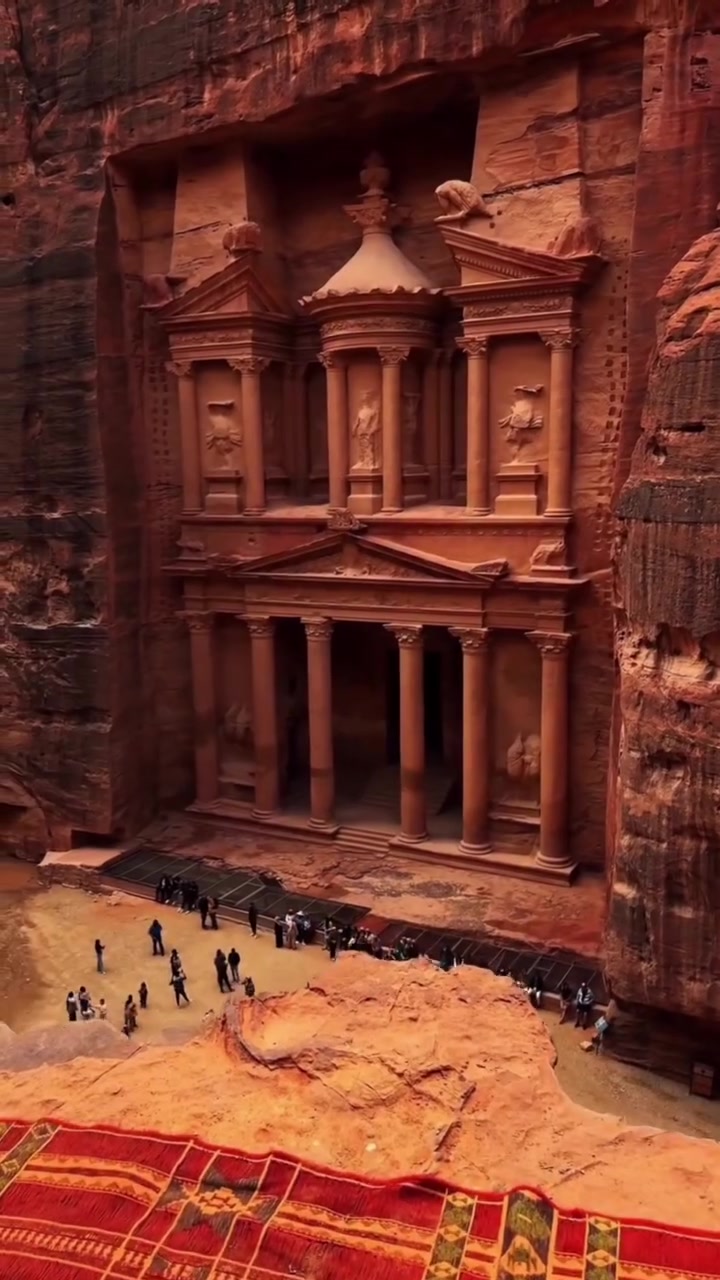
A City Carved from Stone
Nestled in Jordan, Petra is an ancient city unlike any other. It was featured in Indiana Jones in search of the Holy Grail. The city lies between towering, rose-hued sandstone cliffs, carved in centuries gone. The beauty of Petra is rooted in its intricate architecture, the experiences it offers, and its historical significance. The Slik, a narrow canyon corridor, buzzes with quiet energy. The Treasury — Al-Khazneh— is the most iconic landmark of the city. Its facade, with the urn-bearing monument at the center and a prominent flight of stairs, stands out as one of the most intricate and intriguing landmarks in the ancient world. It is the most recognizable landmark of Petra, etched into the cliffside; the ornate carvings leave visitors marveling at its grandeur.
Petra is a Marvel of World History
Petra is the stuff of legends — and blockbuster movies, too. It displays the ingenuity of the Nabataean people, who carved elaborate buildings and monuments into sandstone cliffs; its architecture is carved straight from rock, including entire tombs, temples, and structures. The city stands as a testament to the human ability to realize grand visions in a challenging environment. It was the capital of the Nabataeans, a trading powerhouse between 400 BCE and 106 CE. The city from these centuries stands as a testament to the magnitude of their skills and accomplishments. Social media platforms are filled with pictures of the incredible architecture and intricate carvings of Petra, pushing its visibility to new heights, attracting travelers across the world.
The urban center
The grandeur of Petra's architecture goes beyond the Treasury. Petra is a sprawling urban center, and its many architectural marvels lie beyond the famous Slik that leads to the Treasury. The Street of Facades —Wadi Farasa — is a central hub where numerous tombs are carved out of the rock. It is a stream of Nabataean tombs dating back to the 1st to 2nd centuries CE. This area is also home to the largest monument in Petra, the Royal Tombs. This iconic structure boasts a massive facade, with intricate carvings and large windows, showcasing the detail of Nabataean architecture. It is a testament to the scale of the Nabataeans' ambitions and capabilities. Situated on the summit of the cliff face, the Monastery is another must-see area in Petra. Underneath the carving, it is the solitary monastery of Petra. There is no place in Petra that seems quite so isolated, but this isolation gives it an allure that just adds to its magic. The Monastery features a 44-columns facade and an ornate urn similar to the one in the Al Khazneh. After the 2,000-year-old stairs cut into the cliff face, visitors may explore the surroundings. The temple of Al-Deir is unique. The path to it winds through the heart of Al-Azran. It features an intricate facade with carvings and a massive urn.
Where Religion and Nature Meet
Petra is a holy city, often referred to as the Rose City, owing to the striking reddish sandstone from which it is carved. Its close-knit community of 13,000 persons is known as the City of Moses. The fearsome nature helped keep Petra's inhabitants safe, according to the show. The city contains several churches that reflect the early Christian influence in the area. According to legend, the apostle Paul's first sermon in Arabia was given in the city. The city's many tombs and shrines are reminiscent of the religious activities that once took place there.
The Path to the Treasury
The approach to the Treasury winds through the narrow canyon of the Slik — the Siq. The canyon is formed by two massive cliffs positioned at an angle to it. It runs into the city from the eastern border. The internal walls narrow down the space, giving the narrow canyon a strange feeling of both intimacy and isolation. The journey down the Slik is an immersive experience that transforms the visitor into a traveler, transporting them back to ancient times. There is an almost spiritual feeling as the sun paints the walls of the narrow canyon in hues of orange and pink, slowly giving way to the rock-hewn façade of Al-Khazneh or the Treasury.
The Petra Hiking Experience
Anticipating the climb to 4,000 feet for the best views of the city.
Climb to the Monastery
The 450 steps up to the top of the canyon, called the Monastery Trail, begin after the Al-Deir Monastery. The route begins at the back of the Monastery and runs steeply upwards in serpentine turns. High steps and a shorter climb offer an alternative to the direct route. Experienced hikers must also be prepared for rough terrain and loose rocks. Allow 30 minutes for the hike, and another 30 for the descent. There are no support facilities along the path.
Scrambling to the High Place of Sacrifice
The route to the High Place of Sacrifice — the site where animal sacrifices were once performed — begins near the Great Temple and continues for about 15 minutes to reach the summit. The trail is steep and rough, and scrambling and climbing are necessary at many points. The High Place of Sacrifice offers a panoramic view of the lower city from a vantage point of approximately 2,900 feet. The displays in the museum in the Treasury include artifacts from the archaeological excavations that began in the 1970s. The trip continues to the lower city, where there are many more ruins to see, including the remains of a church and a Roman road. The High Place of Sacrifice is located 1,000 feet above the Treasury on the edge of a cliff, and the climb to the top can be challenging.
A note on travel. Petra is a journey, not a destination.
The city is often discussed in tourism terms. Petra has become an increasingly popular tourist destination, pushing the available facilities to new limits. And that popularity comes with its drawbacks. Tourist footfall is one of the biggest problems. The pathways are not as accessible as one would expect for a popular tourist area, and maintaining them is a challenge due to the city's location. The sites are not well connected, and there are no dedicated resting spaces, which makes the journey around the city a bit more challenging. Petra is a UNESCO World Cultural Heritage Site and an Architectural Marvel. The scale and grandeur of its architectural accomplishments are beyond belief. Petra, Jordan, even in its ruins, is one of the most thrilling historical sites in the world, and it is a must-visit for anyone interested in history and beautiful structures.
Watch the Reel
Questions readers ask
What makes Petra's architecture so unique?
Petra's architecture is unique because it was carved directly into the sandstone cliffs. The Nabataeans created elaborate buildings, tombs, and monuments by sculpting the rock itself, which is a testament to their engineering and artistic skills. This approach is quite different from other ancient civilizations that typically constructed buildings with separate materials.
Why is the Treasury (Al-Khazneh) so famous?
The Treasury is the most iconic landmark in Petra due to its intricate and ornate facade. It's famous for its central urn-bearing monument and prominent stairway. Its appearance in films like Indiana Jones has also contributed to its global recognition.
Can you explore Petra beyond the Slik and the Treasury?
Absolutely, Petra is a sprawling urban center with many architectural marvels beyond the Slik and the Treasury. The Street of Facades, the Monastery, and the Temple of Al-Deir are just a few examples of the other remarkable sites within Petra. Each offers its own unique experience and showcases the Nabataeans' architectural prowess.
What is the significance of the Monastery in Petra?
The Monastery, or Ad Deir, is significant for its isolation and grandeur. It features a 47-column facade and an ornate urn, similar to the Treasury. The climb to the Monastery is an adventure in itself, with over 800 steps cut into the cliff face, offering breathtaking views of the surrounding landscape.
How did the Nabataeans carve such intricate structures into the sandstone?
The Nabataeans used advanced engineering techniques to carve their structures. They employed tools like chisels and hammers to shape the sandstone, creating intricate facades and detailed carvings. Their ability to create such grand structures in a challenging environment is a testament to their skill and ingenuity.
Can you visit Petra without a guide?
Yes, you can visit Petra without a guide. The site is well-marked with signs and paths, making it easy for visitors to navigate on their own. However, hiring a guide can enhance your experience by providing historical context and insights into the Nabataean culture.
Is Petra only accessible on foot?
While much of Petra is best explored on foot, there are other options for getting around. You can hire a horse, donkey, or camel to ride through the site, which can be a fun and convenient way to see more of Petra without expending too much energy. Alternatively, there are also horse-drawn carriage rides available.
Related deep dives
Similar reads based on topic and creator.



Recent articles
Fresh deep dives from the latest Reels we unpacked.


Comments
Be the first to comment.