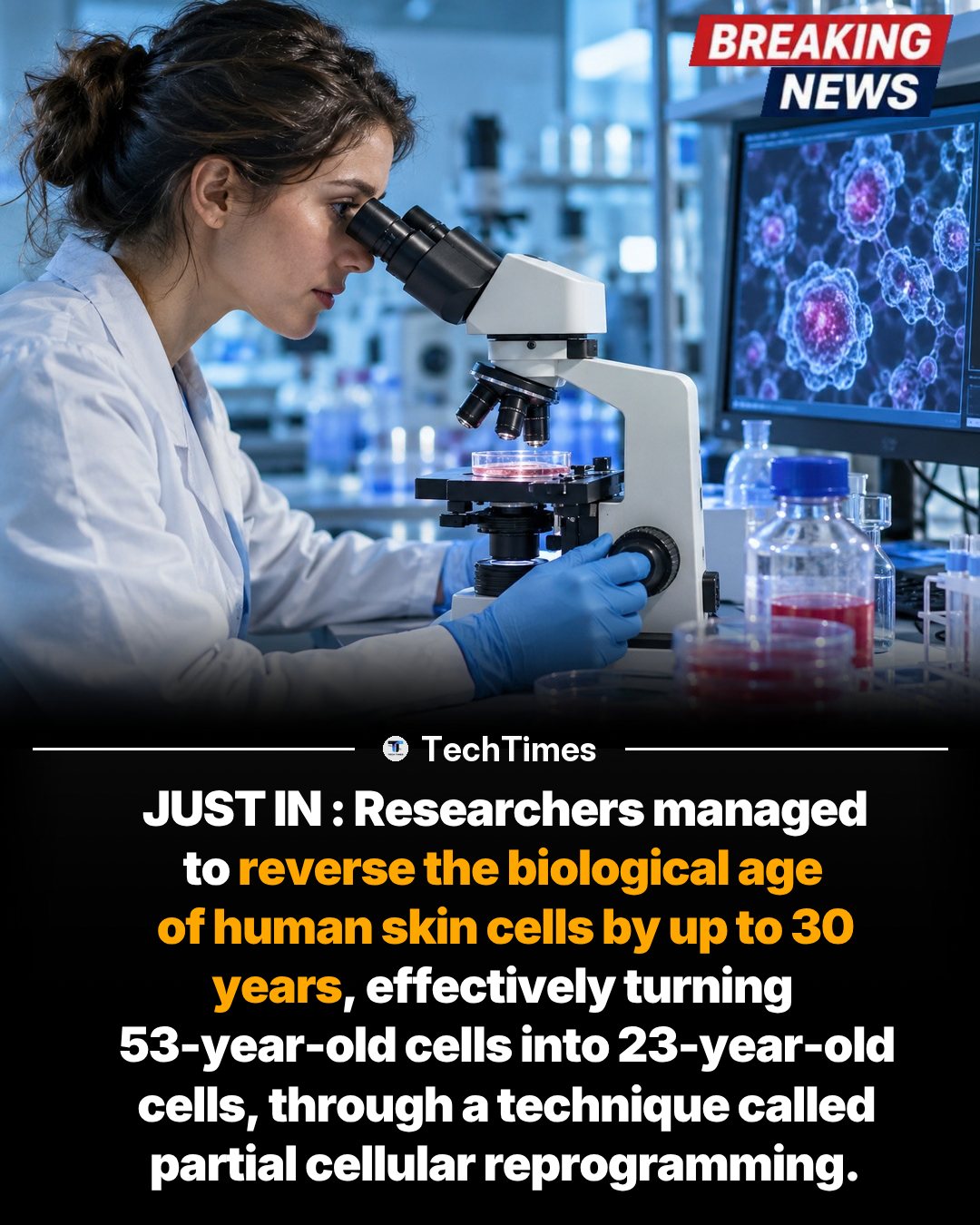
Researchers have reversed the biological age of human skin cells by up to 30 years. A technique called partial cellular reprogramming has turned 53-year-old cells into cells that appear to be 23 years old. The breakthrough — shown with a microscope and on-screen text — offers new hope for anti-aging therapies.
What is partial cellular reprogramming?
Partial cellular reprogramming is a technique used by researchers to reverse the aging process in cells. By using a cocktail of genes, scientists can push cells back to a more youthful state. The technique involves introducing specific genes into a cell. This cocktail of genes temporarily activates the same transcription factors that are active in embryonic stem cells. This mimics the normal development process that would occur in a young organism. Essentially, the cell is reset to a younger In this breakthrough, researchers managed to reverse the biological age of human skin cells by 30 years, effectively turning 53-year-old cells into 23-year-old cells. Why does skin matter? Because it is the body's largest organ. It is directly exposed to the environment, so changes in cells show up on it first.
Why now matters / the pace of aging
The ability to control the process of aging is a hot topic across medicine. Researchers have long sought ways to combat aging, a process inexorably tied to diseases like cancer and Alzheimer's. But aging itself has proven tricky to pin down. Until recently, the best anti-aging strategies involved lifestyle changes like exercise and diet. The development of partial cellular reprogramming offers a new frontier. The technique hints at potential anti-aging therapies to treat age-related diseases. This breakthrough suggests that changing aging might involve making cells change.
What happens to cells under partial cellular reprogramming
Altering skin's chronological clock
By reversing the cells' biological age, researchers have shown that partial cellular reprogramming can effectively turn back the clock on skin cells. The skin is our largest organ, and skin cells are easy to access, so this impact could be a game-changer.
The cocktail of genes involved
The technique involves introducing a cocktail of genes into cells. This cocktail includes transcription factors like Oct4, Sox2, Klf4, and c-Myc. These genes are known as the Yamanaka factors. They are crucial for inducing pluripotency in cells. This means that these genes can essentially reset a cell to a more youthful state. The cocktail of genes temporarily activates the same transcription factors that are active in embryonic stem cells. This is a normal development process that would occur in a young organism. Essentially, the cell is reset to a younger state.
Stemming from the roots of creature development
The reason these genetic triggers can mimic youth? In a developing embryo, pluripotent stem cells have the ability to differentiate into any type of cell in the body. These embryonic stem cells are pluripotent, meaning they have the potential to develop into any type of cell in the body. The genes involved in partial cellular reprogramming are the same transcription factors that give embryonic stem cells their pluripotency.
Disentangling biology — partially
NON-precisely the same as full reprogramming
Partial cellular reprogramming shouldn't be confused with full reprogramming, where cells are reverted to a stem cell-like state. This full reprogramming process can lead to cells that are similar to embryonic stem cells. They have the potential to act as pluripotent cells. Partial reprogramming is a gentler process. It only partially resets the cells and does not interfere as much with the existing cellular identity.
More than fuzzy wrinkles
The partial reprogramming cocktail can help keep skin healthy, "But if you just make skin live longer without changing its function, you end up with wrinkly, dead skin," as one source in the video puts it. Instead, partial cellular reprogramming extends to other organs besides the skin. It has the potential to restore the functions of aging tissues, including the potential to treat age-related diseases.
Hooking into the epigenome
This reversal of aging is not just about turning back the clock on cells. It also involves changes at the epigenetic level. Epigenetic changes are modifications to DNA that do not involve changes to the DNA sequence itself. The genes involved in partial cellular reprogramming can alter these epigenetic marks. This makes partial cellular reprogramming unique in its ability to reverse aging.
Your cells' future
If you just want to try things yourself? There's no simple, at-home solution yet. This is still a breakthrough from the lab only available to researchers. No specific products came up in the sources. But partial cellular reprogramming is a technique that holds promise for future anti-aging therapies. While it may not be available for consumers yet, the potential applications are vast. The ability to reverse the aging process at the cellular level could lead to new treatments for age-related diseases.
Watch the Reel
Questions readers ask
What exactly are the Yamanaka factors and why are they important in partial cellular reprogramming?
The Yamanaka factors are a set of genes including Oct4, Sox2, Klf4, and c-Myc. They are crucial because they can induce pluripotency in cells, essentially resetting them to a more youthful state. These factors are named after Shinya Yamanaka, the scientist who discovered them, and they play a key role in partial cellular reprogramming by activating the same transcription factors found in embryonic stem cells.
Can partial cellular reprogramming be applied to other organs besides the skin?
While the article focuses on skin cells, the underlying principle of partial cellular reprogramming could theoretically be applied to other cell types. However, the accessibility and ethical considerations of using different cell types vary significantly. For instance, skin cells are easy to access, making them a good starting point for research. Other organs might require more invasive procedures to harvest cells, and the ethical implications would need to be carefully considered.
How does partial cellular reprogramming differ from full cellular reprogramming?
Partial cellular reprogramming involves temporarily resetting cells to a younger state without fully converting them into pluripotent stem cells. In contrast, full cellular reprogramming would involve converting cells into pluripotent stem cells, which can then differentiate into any type of cell. Partial reprogramming aims to reverse aging without the risks associated with full reprogramming, such as potential cancer development. Researchers are exploring partial reprogramming as a safer and more controlled method for anti-aging therapies.
Is partial cellular reprogramming a permanent solution to aging?
No, partial cellular reprogramming is not a permanent solution to aging. The technique temporarily resets cells to a younger state, but the effects are not permanent. Researchers are still exploring how to maintain this youthful state over time. Additionally, the process involves introducing genes into cells, which could have unforeseen side effects. More research is needed to fully understand the long-term implications and to develop safe and effective anti-aging therapies based on this technique.
What are the potential risks and side effects of partial cellular reprogramming?
The potential risks and side effects of partial cellular reprogramming are not fully understood, but there are concerns. Introducing genes into cells could potentially lead to cancer or other diseases. Additionally, the long-term effects of resetting cells to a younger state are unknown. Researchers are carefully studying these aspects to ensure the safety and efficacy of the technique before it can be widely used in humans.
How soon could we see partial cellular reprogramming used in clinical settings?
The timeline for clinical application of partial cellular reprogramming is uncertain. Currently, the technique is still in the experimental stages, and researchers are working to understand its safety and long-term effects. Before it can be used in clinical settings, extensive testing and regulatory approvals will be required. It could take several years, if not decades, before this technique becomes available for widespread use in anti-aging therapies.
Recent articles
Fresh deep dives from the latest Reels we unpacked.




Comments
Be the first to comment.