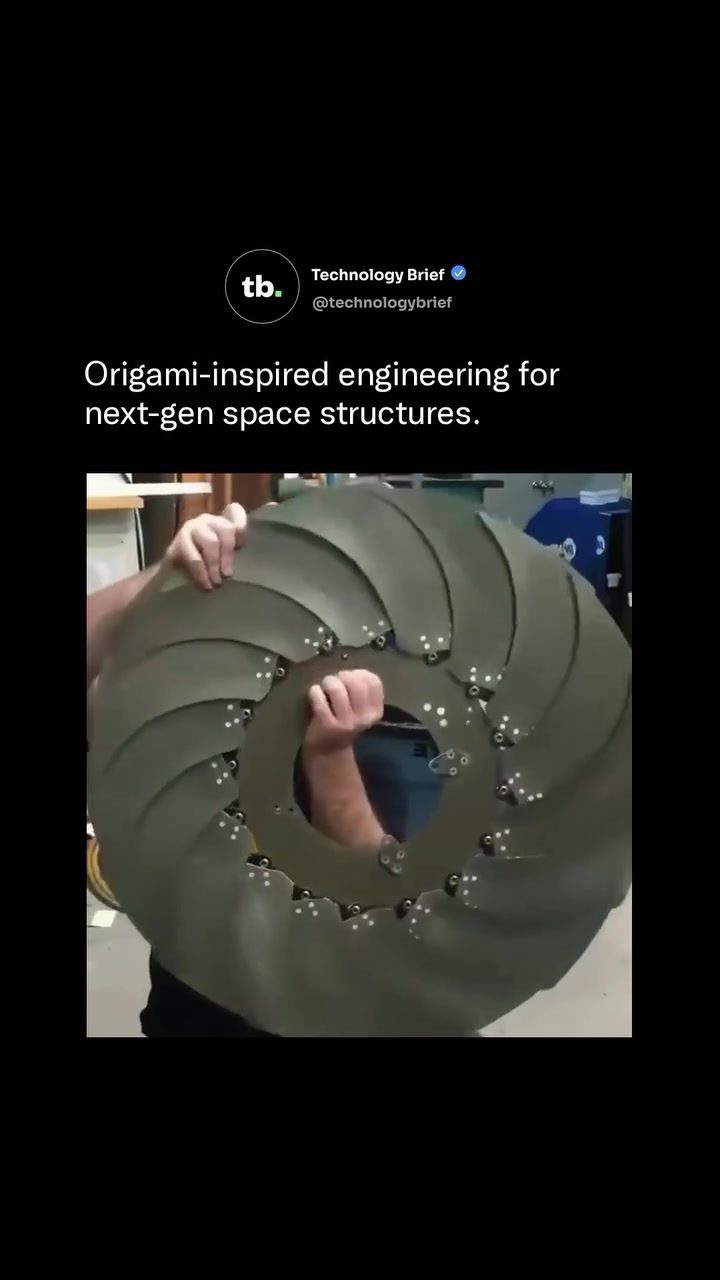
Origami-inspired space structures are revolutionizing how engineers approach the design and deployment of components for space exploration. This innovative approach, inspired by the ancient art of origami, involves folding and unfolding structures in a precise and controlled manner to create lightweight and deployable designs. These structures are pivotal for next-generation space missions, offering unique advantages over traditional engineering methods.
Why This Matters
The successful deployment of the James Webb Space Telescope (JWST)'s sunshield is a testament to the practical applications of origami-inspired engineering. The sunshield, a critical component of the JWST, measures approximately 21 by 14 meters when fully deployed, roughly the size of a tennis court. However, to fit inside the Ariane 5 rocket, it had to be folded using an origami-style mechanism. This intricate folding process allowed the sunshield to unfurl automatically 800,000 kilometers from Earth, a feat that required 140 membrane release mechanisms, 400 pulleys, and more than 400 meters of cable. The successful deployment of the sunshield on January 4, 2022, showcased the precision and reliability of origami-inspired engineering in space applications.
Main Discussion
The Origins of Origami-Inspired Engineering
Origami, the traditional Japanese art of paper folding, has found a unique application in modern engineering. The principles of origami, which involve folding a flat sheet of material into a three-dimensional shape, have been adapted to create complex and deployable structures for space exploration. These structures can be packed into a compact form for launching and then unfolded in space to perform their intended functions.
Lightweight and Deployable Designs
One of the primary advantages of origami-inspired engineering is the ability to create lightweight and deployable designs. Traditional engineering methods often result in bulky and heavy components that are challenging to launch into space. In contrast, origami-inspired structures can be folded into a compact form, reducing their size and weight significantly. This makes them ideal for space missions, where every gram and centimeter of space is crucial.
Mechanical Iris Designs
Mechanical iris designs are another area where origami-inspired engineering shines. These designs use the same spiral-folding geometry seen in the JWST's sunshield. Engineers on Earth verify these designs by creating large cardboard test structures, ensuring that the flat surfaces can open in a controlled sequence. This verification process is essential before the design ever goes to space, ensuring that the structures will function as intended in the harsh conditions of space.
Engineering Models
Engineering models play a crucial role in the development of origami-inspired space structures. These models demonstrate the potential for new possibilities in space exploration and construction. By showcasing various configurations, these models illustrate how origami-inspired designs can be folded and unfolded, highlighting the technology's versatility and adaptability.
Applications in Space Exploration
Origami-inspired engineering has numerous applications in space exploration. For example, the JWST's sunshield, which uses this technology, helps keep the telescope's instruments at a frigid minus 233 degrees Celsius. This extreme cold is necessary to detect infrared light from galaxies formed shortly after the Big Bang, making the sunshield a critical component of the mission. Additionally, origami-inspired designs can be used to create large, deployable structures, such as solar panels, antennas, and habitats, which are essential for future space missions.
Practical Tips
When designing origami-inspired space structures, several practical tips can enhance their effectiveness:
-
Precision Folding: Ensure that the folding process is precise and controlled. Any deviation in the folding process can compromise the structure's deployment in space.
-
Material Selection: Choose materials that are lightweight, durable, and can withstand the harsh conditions of space. Materials like thin metallic membranes and composite materials are commonly used.
-
Testing and Verification: Conduct extensive testing on Earth to verify that the folded structures can deploy correctly. This includes creating large-scale test structures and simulating the space environment.
-
Automation: Integrate automated systems for unfolding the structures. This ensures that the deployment process is reliable and can be executed remotely from Earth.
-
Redundancy: Incorporate redundancy mechanisms, such as additional release mechanisms and pulleys, to ensure that the structure can deploy successfully even if some components fail.
Important Takeaways
Origami-inspired engineering offers several important takeaways for space exploration:
- Lightweight and deployable designs are essential for space missions, where every gram and centimeter of space is crucial.
- The principles of origami can be adapted to create complex and reliable space structures.
- Comprehensive testing on Earth is necessary to ensure the successful deployment of these structures in space.
- Automated systems and redundancy mechanisms enhance the reliability of origami-inspired space structures.
- Origami-inspired engineering has the potential to transform various aspects of space exploration, from telescopes to habitats.
Conclusion
Origami-inspired space structures represent a groundbreaking advancement in engineering, offering lightweight, deployable, and reliable solutions for space exploration. From the JWST's sunshield to mechanical iris designs and large-scale deployable structures, this innovative approach is paving the way for new possibilities in space missions. By leveraging the principles of origami and conducting rigorous testing and verification, engineers can create space structures that are not only functional but also efficient and reliable. As space exploration continues to push the boundaries of what is possible, origami-inspired engineering will undoubtedly play a crucial role in shaping the future of human endeavors in space.
Watch the Reel
Related deep dives
Similar reads based on topic and creator.




Recent articles
Fresh deep dives from the latest Reels we unpacked.




Comments
Be the first to comment.