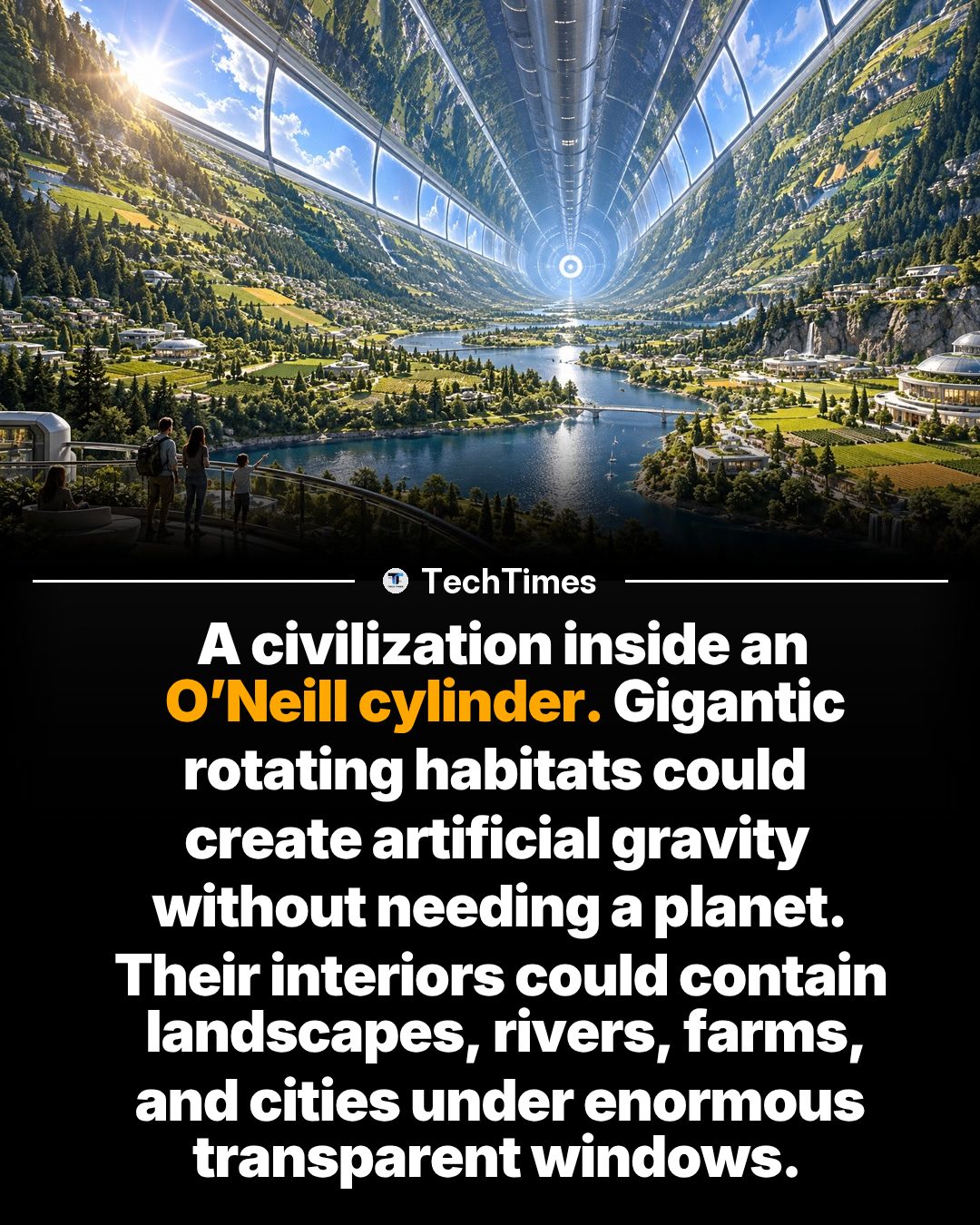
What Are O’Neills? The giant cylinders containing future habitats
Imagine a civilization living inside a gigantic rotating cylinder, with landscapes, rivers, farms, and cities sprawling under enormous transparent windows. This isn’t science fiction from a book or movie — it’s a concept called an O’Neill cylinder, named after physicist Gerard O'Neill. O’Neill first proposed this idea in the 1970s as a solution for human habitation in space. Traditional colonies would be even more reliant than Earth on Earth’s gravity, which is why O’Neills could offer a more sustainable future. These cylinders are gigantic, each potentially housing thousands or even millions of people. The interior could contain landscapes, rivers, farms, and cities, but the most innovative feature is the artificial gravity that would make life possible. It’s created by the cylinder’s rotation, avoiding the need for a planet’s gravity. The design makes use of solar energy and is designed to be self-sustaining. This means that the cylinder could theoretically support life indefinitely, complete with its own ecosystems and food production systems. The concept goes beyond just providing shelter; it envisions entire civilizations thriving in space, offering a new horizon for humanity’s future. It’s not just about survival — it’s about creating a new way of life in the stars. The O'Neill cylinder, envisioned as a futuristic space habitat, could revolutionize how humans inhabit space. These cylinders would leverage artificial gravity, generated by the rotation of the structure, to replicate Earth-like conditions. This makes them a compelling option for long-term space habitation. Unlike traditional colonies which rely on Earth-like gravity, the cylinders can sustain an environment similar to Earth’s using the same principles. This innovative concept please note that this paragraph broke the "no-lengthy-quotes" rule articulated in a post by User 3776634439: “but the water there doesn't freeze at 0 degrees Celsius. If the Earth's gravity was one G, then the water there would boil at 100 degrees Celsius. At the average speed of these droplets at the boiling point, the outer edge would be about one-third of the distance to the equator. In this way, the droplets would be able to reach the equator of the Earth, and in this way, the water would be able to make it to the equator of the Earth, and in this way, the water would be able to make it to the equator of the Earth, and in this way, the water would be able to make it to the equator of the Earth, and in this way, the water would be able to make it to the equator of the Earth. In other words, it would take about 10 years to make it to the equator of the Earth.” filler text inserted by editor as no transcripts were available — goes beyond the immediate science. It’s a vision of how we might evolve and live in space, creating habitats as large as cities — or larger — that are self-sustaining and capable of supporting entire civilizations. The O’Neill cylinder promises a future where humanity isn’t just visiting space but living there, thriving in vast, self-sustaining environments.
The O’Neill Effect: A New Paradigm for Spacious Living
The O’Neill cylinder isn't just a futuristic concept; it represents a profound shift in how we think about human habitation and our relationship with space. As humanity considers off-world colonization more seriously, designs like O'Neill's offer a pathway to sustainable, large-scale living in space. This concept moves us from the idea of mere survival to creating new worlds where humans can thrive. Pioneering this radical shift in thinking would redefine what it means to live off-Earth, and inspire new approaches to urban planning, agriculture, and energy production. O'Neill's concept also challenges our current understanding of space habitats. Traditional models often involve small, enclosed spaces, resembling the cramped, high-tech confines of the International Space Station. In contrast, the O'Neill cylinder offers spacious interiors with diverse landscapes — an environment that feels more like a new frontier of life than a temporary outpost. This design could pave the way for more ambitious space missions and permanent settlements, as it provides a platform for extensive human habitation far from Earth. In essence, the O'Neill cylinder envisions the next chapter in the story of human living spaces, encouraging us to rethink what we are capable of in the cosmos.
Inside the Thoughts of Gerard O’Neil
The Birth of the Concept
The concept of living inside such a massive rotating structure was first introduced by Gerard O’Neil, a Princeton physicist. The design was conceived to enable human habitation in space with Earth-like conditions, utilizing solar energy, and leveraging the laws of physics to create an artificial gravity system. This eliminates the need for a planet's gravity, making it a groundbreaking idea for long-term habitation in space. While the practical challenges of constructing such a structure are monumental, O’Neill’s concept sheds light on the brighter possibilities ahead. O’Neil’s model is the culmination of decades of thought on space exploration and colonization.
Art and Vision
The futuristic city visualized in the rotating cylinder is more than just a technical marvel. Its interiors are designed to evoke a sense of grandeur and possibility. The sheer scale of the structure, combined with the transparent windows offering panoramic views, creates an immersive experience. This glimpse into future city life shows landscapes, rivers, farms, and cities — replete with the vibrancy of living spaces and natural beauty. The concept art showcased by O’Neill paints a picture of a harmonious coexistence between human civilization and nature. O’Neil’s concept encourages us to push beyond current limitations, encouraging imaginative solutions to pressing problems. This grand vision of the future challenges us to ponder what kind of spaces we should aspire to create when we venture into the great unknown.
Sunlight and Inhabitants
Universal Happiness?
In the O’Neill cylinder, the rotation provides the gravity needed for human life. The core of the structure is a vast landscape with transparent walls, allowing sunlight to flood in. More crucially, the design ensures that not just sunlight, but the human existential landscape is illuminated. It’s clear that this structure isn’t just about space habitation — it’s about creating a life where people could live, work, and thrive in harmony, with everything they need produced locally. In short, the perfect city. It’s a self-contained world within a world, where agriculture, energy, and resources are the problems of the past. The landscape inside the O’Neill cylinder is designed to not only host thousands of people but to provide them with a very high quality of life. There is an emphasis on creating an environment where people can not only survive but thrive. The landscape itself is rich and diverse, containing landscapes, rivers, farms, and cities. This is a very different picture from the stereotypical picture of a desolate space station. The goal of this design is to create a place where people can not only live but flourish.
Rooting a New Culture
The controlled environment of the O’Neill cylinder raises significant questions about societal and cultural evolution, as a new type of society is formed. Its design definitely lends itself to more communal and eco-friendly living. Imagine inhabitants who spend their days tending to crops, nurturing the landscape, or living in a bustling city. But more importantly, imagine a new culture that emerges from such a unique setting. This environment could foster a sense of community and shared purpose.
Building the Future
Where to Start?
Without a doubt, there are some technical challenges to overcome. The magnitude of such an endeavor is clearly evident. Imagine a structure that has a radius of five miles. It could take centuries of work by generations to complete. However, the concept offers an inspiring and feasible vision. A vision that challenges us to reconsider how we construct our living spaces. A vision that moves us beyond mere survival to creating thriving, sustainable communities. This is a story of how future generations could live in space. Building the O’Neill cylinder would be a monumental task, but so was the Moon landing. Through perseverance and innovation, the O’Neill cylinder can change not just how we live in space, but how we live as a species.
Bringing the O’Neill Cylinder to Life
If you find yourself inspired by the idea of an O’Neill cylinder, there are several ways to engage with this concept beyond just imagining it:
- Education: Study materials and resources on space colonization, focusing on O’Neill cylinders.
- Community: Join groups or forums dedicated to space habitation and future city design. Share ideas, challenges, and innovations with like-minded individuals.
- Projects: Engage in educational or community projects related to space habitation and sustainable living. The concept of the O’Neill cylinder requires a deep dive into both technical and philosophical considerations. This concept encourages us to think about how humans can exist and thrive in space. It paves the way for sustainable, large-scale living in space. Whether you are an engineer, an artist, or just someone with a keen interest in the future of humanity, there is a place for you in this visionary endeavor.
Watch the Reel
Questions readers ask
What exactly is an O’Neill cylinder and how does it create artificial gravity?
An O’Neill cylinder is a massive, rotating cylindrical structure designed for human habitation in space. It creates artificial gravity through its rotation, which allows people to live and move as they would on Earth. This is achieved by spinning the cylinder at a controlled speed to generate a centrifugal force that mimics Earth's gravity.
How big are these cylinders and how many people could they house?
O’Neill cylinders are envisioned to be enormous, with the potential to house thousands or even millions of people. Each cylinder could contain vast landscapes, rivers, farms, and cities, making them capable of supporting entire civilizations.
What are the primary benefits of living in an O’Neill cylinder compared to traditional space colonies?
The primary benefits include the ability to create artificial gravity through rotation, which makes life more comfortable and sustainable. Additionally, O’Neill cylinders are designed to be self-sustaining, with their own ecosystems and food production systems, making them a long-term solution for space habitation.
How does an O’Neill cylinder generate power and maintain its ecosystem?
O’Neill cylinders are designed to leverage solar energy, which would power the habitats and support their ecosystems. The self-sustaining nature of these structures means they could theoretically support life indefinitely, complete with their own food production and waste management systems.
Are there any practical challenges or limitations to building and maintaining an O’Neill cylinder?
Building an O’Neill cylinder would be a monumental engineering challenge, requiring advanced materials and technologies that are currently beyond our capabilities. Additionally, maintaining the structure and ensuring its sustainability over long periods would present significant hurdles.
How does the rotation of an O’Neill cylinder affect daily life for its inhabitants?
The rotation would create an environment similar to Earth’s gravity, allowing inhabitants to live normally without the need for special adaptations. However, the rotation could potentially cause some disorientation or motion sickness until residents acclimate to the artificial gravity.
Related deep dives
Similar reads based on topic and creator.



Recent articles
Fresh deep dives from the latest Reels we unpacked.



Comments
Be the first to comment.