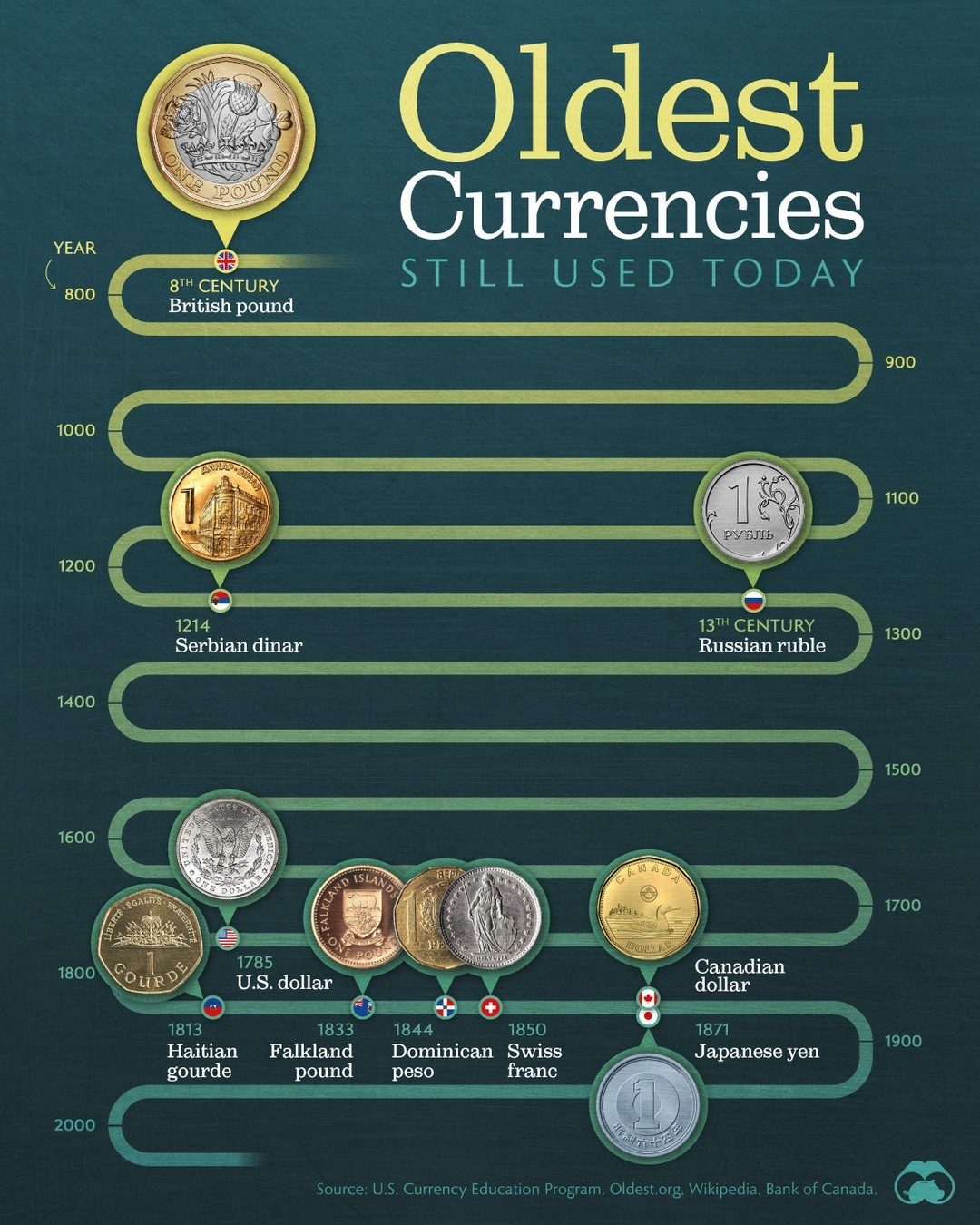
Oldest Currencies in Circulation
Certain currencies have maintained a steadfast presence in the global economy, tracing their origins back to centuries past. These currencies, although evolving over time, have stood the test of centuries, maintaining a direct link to their ancient origins. Here, we explore the oldest currencies still in circulation, highlighting their historical significance and enduring relevance in the modern financial landscape.
Why This Matters
Understanding the oldest currencies provides insight into the evolution of global economies. These currencies have adapted to numerous political, social, and economic changes, offering a unique perspective on the history of money and finance. Whether you're a finance enthusiast or a history buff, exploring these currencies can deepen your appreciation for the enduring legacy of certain economic systems.
The 10 Oldest Currencies
British Pound Sterling
The British pound sterling, with its origins dating back to around 775, is the oldest currency still in use today. Despite significant changes over the centuries, it has maintained its status as a major global currency, influencing financial markets worldwide. The pound was initially based on the value of silver, reflecting the economic power of the British Empire.
Serbian Dinar
The Serbian dinar, introduced in 1214, is another ancient currency that continues to be used. Originating as a silver coin, the dinar has undergone various changes, reflecting the political and economic transformations of Serbia over the centuries. Today, it remains the official currency of Serbia, symbolizing the country's economic heritage.
Russian Ruble
The Russian ruble, established in the 13th century, is one of the oldest currencies in continuous use. Initially minted in the form of silver and gold coins, the ruble has seen numerous reforms and restructurings. It has served as a financial backbone for Russia, adapting to the country's economic shifts and political changes.
U.S. Dollar
The U.S. dollar, introduced in 1785, is a cornerstone of the global financial system. Originating as a coinage act during the early years of the United States, the dollar has evolved into a universally accepted currency. Its stability and widespread use make it a key player in international trade and finance.
Falkland Peso
The Falkland peso, created in 1844, serves as the official currency of the Falkland Islands. Despite its relatively smaller scale, the Falkland peso has a rich history, reflecting the unique economic and political landscape of the islands. The peso's introduction marked a significant step in the islands' economic development.
Canadian Franc
The Canadian franc, which emerged in 1850, has a storied history intertwined with Canada's economic development. Initially used in Quebec, the franc played a crucial role in establishing a monetary system that would later be unified under the Canadian dollar. Today, it serves as a historical artifact, reminding us of the complex economic ties within Canada.
Haitian Gourde
The Haitian gourde, introduced in 1813, is the official currency of Haiti. Derived from the French word for a silver coin, the gourde has a tumultuous history, reflecting Haiti's political and economic challenges. Despite these difficulties, the Haitian gourde has endured, symbolizing the resilience of the Haitian people.
Falkland Pound
The Falkland pound, established in 1833, is another currency with a unique history. It serves as the official currency of the Falkland Islands and has played a significant role in the islands' economic development. The pound has adapted to the needs of the island community, reflecting its enduring importance in the region.
Japanese Yen
The Japanese yen, introduced in 1871, is a key component of the global financial system. Originally established during the Meiji Restoration, the yen has undergone significant reforms, reflecting Japan's economic growth and modernisation. Today, it stands as a symbol of Japan's economic strength and stability.
Canadian Dollar
The Canadian dollar, also introduced in 1871, is the official currency of Canada. It has undergone several changes, reflecting Canada's economic development and its place in the global market. The Canadian dollar is a pivotal currency, used extensively in international trade and finance.
Practical Tips
If you're interested in learning more about these currencies, consider the following tips:
Historical Research
Delve into the historical context of each currency. Understanding the political, social, and economic circumstances under which these currencies were established can provide a deeper appreciation for their enduring relevance.
Comparative Analysis
Compare these currencies to more modern ones. Highlight the differences and similarities in their evolution, economic influences, and adaptation to global changes. This comparison can offer valuable insights into the dynamics of currency and finance.
Economic Impact
Explore the economic impact of these currencies. Look into how they have influenced local and global economies, affecting trade, investment, and development. This analysis can provide a comprehensive view of their significance.
Important Takeaways
The oldest currencies still in use today offer a fascinating glimpse into the history of money and finance. Their enduring presence reflects the stability and adaptability of these economic systems, which have navigated centuries of change. Whether you're a finance professional or a history enthusiast, understanding these currencies can enrich your knowledge and provide valuable insights into the world of finance.
Understanding these currencies also underscores the importance of financial history. By studying the origins and evolution of these currencies, one can gain a deeper appreciation for the complexities and intricacies of modern financial systems. The resilience and adaptability of these currencies serve as a testament to the enduring relevance of these economic systems in the global economy.
Conclusion
The oldest currencies still in use today, such as the British pound, Serbian dinar, and U.S. dollar, have a rich history and a profound impact on the global economy. Their enduring presence is a testament to their adaptability and resilience, reflecting centuries of economic and political transformations. By exploring these currencies, we gain a deeper understanding of the evolution of money and finance, and the enduring legacy of these economic systems.
Watch the Reel
Questions readers ask
What is the oldest currency still in use today?
The British Pound Sterling is considered one of the oldest currencies still in use. Its history can be traced back to the 8th century when Anglo-Saxon King Offa of Mercia introduced the silver penny. The Pound Sterling has evolved significantly since then, but it remains a key player in the global economy and the fourth most traded currency in the world.
What is the history of the Serbian Dinar?
The Serbian Dinar has a complex history, with its origins dating back to the 13th century. The currency has seen numerous changes and interruptions, including periods of foreign rule and economic turmoil. The most recent version, the Serbian Dinar, was introduced in 1994 and has since been stable, reflecting the country's economic recovery and growth.
How has the Russian Ruble adapted over time?
The Russian Ruble has undergone several transformations since its introduction in the 13th century. It has adapted to various political regimes and economic systems, from the Russian Empire to the Soviet Union and now the Russian Federation. The modern Ruble, introduced in 1998, is a result of economic reforms aimed at stabilizing the currency and promoting growth. Today, it is a significant currency in global trade and finance.
What can we learn from the oldest currencies still in circulation?
The oldest currencies still in circulation, such as the British Pound Sterling, Serbian Dinar, and Russian Ruble, offer valuable insights into the evolution of global economies. By studying these currencies, we can understand how money and finance have adapted to political, social, and economic changes over centuries. This perspective can help us appreciate the resilience and adaptability of currencies and the systems that support them.
What is the oldest currency in the world?
Determining the oldest currency in the world can be complex due to the various forms of money that have existed throughout history. However, the British Pound Sterling is often highlighted for its long-standing use, with roots tracing back to the 8th century. Other contenders include the Serbian Dinar, with origins in the 13th century, and the Russian Ruble, which also has a long history dating back to the same period.
Why is the British Pound Sterling significant in global finance?
The British Pound Sterling's significance in global finance is attributed to its long history and its role in the development of modern financial systems. As one of the oldest currencies still in use, it has influenced the creation of other currencies and financial instruments. Today, it remains a major reserve currency and is widely used in international transactions, contributing to its enduring relevance in the global economy.
What is the currency of the Falkland Islands and what is its history?
The currency of the Falkland Islands is the Falkland Islands Pound, which has been in use since 1899. It is pegged to the British Pound Sterling, reflecting the islands' political and economic ties to the United Kingdom. The currency has a unique history, having been influenced by the islands' strategic location and diverse cultural heritage. Today, it is an important part of the local economy and a symbol of the islands' identity.
Related deep dives
Similar reads based on topic and creator.


Recent articles
Fresh deep dives from the latest Reels we unpacked.




Comments
Be the first to comment.