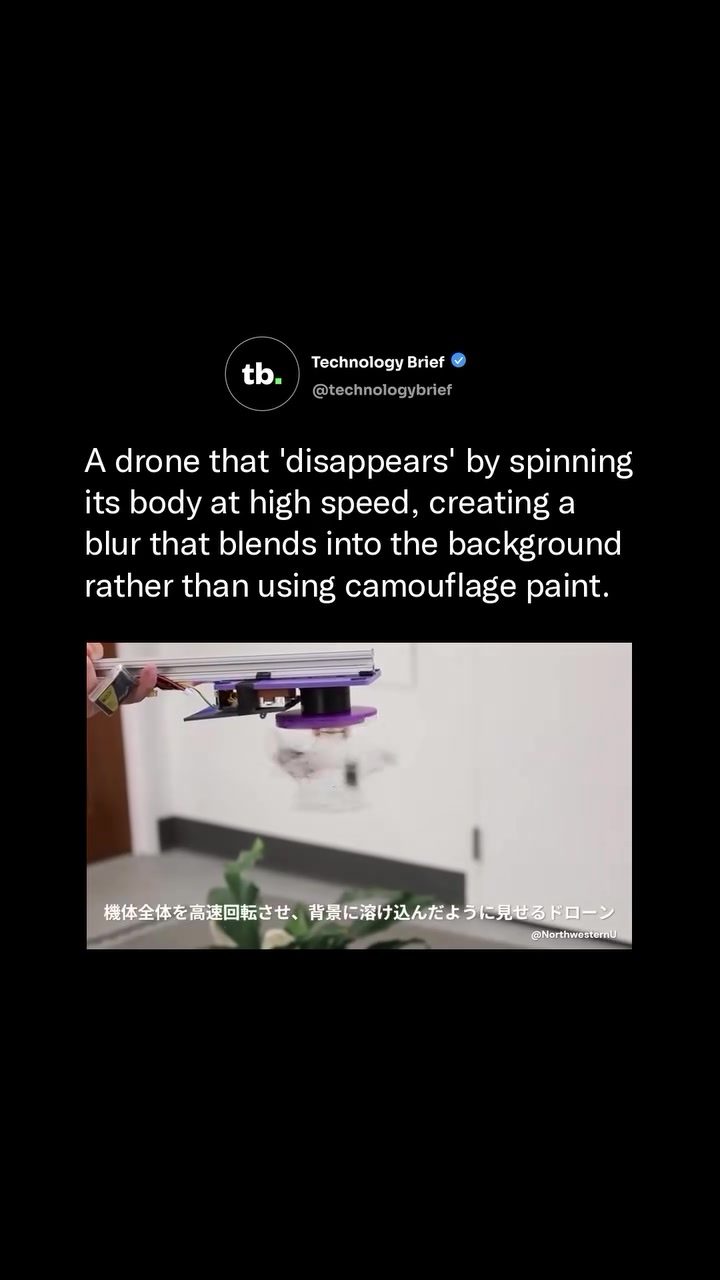
Spinning Drone Camouflage
Phantom Twist, a revolutionary drone developed by Northwestern University engineers, is designed to almost disappear in mid-air. Unlike traditional drones that rely on camouflage paint or special coatings, Phantom Twist achieves its stealthy effect by spinning its entire body at an incredibly high speed.
Context / Why this matters
Standard drones can be easily spotted due to their visible rotors and body structures. Phantom Twist circumvents this issue by spinning its entire body, creating a blur that makes it nearly invisible against various backgrounds. The quadcopter design follows the spinning body concept in the opposite direction with a single motor and propeller. This design reduces visibility making it less noticeable than the conventional quadcopter of the same size. This technique has significant implications for applications where discretion is crucial, such as wildlife monitoring, environmental surveys, and infrastructure inspections.
Main discussion
The Science Behind Phantom Twist
The drone achieves its invisibility trick through a unique propulsion system. The single motor and propeller rotate in one direction while the rest of the drone spins in the opposite direction, creating a blur effect. This spinning motion, reaching up to 25 rotations per second, allows the drone to avoid the human eye's ability to resolve a clear shape. The result is a faint, semi-transparent smudge that blends into the background.
Optimal Design through AI and Optimization
The engineers at Northwestern University utilized advanced AI and optimization algorithms to refine the drone's design. They evaluated approximately 20,000 different component arrangements, scoring each design using the LPIPS perceptual metric. This metric measures visibility based on how human vision perceives it, ensuring that the final design is highly effective in reducing the drone's visibility.
Propulsion and Structural Design
The Phantom Twist's unique design involves a single motor and propeller, with the propeller spinning in one direction and the rest of the drone rotating in the opposite direction. This configuration creates a blur effect that makes the drone nearly invisible. The design optimizes visibility and reduces the drone's visual impact, making it about 10 times less noticeable than a conventional quadcopter of the same size. However, the propeller still produces audible noise, and some wiring and support rods remain partially visible at close range.
Future Enhancements
While the current design has limitations, the research team at Northwestern University is already planning future improvements. These enhancements include using quieter propulsion systems and more transparent structural materials. These advancements will further reduce the drone's visibility and noise, making it even more effective for stealthy operations.
Practical tips
If you're considering using a similar technology for your applications, here are some practical tips to keep in mind:
-
Understand the Use Case: Determine the specific requirements of your application. For example, wildlife monitoring or environmental surveys may benefit significantly from a less visible drone.
-
Evaluate Propulsion Systems: Consider the noise levels and visibility of the drone's propulsion system. Quieter and more transparent systems will enhance the drone's stealth capabilities.
-
Optimize Design: Use advanced AI and optimization algorithms to evaluate different component arrangements. This will help you achieve the best possible design for your specific needs.
-
Test in Various Environments: Conduct tests in different environments to ensure the drone's effectiveness. The background and lighting conditions can significantly impact the drone's visibility.
Important takeaways
The Phantom Twist drone represents a groundbreaking advancement in drone technology. Its unique spinning mechanism and optimized design make it nearly invisible, addressing critical issues in wildlife monitoring, environmental surveys, and infrastructure inspections. Future enhancements, such as quieter propulsion and more transparent materials, will further improve its effectiveness. By leveraging AI and optimization algorithms, engineers can continue to refine and improve drone technology, opening up new possibilities for stealthy and efficient operations.
Conclusion
The Phantom Twist drone from Northwestern University showcases a pioneering approach to drone camouflage, bypassing the need for traditional paint or coatings. By spinning its entire body at high speeds, it achieves a visually noticeable effect, making it a game-changer for applications requiring discretion. Future iterations promise even greater advancements, ensuring that such technology remains at the forefront of innovation.
Watch the Reel
Questions readers ask
How does the Phantom Twist drone achieve its invisibility?
The Phantom Twist drone uses a unique spinning mechanism. By rotating its entire body at high speeds, the drone creates a visual blur that allows it to blend seamlessly with its surroundings, making it nearly invisible.
What are the practical applications of the Phantom Twist drone?
The Phantom Twist drone's stealth capabilities make it ideal for tasks that require discretion. These include wildlife monitoring, where the presence of the drone should not disturb or alert animals, and infrastructure inspections, where the drone can assess structures without drawing attention.
How does the Phantom Twist drone differ from traditional drones?
Unlike traditional drones that rely on camouflage paint or special coatings and have visible rotors and body structures, the Phantom Twist drone spins its entire body to create a visual blur. This makes it less conspicuous and harder to spot, even in complex visual environments.
What advantages does the spinning mechanism provide in drone design?
The spinning mechanism in the Phantom Twist drone reduces the visibility of the drone's body and rotors, making it less noticeable. This design is particularly useful for applications where stealth is crucial, as it allows the drone to operate more discreetly.
Can the Phantom Twist drone be used for photography or videography?
While the Phantom Twist drone is primarily designed for tasks that require stealth and discretion, it could potentially be used for photography or videography in situations where the presence of a drone needs to be minimized. However, the spinning mechanism might affect the stability of the camera, so further development would be needed to optimize its use for such purposes.
What challenges might the spinning mechanism of the Phantom Twist drone present?
The spinning mechanism, while effective for invisibility, could pose challenges such as increased power consumption and potential issues with stability and control. Engineers would need to address these factors to ensure the drone's optimal performance in real-world applications.
How might the Phantom Twist drone be used in environmental conservation efforts?
The Phantom Twist drone's ability to blend into its surroundings makes it a valuable tool for environmental conservation. It can be used for monitoring wildlife populations, tracking environmental changes, and conducting surveys in sensitive ecological areas without disturbing the natural habitat or the species being studied.
Related deep dives
Similar reads based on topic and creator.




Recent articles
Fresh deep dives from the latest Reels we unpacked.




Comments
Be the first to comment.