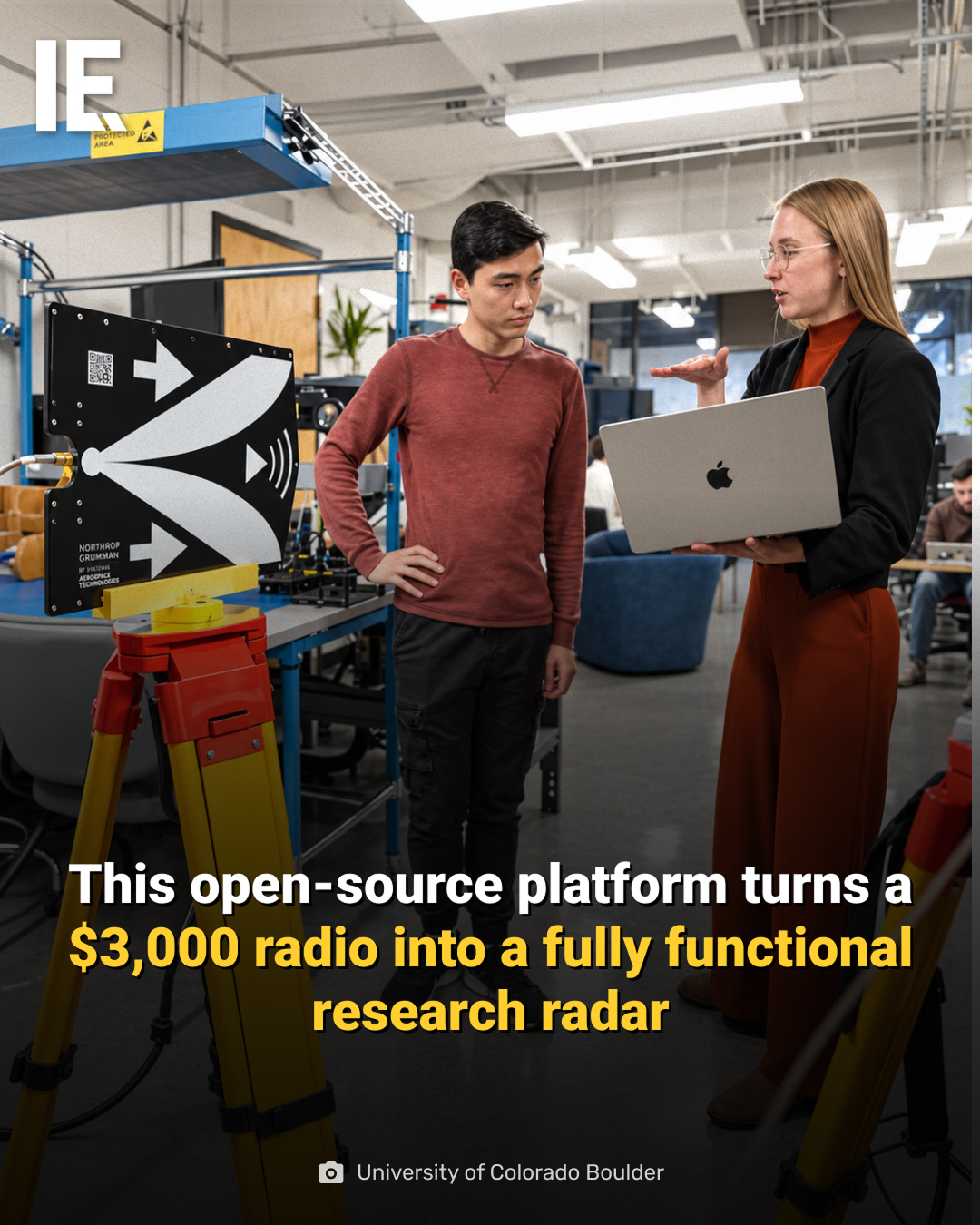
The University of Colorado Boulder is using a $3000 radio to detect small objects up to 100 meters away Northrop Grumman was involved in developing an open-source technology that allows a standard $3,000 radio to function as a high-performance, cutting-edge research radar. The project itself is part of a broader effort to provide affordable and accessible radar capabilities that meet the needs of educational institutions as well as industry professionals and researchers. Northrop Grumman is a major aerospace and defense technology company, known for its expertise in aviation, space, defense, and cybersecurity solutions. Their involvement in this project highlights the company's commitment to innovation and its ability to develop cutting-edge technologies. The project leverages Northrop Grumman's decades of experience in radar technology, as well as their commitment to fostering innovation in the aerospace and defense industries.
The Nuts and Bolts of A Radar-Capable Radio
Northrop Grumman's platform turns a $3000 radio into a powerful research radar by programming it to detect objects in its vicinity. The technology works by sending out radio waves, which bounce off objects and return to the radar as echoes. These echoes are then analyzed to determine the object's size, shape, and distance from the radar. The device essentially transforms a standard radio signal from a $3,000 radio into a high-performance radar system. Thanks to the code written for this technology, this transformed radio can detect objects up to 100 meters away, with a high degree of accuracy and precision. The University of Colorado Boulder is one of the first educational institutions to demonstrate this technology in a real-world setting. By leveraging this platform, they aim to provide students with practical, hands-on experience in radar technology, as well as the opportunity to conduct cutting-edge research. The platform is also an excellent opportunity for students to learn about the applications of radar technology in various fields, such as aerospace, defense, and environmental monitoring. One key advantage of this open-source platform is that it enables users to customize the radar system to meet their specific needs. This flexibility means that researchers and educators can tailor the system to suit their unique requirements, whether it's for detecting small objects, monitoring environmental changes, or studying atmospheric conditions. The platform also provides a cost-effective solution for educational institutions and researchers who may not have access to expensive radar systems. However, the platform still must be considered in the early stages of development, with a cost of $3000 still forming a barrier that will likely exclude some of these institutions and researchers. The open-source nature of the platform may also present challenges for users who lack the necessary technical expertise to implement and customize the system. Fortunately, the tech can be improved over time, and it is worth noting that development and innovation in this field are ongoing. Check out the below sections to learn more.
The Making of an Innovative Open-Source Radar
Measuring Up
The converted radio can detect objects up to 100 meters away with a high degree of accuracy. This capability is significant because it allows researchers and educators to study objects and phenomena in great detail, making the converted radar an ideal for many uses. The platform's open-source nature allows users to customize it further, potentially increasing its range and accuracy.
Simplicity in Innovation
Northrop Grumman's open-sourcing of the radar system is a significant shift from traditional radar technology. The open-source platform provides a cost-effective and flexible solution for educational institutions and researchers. By making the technology openly available, Northrop Grumman is democratizing radar technology, enabling a wider range of users to access and benefit from its capabilities. The platform's open-source nature allows users to modify and customize the system to meet their specific needs. This flexibility means that researchers and educators can tailor the platform to suit their unique requirements. They can adjust the system's parameters, such as the radio's frequency, range, and sensitivity, to optimize its performance for their specific use case. This customization can be done using the programming languages within the platform's codebase. The platform's open-source nature also fosters a collaborative and innovative community. By allowing users to share their modifications and improvements with the wider community, the platform encourages a culture of innovation and collaboration. This collaborative environment can lead to rapid advancements in radar technology, as users build on each other's work to develop new and improved capabilities.
Latest in Radar Technology
The technology built by Northrop Grumman builds on the history of radar technology. In 1942, Joseph Henry Taylor and Leo Spitzer invented the crystal video radar, which could view all-in-one signals (in the highest power received) in real time. In 1948, the British Royal Navy used the first continuous search radar to detect enemy aircraft. In 2023, Northrop Grumman developed the most advanced version of this technology. The importance of the platform lies in its impact on the field of radar technology. By providing a cost-effective and flexible solution for educational institutions and researchers, the platform can accelerate the development of new radar technologies. It enables users to experiment with different radar configurations and techniques, leading to breakthroughs in radar performance and functionality.
Using Open-source Radio Platforms in Daily Practice
- Educational Institutions: Universities and colleges can use this open-source platform to provide students with practical, hands-on experience in radar technology. This can help students develop the skills and knowledge necessary to succeed in the field of radar technology.
- Instrumentation: Students can use this open-source platform to learn about the various components of a radar system, including the transmitter, receiver, and antenna.
- Signal Processing: Students can use this open-source platform to learn about signal processing techniques, such as filtering, amplification, and modulation.
- Data Analysis: Students can use this open-source platform to learn about data analysis techniques, such as Fourier transforms, spectral analysis, and statistical analysis.
- Customization: Students can use this open-source platform to customize the radar system to meet their specific needs, such as adjusting the frequency, range, and sensitivity of the radio.
- Research Institutions: Researchers can use this open-source platform to conduct cutting-edge research in radar technology. This can include developing new radar techniques, testing new radar hardware and software, and exploring new applications for radar technology.
- Experimental Research: Researchers can use the open-source platform to conduct experimental research, testing new radar configurations and techniques.
- Customization: Researchers can use the open-source platform to customize the radar system to meet their specific research needs, such as adjusting the frequency, range, and sensitivity of the radio.
- Collaboration: Researchers can use the open-source platform to collaborate with other researchers, sharing their modifications and improvements with the wider community.
The Future of Radar
With open-source platforms like the one developed by Northrop Grumman, educators and researchers gain access to advanced radar technology that was once out of reach due to cost and complexity. The ongoing development of this technology holds significant promise for the future. As more users adopt and contribute to the platform, it will likely evolve, becoming more sophisticated and versatile. The platform's success could pave the way for similar initiatives, further democratizing access to cutting-edge technology. The accessibility and flexibility of this platform, combined with the collaborative spirit of open-source development, position it as a vital tool for advancing radar technology and its applications.
Watch the Reel
Questions readers ask
What exactly is Northrop Grumman's open-source radio platform?
Northrop Grumman's open-source radio platform is a technology that transforms a standard $3,000 radio into a high-performance radar system. It allows users to detect objects up to 100 meters away by sending out radio waves and analyzing the echoes that bounce back. This technology is designed to be accessible and customizable, making it suitable for both educational and research purposes.
How does Northrop Grumman's open-source radio platform work?
The platform works by programming a standard radio, like the $3,000 one used by the University of Colorado Boulder, to send out radio waves that bounce off objects and return as echoes. These echoes are then analyzed to determine the size, shape, and distance of the detected objects. It's a clever way to turn an everyday radio into a powerful research tool.
Why is the University of Colorado Boulder using this technology?
The University of Colorado Boulder is using Northrop Grumman's open-source radio platform to provide students with hands-on experience in radar technology and to conduct cutting-edge research. The platform allows them to detect small objects up to 100 meters away and offers a cost-effective solution for educational institutions that might not have access to expensive radar systems.
Can I use this technology for my own projects or research?
Yes, the platform is open-source, which means you can customize it to meet your specific needs. However, it does require some technical expertise to implement and customize. If you're comfortable with that, you can use it for a variety of applications, from detecting small objects to monitoring environmental changes.
Is the $3,000 price tag a barrier for many users or institutions?
Yes, the $3,000 cost can be a barrier for some educational institutions and researchers, especially those with limited budgets. While the platform is more affordable than many high-end radar systems, it's not cheap. Plus, since the platform is still in the early stages of development, there may be additional costs associated with customization and implementation.
What kind of support is available for users who aren't tech-savvy?
The open-source nature of the platform means that there might be a learning curve, especially for those who lack technical expertise. While Northrop Grumman's involvement suggests a level of sophistication and support, it's not clear how much assistance is available for beginners. Users may need to rely on community forums or their own technical skills to get the most out of the platform.
What are the long-term prospects for this technology?
The platform is still in the early stages of development, so there's plenty of room for improvement. As the technology evolves, it could become more accessible and affordable, making it a valuable tool for a wider range of users. Additionally, ongoing development and innovation in this field suggest that the platform could become even more powerful and versatile over time.
Related deep dives
Similar reads based on topic and creator.

Recent articles
Fresh deep dives from the latest Reels we unpacked.
Comments
Be the first to comment.