World of the slope
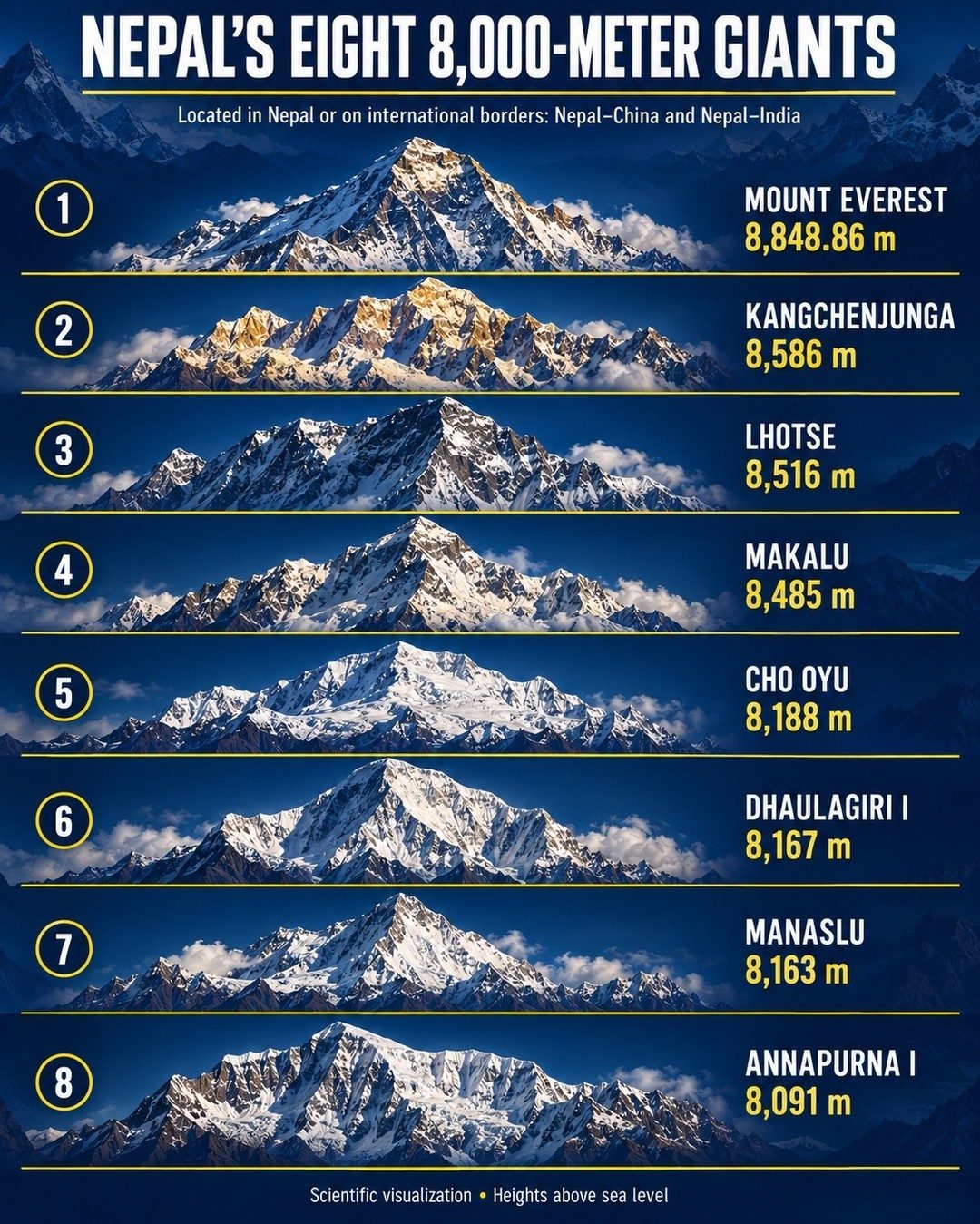
Nepal holds eight of the fourteen mountains that exceed 8,000 meters in height, a staggering feat of nature that has long captivated mountaineers and scientists alike. These peaks, each a study in extremes, boast starkly different faces than the weatherworn ranges of Europe or Scandinavia. At least two of the peaks lie on Nepal's borders. Fangchenjunga, the third tallest peak in the world at 8,586 meters, is located along the Nepal-India border. Makalu, the fifth highest 8,000-meter peak, and other peaks sit along the Nepal-China border Mountains are not just landmarks. They are laboratories of the earth's physical processes. These 8,000 meters above sea level become a unique natural environment where the oxygen in the air is thinner and organisms need to adapt. Freezing temperatures. Powerful winds. Cortical terrain. Avalanches. Dangerously low oxygen levels — these mountains are not just high; they are harsh.
The giants
Mount Everest is the tallest peak. It has been in the limbs of climbers since the 1950s, and it still pushes climbers. The other peaks harbor their own challenges and stories. The mountainous terrain of Nepal, on the borders between Nepal and China or Nepal and India, includes: Mount Everest, which stands at 8,848.86 meters. Kangchenjunga, at 8,586 meters, Lhotse, 8,516 meters, Makulu, 8,485 meters. Cho Oyu, at 8,188 meters, Dhaulagiri, at 8,167 meters, Manaslu, 8,163 meters, and Annapurna I, at 8,091 meters. Each mountain's elevation is measured above sea level. These giants are more than static giants. They interact with the atmosphere, the tectonic plates, and the glaciers at their feet. The peaks are also part of Nepal's cultural heritage. Their names, the legends that surround them. And the mountaineers' stories are as much part of Nepal as the physical mountains themselves.
A scientific visualisation
Nepal's eight 8,000-meter peaks is not just a list of hills. The 8,000-meter peaks are part of the Himalayas, which formed when two tectonic plates collided and pushed up the rock to form mountains, some of which now exceed 8,000 meters in elevation, creating Nepal's defining topography. Their formation is the result of millenia of geological activity. But more than that, they are someone's science project. They are someone's way to grasp the world. Nepal's eight 8,000-meter peaks is a scientific visualization. The elevations are measured above sea level, but these peaks are also measures of readiness to tackle the world and adapt to its challenges. They are measures of what has been achieved in the past, and what could be achieved in the future. They ask that we put on our thinking caps and ask what else is out there.
Watch the Reel
Related deep dives
Similar reads based on topic and creator.

Recent articles
Fresh deep dives from the latest Reels we unpacked.



Comments
Be the first to comment.