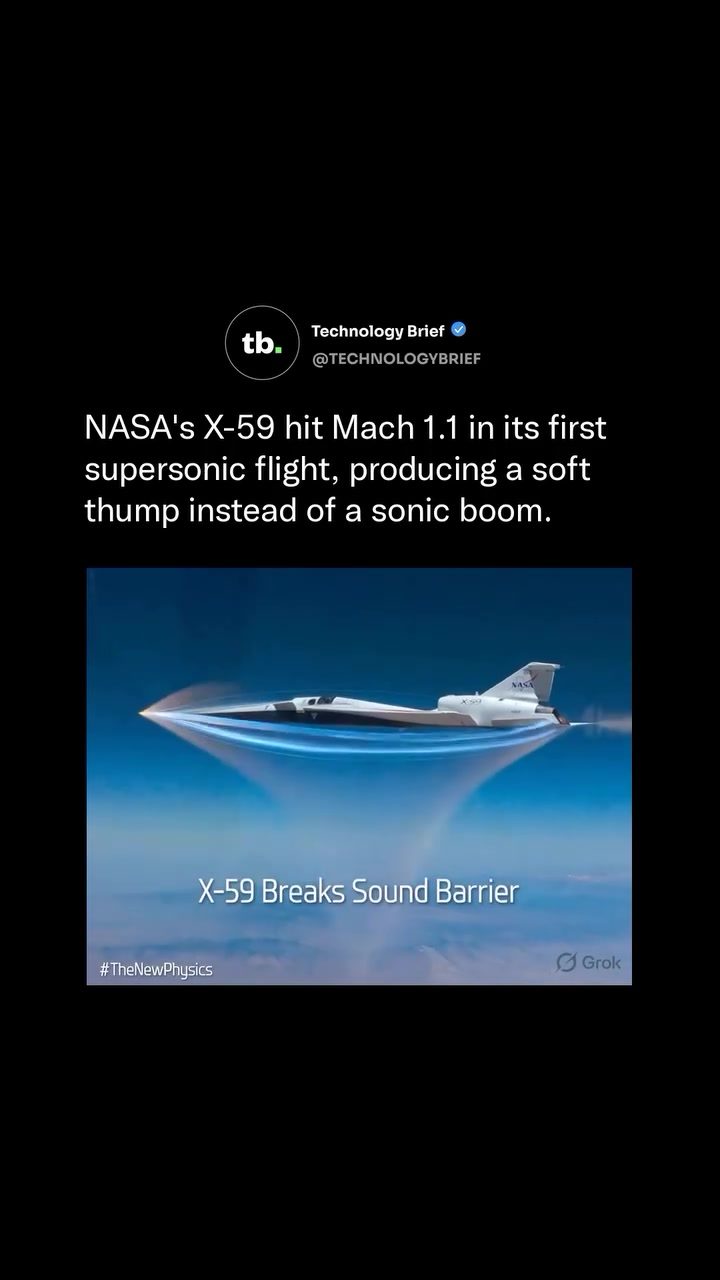
NASA’s X-59: Breaking the Sound Barrier Quietly
NASA's X-59, developed by Lockheed Martin’s Skunk Works division, achieved a significant milestone on June 5, 2026, when it broke the sound barrier for the first time. This aircraft, which made its maiden flight on October 28, 2025, reached a speed of Mach 1.1—approximately 713 mph—during an 81-minute test flight from Edwards Air Force Base in California. This accomplishment is part of NASA’s Quesst mission, which aims to revolutionize supersonic flight by making it quieter and more practical for overland travel.
Why Quiet Supersonic Flight Matters
Supersonic flight has long been a dream for aviation enthusiasts and travelers alike, but the sonic boom associated with it has been a significant barrier. The sharp, window-rattling noise generated by aircraft breaking the sound barrier has led to a ban on overland supersonic flights in the U.S. since 1973. The X-59, however, is designed to produce a much softer thump, potentially paving the way for a return to supersonic travel over populated areas.
The Technology Behind the X-59
The X-59's unique design is a major breakthrough in aerospace engineering. Its long, narrow shape is specifically engineered to break up the shockwaves that form during supersonic flight. This design innovation is crucial because it reduces the impact of the sonic boom, replacing it with a much quieter "thump." The goal is to make supersonic flight more acceptable to residents on the ground, thereby reopening the skies to faster commercial travel.
Design and Engineering
The X-59’s design is the result of meticulous research and engineering. The narrow fuselage and unique wing configuration help distribute the shockwaves more evenly, reducing their intensity. This breakthrough is a testament to the advancements in aerodynamics and material science, allowing for a more streamlined and efficient aircraft.
Propulsion and Speed
The X-59 is powered by advanced propulsion systems that enable it to achieve speeds up to Mach 1.4, or 925 mph, which is the planned speed for future test flights over U.S. communities. These flights will help measure public reaction to the quieter sonic thump, providing valuable data for regulators.
The Future of Supersonic Travel
NASA’s Quesst mission is not just about achieving supersonic speeds; it’s about making this mode of travel feasible and acceptable for everyday use. The data collected from the X-59’s flights will be crucial in developing new noise standards. These standards could pave the way for commercial supersonic passenger flights, something that has been off the table since the Concorde era.
Public Acceptance and Regulatory Changes
One of the key objectives of the Quesst mission is to gather public feedback on the noise levels produced by the X-59. NASA plans to fly the aircraft over several U.S. communities at its full mission speed to measure how people react to the quieter sound. This data will be essential in convincing regulators to build new noise standards that could reopen the skies to commercial supersonic travel. The success of this mission could mark a significant shift in aviation, making high-speed travel over land a realistic possibility.
Environmental and Economic Impacts
The return of supersonic travel could have significant environmental and economic impacts. Reduced travel times could lead to more efficient use of fuel, and potential economic benefits from faster business travel and tourism. However, it’s important to address the environmental concerns and ensure that any new standards are sustainable and eco-friendly.
Practical Tips for Understanding Supersonic Flight
Understanding the intricacies of supersonic flight involves delving into the science behind it. Here are some practical tips to help you grasp the concepts and appreciate the advances made by the X-59.
Basic Physics of Supersonic Flight
Supersonic flight involves traveling at speeds faster than the speed of sound. This speed, known as Mach 1, is approximately 767 mph at sea level. Breaking the sound barrier creates shockwaves that can produce a loud sonic boom. The key to reducing this boom is to manage the shockwaves more efficiently, which the X-59 does through its innovative design.
Key Terminology
Familiarize yourself with key terms like Mach number, shockwaves, and sonic boom. The Mach number is a measure of an aircraft's speed relative to the speed of sound. Shockwaves are the disturbances created by an object moving at supersonic speeds, and a sonic boom is the audible result of these shockwaves.
Historical Context
The history of supersonic flight is fascinating. The Concorde, for example, was a pioneering supersonic passenger jet that operated from 1976 to 2003. However, its sonic boom and high operating costs led to its retirement. The X-59 aims to overcome these challenges, making supersonic travel more sustainable and acceptable.
Important Takeaways
NASA's X-59 represents a groundbreaking advancement in supersonic flight technology. Its ability to produce a soft thump instead of a loud sonic boom is a significant step towards making overland supersonic travel a reality. The data collected from its flights will be crucial in developing new noise standards, which could potentially reopen the skies to commercial supersonic passenger flights.
The Role of Innovation
Innovation is at the heart of the X-59's success. The unique design and advanced propulsion systems highlight the importance of continuous research and development in aerospace engineering.
Public and Regulatory Support
The success of the X-59 also underscores the importance of public and regulatory support. Gathering data from real-world flights and measuring public reaction will be key in convincing regulators to update noise standards.
Future of Aviation
The future of aviation could see a return to supersonic travel if the X-59's mission is successful. This would not only reduce travel times but also open up new possibilities for business and leisure travel.
Conclusion
NASA’s X-59 is a testament to human ingenuity and the relentless pursuit of progress. Its achievement of Mach 1.1 with a minimal sonic impact is a significant milestone in aviation history. As we look to the future, the X-59’s success could herald a new era of supersonic travel, making the skies more accessible and efficient. The journey towards quieter, more sustainable supersonic flight is ongoing, and the X-59 is at the forefront of this exciting adventure.
Watch the Reel
Questions readers ask
What is the significance of the X-59 breaking the sound barrier at Mach 1.1?
The X-59 breaking the sound barrier at Mach 1.1 is significant because it demonstrates the aircraft's ability to fly supersonically while generating a much quieter sonic signature. This achievement is a key step towards making supersonic travel over populated areas more feasible and less disruptive. It is part of NASA's ongoing efforts to make supersonic flight practical.
Who developed the X-59 supersonic aircraft?
The X-59 aircraft was developed by Lockheed Martin's Skunk Works division. This division is known for developing innovative and advanced aircraft technologies, including the X-59, which is designed to reduce the traditional sonic boom to a soft thump.
What is the goal of NASA’s Quesst mission?
NASA's Quesst mission aims to make supersonic flight quieter and more practical for overland travel. By achieving a quiet supersonic flight, NASA hopes to enable faster commercial flights over populated areas, which has long been restricted due to the loud sonic boom.
Where did the X-59 conduct its first supersonic flight?
The X-59 conducted its first supersonic flight from Edwards Air Force Base in California. This flight was part of a series of tests designed to validate the aircraft's ability to break the sound barrier while minimizing the noise impact, a critical step for future supersonic travel over populated areas.
What makes the X-59 unique in terms of supersonic flight?
The X-59 is unique because it is specifically designed to reduce the traditional sonic boom to a soft thump. This feature is what makes it less disruptive and more suitable for supersonic travel over populated areas, as opposed to conventional supersonic aircraft that produce loud, startling sonic booms.
How fast did the X-59 travel during its historic flight?
During its historic flight, the X-59 reached a speed of Mach 1.1, which is approximately 713 miles per hour. This speed is slightly faster than the speed of sound, making it the first time the aircraft broke the sound barrier, a key milestone in the development of quiet supersonic travel.
What is the potential impact of quiet supersonic travel?
Quiet supersonic travel could revolutionize air travel by significantly reducing travel times for passengers. By making it possible to fly supersonically over populated areas without disturbing residents, it could open up new routes and opportunities for faster, more efficient travel.
Related deep dives
Similar reads based on topic and creator.


Recent articles
Fresh deep dives from the latest Reels we unpacked.




Comments
Be the first to comment.