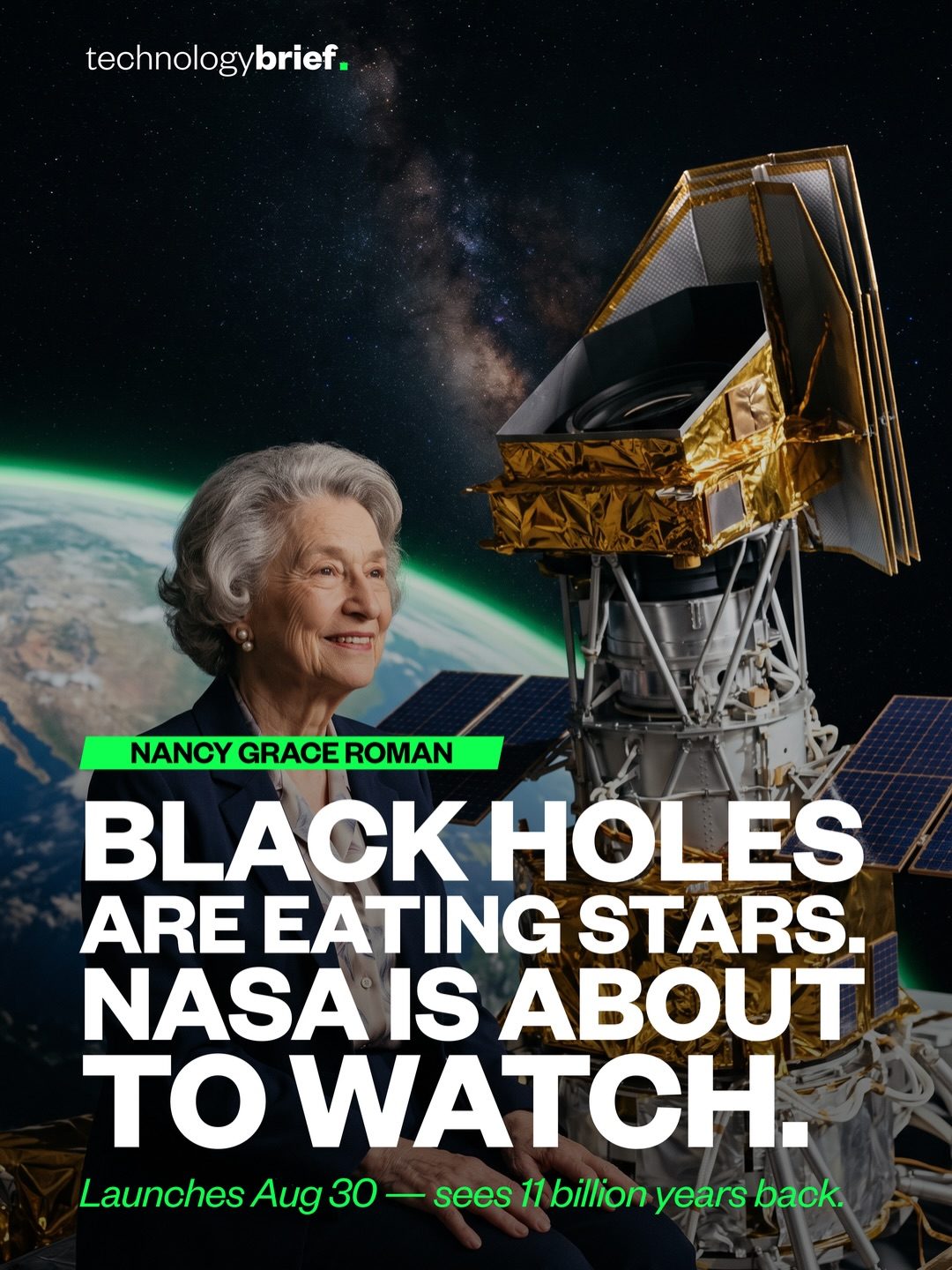
Nancy Grace Roman Space Telescope: A New Era in Space Exploration
The Nancy Grace Roman Space Telescope has the potential to revolutionize space exploration and deepen our understanding of the cosmos. Unlike the Hubble Space Telescope, which has provided stunning images and insights for decades, Nancy Grace Roman is designed to observe vast areas of the sky in infrared. This capability will help astronomers study rare events that would otherwise go unnoticed, providing a more comprehensive view of the universe.
Why This Matters
The Nancy Grace Roman Space Telescope is set to launch on August 30, marking a significant milestone in space exploration. This telescope isn't just an upgrade; it's a new tool designed to complement and extend the capabilities of existing telescopes. Roman can scan areas of the sky 100 times wider than Hubble, all in infrared. This unique combination allows scientists to observe phenomena that were previously impossible to detect.
While Hubble has given us detailed views of specific cosmic objects, Roman will survey larger areas, providing a broader perspective. This wide-angle view is particularly useful for spotting transient events, such as supernovae and black holes consuming stars. These events are brief and can occur anywhere in the sky, making them difficult to predict and observe with narrow-field telescopes like Hubble.
The Telescope's Capabilities
Wide-Field Infrared Survey
One of the most exciting features of the Nancy Grace Roman Space Telescope is its ability to conduct wide-field infrared surveys. Infrared light is crucial for studying distant and obscured objects, as it can penetrate dust and gas that visible light cannot. This makes Roman ideal for exploring the early universe, where many celestial objects are hidden behind cosmic dust.
Roman's wide field of view allows it to capture images of the sky that are 100 times larger than those taken by Hubble. This vast field means that Roman can survey large areas quickly, increasing the chances of spotting rare and transient events. For example, it is expected to observe black holes tearing stars apart, events that briefly light up these otherwise hidden phenomena, making them easier to study.
Observing the Early Universe
Another key capability of the Nancy Grace Roman Space Telescope is its ability to look back in time. By observing infrared light, Roman can see objects as they were more than 11 billion years ago. This means scientists will be able to study the early universe in unprecedented detail, providing insights into the formation of galaxies, stars, and black holes.
These observations will help answer fundamental questions about the origin and evolution of the cosmos. For instance, by studying the distribution of dark matter and the large-scale structure of the universe, Roman will contribute to our understanding of cosmology and the fundamental forces that govern the universe.
Studying Black Holes and Star Formation
Black holes are some of the most intriguing and mysterious objects in the universe. They are regions of space where the gravitational pull is so strong that nothing, not even light, can escape. By observing black holes consuming stars, Roman will provide valuable data on the dynamics of these cosmic phenomena.
When a star gets too close to a black hole, it is torn apart by the immense gravitational forces, a process known as tidal disruption. This event releases a burst of energy that can be detected by telescopes like Roman. By studying these events, astronomers can learn more about the physics of black holes, their distribution in the universe, and their role in the evolution of galaxies.
Practical Tips for Following the Mission
If you're interested in following the Nancy Grace Roman Space Telescope's journey and its discoveries, here are a few practical tips:
Stay Informed
Keep an eye on official NASA updates and press releases to stay informed about the telescope's launch, deployment, and early observations. NASA's website and social media channels are excellent sources for the latest information.
Engage with the Community
Join online forums, social media groups, and communities dedicated to space exploration and astronomy. These platforms are great for discussing the latest findings, sharing insights, and connecting with fellow enthusiasts.
Participate in Citizen Science
NASA often involves the public in its missions through citizen science projects. These projects allow anyone to contribute to scientific research by analyzing data, identifying objects, and more. Participating in these initiatives can be both educational and rewarding.
Important Takeaways
The Nancy Grace Roman Space Telescope represents a significant advance in space exploration. Its wide-field infrared capabilities will enable astronomers to study rare cosmic events, observe the early universe, and gain new insights into the nature of black holes and star formation. By complementing the work of other telescopes, Roman will provide a more comprehensive view of the cosmos, helping to answer fundamental questions about the universe.
Conclusion
The launch of the Nancy Grace Roman Space Telescope marks an exciting new chapter in space exploration. With its unique capabilities, this telescope will significantly enhance our understanding of the cosmos, from the early universe to the dynamics of black holes. By observing vast areas of the sky in infrared, Roman will provide a broader and deeper view of the universe, offering new avenues for scientific discovery and inspiring future generations of astronomers.
Watch the Reel
Questions readers ask
What makes the Nancy Grace Roman Space Telescope different from the Hubble Space Telescope?
The Nancy Grace Roman Space Telescope is designed to observe wide areas of the sky in infrared, while the Hubble Space Telescope operates primarily in the ultraviolet and visible light spectrum. This allows Roman to detect faint and distant objects, such as supernovae and black holes, that Hubble might miss. Additionally, Roman's field of view is 100 times wider than Hubble's, enabling it to scan the sky more efficiently.
Why is infrared astronomy important for studying the universe?
Infrared astronomy is crucial because it allows astronomers to observe objects that are too distant, dust-obscured, or faint to be seen in visible light. Many celestial objects, such as supernovae and black holes, emit most of their energy in the infrared spectrum. By studying these wavelengths, astronomers can gain insights into the formation and evolution of stars, galaxies, and the universe as a whole.
What kind of events can the Nancy Grace Roman Space Telescope help observe?
The Nancy Grace Roman Space Telescope is particularly well-suited for observing rare and transient events, such as supernovae, which are difficult to predict or observe with existing telescopes. Its wide field of view and infrared capabilities allow it to detect these events more efficiently, providing a more comprehensive view of the dynamic universe.
When is the Nancy Grace Roman Space Telescope scheduled to launch?
The Nancy Grace Roman Space Telescope is scheduled to launch in late August. This launch marks a significant milestone in space exploration and will provide a new tool to complement and extend the capabilities of existing space telescopes. The telescope will enable scientists to observe the universe in unprecedented ways.
How will the Nancy Grace Roman Space Telescope help in understanding black holes?
The Nancy Grace Roman Space Telescope’s infrared capabilities will allow astronomers to study the environments around black holes more effectively. By observing the infrared light emitted by matter falling into black holes, scientists can gain valuable insights into these enigmatic objects' behavior and the dynamics of the surrounding regions.
What is the significance of the Nancy Grace Roman Space Telescope’s wide-field infrared survey capabilities?
The wide-field infrared survey capabilities of the Nancy Grace Roman Space Telescope enable it to cover vast areas of the sky efficiently, making it an excellent tool for detecting rare and transient events. This capability allows astronomers to create a comprehensive map of the universe, helping to identify and study objects such as supernovae and galaxy clusters that would otherwise be overlooked.
How will the Nancy Grace Roman Space Telescope assist in the study of supernovae?
The Nancy Grace Roman Space Telescope’s infrared capabilities and wide field of view will significantly enhance the study of supernovae. By detecting these rare and transient events more efficiently, astronomers can gather more data to understand the mechanisms behind these explosive stellar events, as well as their role in shaping the universe.
Related deep dives
Similar reads based on topic and creator.




Recent articles
Fresh deep dives from the latest Reels we unpacked.




Comments
Be the first to comment.