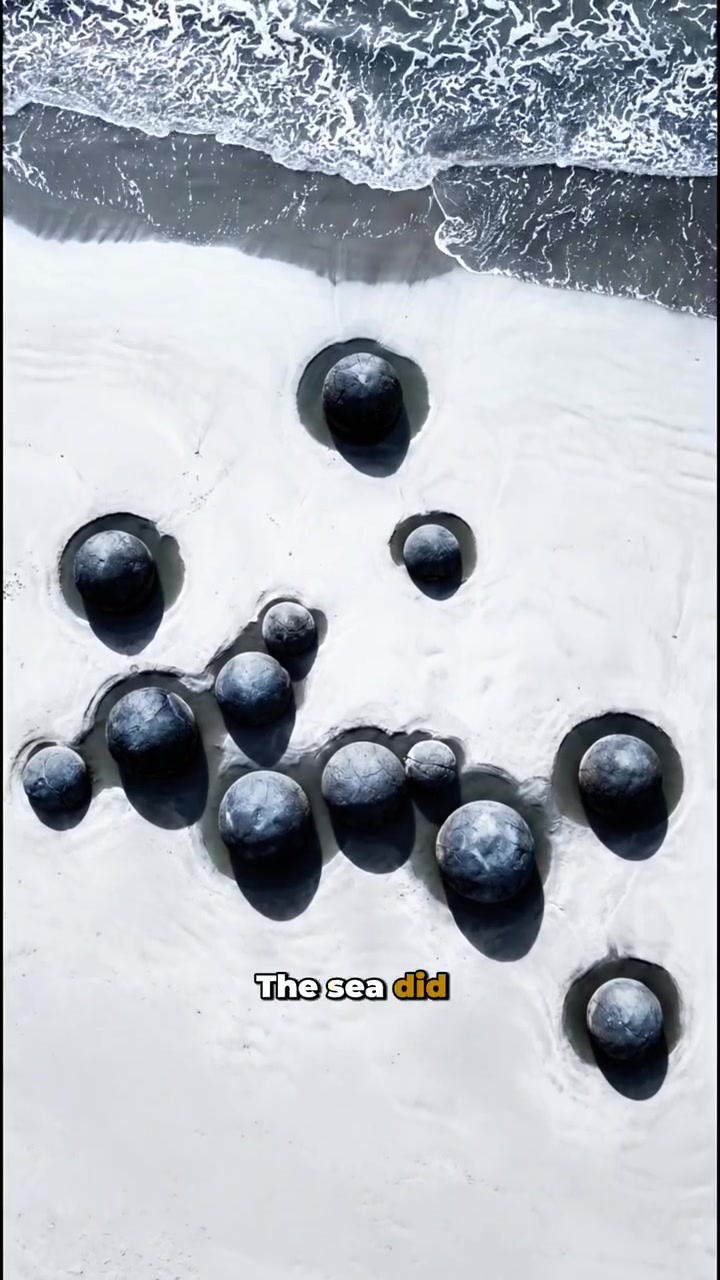
Seven feet wide and perfectly round—the stones strewn across the beach don’t just lie there quietly. They tell a story spanning 60 million years.
The Pearl of the Beach
Scattered along the shore are large round stones, their size about as wide as someone would hold out their arms. Viewers might assume that the beach and the sea molded these stones. However, the sea did not create their shape "Instead, they grew, one layer of material over another, around a core, akin to the formation of a pearl. This process occurred approximately 60 million years ago. At that time, the beach existed as gentle sea mud, teeming with microorganisms. These microbes, sheafs of materials, and salt were collected into the center of the soft mud. These layers hardened over time. In fact, the beach's cliffs, mutated from the hardened mud, are losing bits of themselves to the sea's onslaught. Each storm frees some stones and drops them on the shore. Formation When I think about these stones, a piece of the lore that comes to mind is of a pearl forming inside an oyster. There was no oyster, however in the process of forming these stones, the ingredients become more of a formation than a composition. The stones vary in size nothing like a normal seashell that would wash ashore. The main components are microorganisms, minerals like iron sulphide, and salt. These are seen in addition to the main ingredient which is lava. Mainly, a process that involves the formation of a stone over millions of years is that of a concretion. Much like fossilization, this process is a combination of chemical reactions. It leads to a concretion the outer layers get harder over time and the inner layers remain soft. The minerals and salts create crystal formations within the center. Finally, the element of time is of the utmost importance to this process.
The shift in terra
The appearance of these stones might look like the sea’s work, but the reality is a geological feat of historical proportions. Much like the history of the earth's changing climate, the convection and the shifting of tectonic plates have modified the coastline. The origin of these stones dates back to the beginning of the Paleocene Epoch, where the dinosaurs roamed the Earth. Over time, the rocks from these mountains wore down over time to form the heated mud, which formed the beach of the story.
Behind the rocks
The stones are hollow inside and contain a chamber, lined with pale crystals, and a network of cracks spreading outward. The cause of such cracks remains a mystery. Researchers have suggested several factors, such as drying, trapped pressure, and even earthquakes. These have all been proposed as possible explanations for why the stones crack. Yet, no consensus has been reached. The sea, however, didn’t form the round shapes. It only uncovered them.
The hollow mystery
The mystery of these stones goes deeper than the beach itself. The question of the cause of the cracks is something that many researchers are interested in. While they look to take a chemical approach, the truth is that the changes caused by the sea's constant assault might be the main cause of these formations. The stones themselves have various cracks, which have a spider web appearance running from the hollow inside. Additionally, some of the rocks have crystal formations inside them. These often include iron sulphides and limestone.
Guessing the inside
The question of what is inside the stones has been a mystery for a long time. The outside has been examined and composed of shellfish and some limestone. Inside these stones, scientists speculate that there are the remains of the minerals such as iron sulphide, and limestone. Based on the size and composition of these rocks, researchers are trying to understand what they were. That said, some researchers have used a combination of X-Ray and CAT Scans to figure out the shells inside.
Carefully Closing Orientations:
The sea did not make the mysterious stones round on the beach. The mystery of what lies inside those still sealed formations is intriguing, but the stones themselves are the true majesty the main component of the shoreline. The process of their formation is one of the most interesting geological processes in human history. The real puzzle is that stones described in the video are the same as those that were formed millions of years ago. While we may have the science to describe what happened to these rocks, the true mystery of the beach is the origin of these stones. These reasons are the true mystery of these stones-- they are a unique element on this shoreline.
Watch the Reel
Questions readers ask
What exactly are these round beach stones made of?
The round beach stones are primarily composed of a combination of microorganisms, minerals like iron sulfide, and salt, along with lava. These elements formed layers over a core, much like the formation of a pearl, and hardened over millions of years.
How did the stones get their perfectly round shape?
The stones were formed through a process called concretion, which is a combination of chemical reactions. Over time, the outer layers hardened while the inner layers remained soft, leading to the round shape. The sea did not create this shape but rather uncovered the stones as the surrounding cliffs eroded.
Why are these stones hollow inside?
The stones are hollow inside and contain a chamber lined with pale crystals and a network of cracks. The exact cause of the cracks is still a mystery, with researchers suggesting factors like drying, trapped pressure, and earthquakes as possible explanations.
How old are these round beach stones?
The stones are incredibly old, dating back to the Paleocene Epoch, around 60 million years ago. This was a time when dinosaurs still roamed the Earth. The process of their formation began in gentle sea mud teeming with microorganisms.
Can I find these stones on other beaches around the world?
While these specific stones are unique to the beach described, similar formations might exist in other geological settings. The process of concretion and the specific conditions that led to their formation are not unique to this particular beach, so similar stones could potentially be found elsewhere.
What role did the sea play in the formation of these stones?
The sea did not directly form the stones but rather uncovered them over time. The stones were originally part of the beach’s cliffs, which were formed from hardened mud. Each storm erodes the cliffs, freeing some of the stones and dropping them on the shore.
Related deep dives
Similar reads based on topic and creator.

Recent articles
Fresh deep dives from the latest Reels we unpacked.




Comments
Be the first to comment.