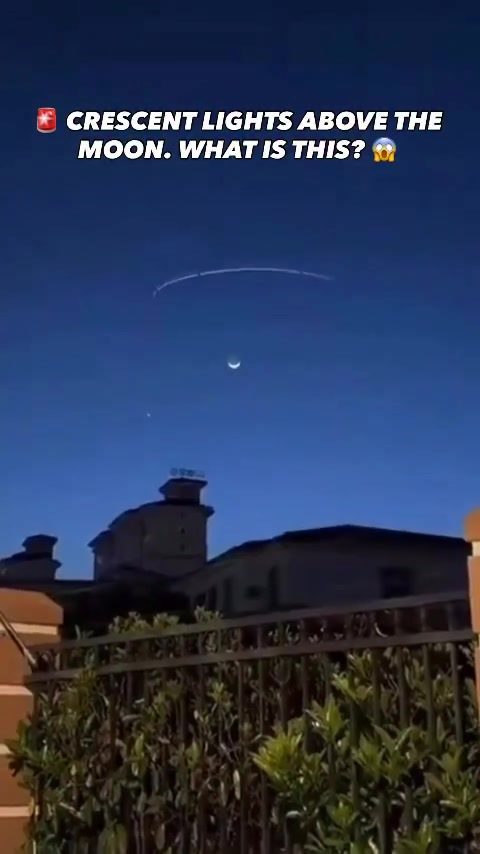
Night Sky Phenomenon: Crescent Lights Above the Moon
The night sky is a vast canvas of natural wonders, and one of the most intriguing sights is the crescent moon. However, when mysterious lights appear above it, the scene can become even more perplexing. This sighting raises questions about the nature of these lights and their potential sources.
Why This Matters
Understanding the night sky and its phenomena can deepen our appreciation for astronomy and the natural world. Identifying the sources of mysterious lights can help demystify these events and provide a deeper understanding of celestial bodies and human activities that intersect with the night sky. Additionally, this knowledge can inspire curiosity and encourage further exploration of astronomy.
Main Discussion
Identifying the Crescent Moon
The crescent moon is a familiar sight in the night sky. It occurs when the moon is in its first or last quarter phase, where only a small portion of the moon's face is illuminated by the sun. This phase is often associated with the beauty and tranquility of the night sky, making it a popular subject for stargazers and photographers alike. The crescent moon's appearance can vary depending on the time of year and the observer's location, but it generally follows a predictable cycle.
Understanding the Lights Above the Moon
The appearance of lights or a light trail above the crescent moon is a more unusual sight. These lights can be caused by various phenomena, both natural and artificial. Common explanations include:
- Satellite Trails: Many satellites orbit the Earth, and their reflective surfaces can create bright trails across the night sky. These trails can appear as a series of lights or a single streak, depending on the satellite's position and the observer's viewpoint.
- Airplane Lights: Airplanes flying at high altitudes can also create bright trails or individual lights in the night sky. These lights are often steady and can be identified by their movement patterns.
- Meteors and Meteor Showers: Meteor showers can produce streaks of light across the sky, often appearing as a series of lights. These are caused by small particles entering the Earth's atmosphere and burning up.
- Auroras: In regions closer to the polar circles, the northern or southern lights (auroras) can create stunning light displays in the sky. These are caused by the interaction of charged particles from the sun with the Earth's magnetic field.
- Human-Space Activities: Occasionally, lights in the sky can also be attributable to human space activities, such as rocket launches or space debris. These events can produce brief, bright trails or lights.
Because the on-screen text asks "CRESCENT LIGHTS ABOVE THE MOON. WHAT IS THIS?" with an emoticon suggesting surprise or concern, it's clear that the observer was uncertain about the phenomenon. Given the lack of additional context, exact identification of the lights is challenging, but the potential explanations above cover a wide range of possibilities.
Practical Tips
Observing the night sky can be a fascinating hobby or a source of scientific inquiry. Here are some tips to help you identify and understand night sky phenomena:
- Use a Star Chart or App: Use a star chart or a smartphone app that maps the night sky. Apps like "Starry Night" or "Sky Safari" can help you identify constellations, planets, and other celestial bodies.
- Track Satellites: Use websites or apps that track satellite orbits, such as "Heavens Above" or "ISS Spotter." These tools can help you predict when satellites will be visible in your area.
- Follow Meteor Showers: Keep track of meteor shower dates and locations. Websites like the American Meteor Society offer calendars and viewing tips for major meteor showers.
- Learn About Auroras: If you live in a region prone to auroras, familiarize yourself with the conditions that cause them. Websites like the Geophysical Institute offer aurora forecasts and viewing tips.
- Observe Regularly: Spend time observing the night sky regularly. Familiarize yourself with the constellations and the movements of planets and other celestial bodies. This will help you identify unusual phenomena more easily.
Important Takeaways
Night sky phenomena, such as the sight of mysterious lights above the crescent moon, can be perplexing and intriguing. Understanding the possible sources of these lights, from satellites to meteors, can help demystify these events and deepen our appreciation for the night sky. Regular observation and the use of modern tools can enhance our understanding and enjoyment of celestial events.
Conclusion
The sight of lights or a light trail above the crescent moon is a reminder of the wonders and mysteries that the night sky holds. By identifying the potential sources of these lights, we can better appreciate the beauty and complexity of our celestial environment. Whether they are caused by satellites, meteors, or other phenomena, these lights add to the enchantment of the night sky and inspire us to look up and explore the cosmos.
Watch the Reel
Questions readers ask
What are some common causes of mysterious lights in the sky, especially above the crescent moon?
Mysterious lights in the sky, particularly above the crescent moon, can be attributed to several common causes. These include satellite trails, which appear as moving dots or lines of light, and airplanes, which can sometimes be mistaken for UFOs when their lights reflect sunlight. Additionally, other celestial bodies like comets or meteors can create a similar effect.
How can I differentiate between a satellite and a plane in the night sky?
To differentiate between a satellite and a plane, observe the speed and direction of the light. Satellites typically move slowly and in a straight line, while planes often have blinking lights and may change direction. Additionally, satellites do not have the characteristic blinking strobe lights of airplanes.
What causes the crescent moon to glow and appear in the night sky?
The crescent moon's glow is due to reflected sunlight. As the moon orbits Earth, the angle between the sun, moon, and Earth changes, creating different phases. The crescent phase occurs when the moon is less than half illuminated by the sun. The faint glow on the dark part of the crescent moon is Earthshine, caused by sunlight reflected off Earth's surface.
Are there any specific apps or tools that can help identify lights above the crescent moon?
Yes, there are several apps and tools available to help identify mysterious lights. Apps like SkySafari, Star Walk, and SpaceX's satellite tracker can assist in identifying satellites, airplanes, and other celestial objects. These tools often provide real-time tracking and information about visible objects in the night sky.
Why do strange lights in the night sky often appear near the moon?
Strange lights in the night sky often appear near the moon due to the moon's brightness and the way it catches the observer's attention. The light pollution of cities can make it difficult to see other celestial bodies, but the moon stands out. When other lights are present, they may be noticed more easily when viewed in the vicinity of this bright object.
Related deep dives
Similar reads based on topic and creator.




Recent articles
Fresh deep dives from the latest Reels we unpacked.




Comments
Be the first to comment.