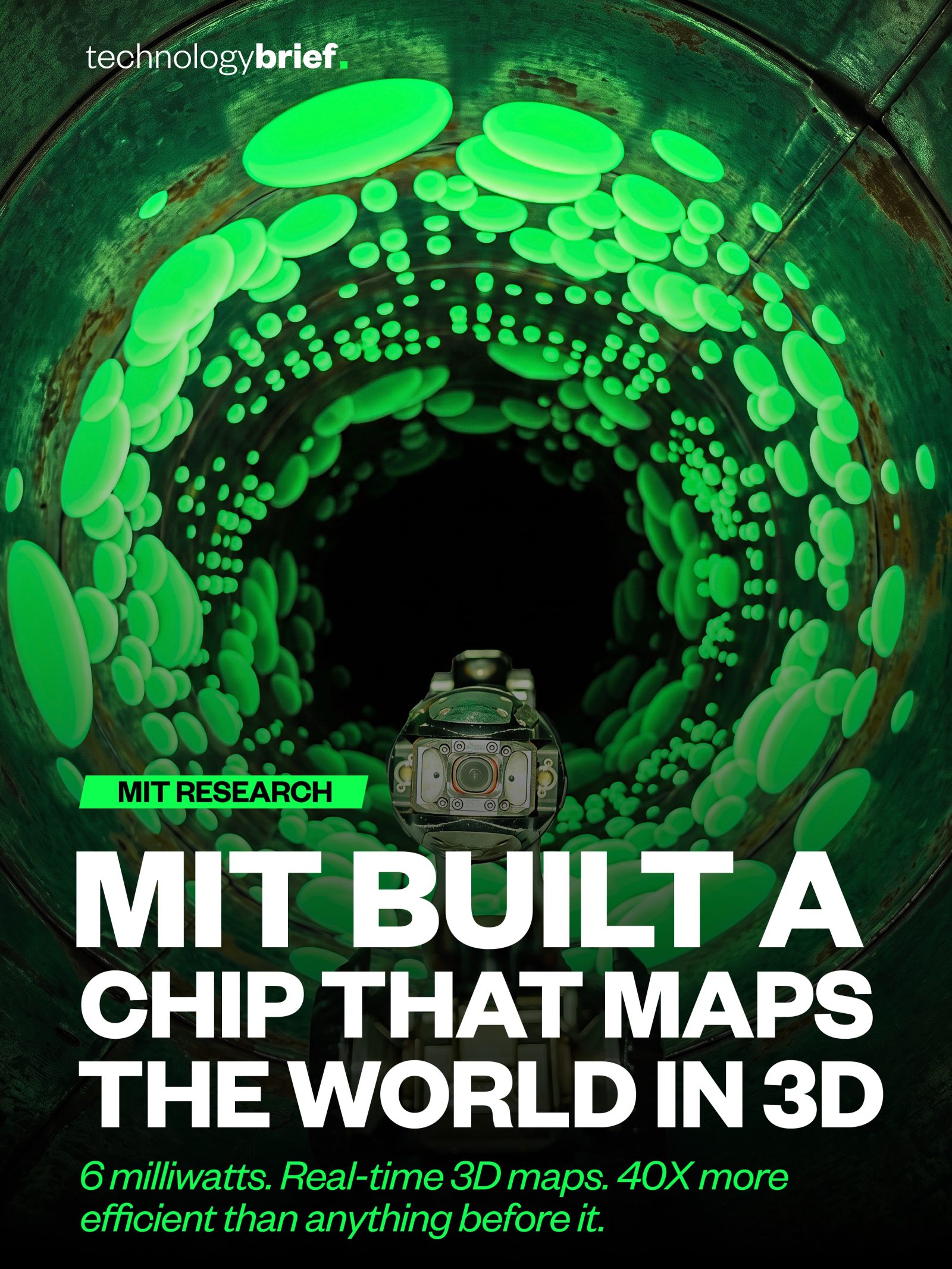
The Gleanmer Chip: Revolutionizing 3D Mapping for Tiny Robots
MIT researchers have developed a groundbreaking chip called Gleanmer, designed to revolutionize how small, autonomous robots navigate and understand their surroundings. The Gleanmer chip is a leap forward in 3D mapping technology, delivering real-time 3D vision capabilities and setting a new standard for efficiency and power consumption in robotics.
Why This Matters
Traditional 3D mapping methods, while effective, have always posed significant challenges for small-scale robots due to their high power, memory, and hardware requirements. Robots need to comprehend their environments accurately—identifying obstacles, open spaces, and navigating tight corners—before they can operate safely. Gleanmer addresses these limitations, making it possible for tiny drones, inspection robots, and lightweight AR devices to map their surroundings with remarkable efficiency.
The Gleanmer Chip: Breakthrough in 3D Mapping
Unmatched Efficiency
One of the standout features of the Gleanmer chip is its incredibly low power consumption. It operates at just 6 milliwatts, which is roughly the power required by a single LED. This energy efficiency is a significant breakthrough, making it 40 times more efficient than any previous chip of its kind. This is crucial for small devices that often have limited power sources, ensuring long operational times without frequent recharging.
High-Speed Data Processing
In addition to its efficiency, the Gleanmer chip can process data at an impressive 88+ frames per second (FPS). This high processing speed allows for real-time 3D mapping, essential for robots that need to react quickly to their changing environments. With the ability to handle 540,000 queries per second, Gleanmer ensures that robots can navigate complex spaces with precision and speed.
Advanced Mapping Techniques
Gleanmer uses flexible Gaussian shapes for mapping, a departure from the traditional grid-based methods. This innovative approach reduces the computational load on small devices, preventing them from becoming overwhelmed. By doing so, it ensures that even the smallest robots can successfully map their surroundings, making them more versatile and capable in various applications.
Potential Applications of the Gleanmer Chip
Autonomous Drones and Inspection Robots
The Gleanmer chip can significantly enhance the capabilities of autonomous drones and inspection robots. These devices often operate in environments where precise navigation and real-time mapping are crucial. The chip's efficiency and high processing speed enable these robots to map out complex structures, such as ventilation shafts and tunnels, where GPS signals are often unavailable.
Lightweight AR Headsets
The applications of the Gleanmer chip extend beyond traditional robotics. Lightweight AR (Augmented Reality) headsets can also benefit from this technology. By providing real-time 3D mapping, the chip can enhance the immersive experience of AR, making it more responsive and accurate. This could revolutionize how we interact with augmented reality in various fields, from gaming to industrial training.
Other Use Cases
The chip's potential applications are vast. It can be used in warehouses for inventory management, where robots need to navigate and map large, dynamic spaces. It can also be employed in any environment where precise, real-time mapping is essential, from search and rescue missions to environmental monitoring.
Practical Tips for Implementing the Gleanmer Chip
While the Gleanmer chip is still in the research phase and not yet available commercially, there are several practical considerations for its potential future applications:
Assessing Power Requirements
When integrating the Gleanmer chip into new or existing devices, it's essential to assess the power requirements carefully. The chip's low power consumption makes it an ideal choice for battery-powered devices, but it's still crucial to design the device's power management system to take full advantage of this efficiency.
Optimizing Data Processing
To fully leverage the Gleanmer chip's high processing capabilities, ensure that the device's software and hardware are optimized for real-time data processing. This may involve updating algorithms, enhancing data transmission speeds, and optimizing the chip's interaction with other components.
Integration with Existing Systems
The chip's compatibility with existing systems should be evaluated before integration. Since it uses flexible Gaussian shapes for mapping, it may require adjustments to existing mapping software and algorithms. Ensuring seamless integration will help maximize the chip's benefits.
Important Takeaways
The Gleanmer chip, developed by MIT researchers, represents a significant advancement in 3D mapping technology for small autonomous robots. Its low power consumption, high data processing speed, and innovative mapping techniques make it a game-changer in robotics and AR applications. As this technology continues to evolve, it promises to revolutionize various industries, from autonomous drones to AR headsets, by providing unprecedented 3D mapping capabilities.
Conclusion
The Gleanmer chip is a testament to the quiet but powerful advances in hardware technology. It addresses the critical challenge of 3D mapping for small, autonomous robots, making them more efficient, faster, and more aware of their surroundings. As this technology progresses, it holds the promise of transforming how robots interact with the world, paving the way for new applications and innovations.
Watch the Reel
Questions readers ask
How does the Gleanmer chip improve 3D mapping for tiny robots?
The Gleanmer chip enhances 3D mapping for tiny robots by providing real-time 3D vision capabilities. This allows small robots to navigate complex environments accurately and at high speeds, which is crucial for applications like tiny drones and AR devices. The chip's efficiency also means that these robots can conserve power while performing these tasks.
What makes the Gleanmer chip different from traditional 3D mapping methods?
Unlike traditional 3D mapping methods, the Gleanmer chip is designed to be highly energy efficient, making it ideal for small-scale robots. Traditional methods often require significant power, memory, and hardware resources, which can be prohibitive for tiny robots. The Gleanmer chip addresses these limitations, enabling more compact and power-efficient navigation systems.
How does the Gleanmer chip benefit small drones and AR devices?
The Gleanmer chip benefits small drones and AR devices by providing real-time, high-speed 3D mapping capabilities in a power-efficient package. This allows these devices to navigate complex environments accurately, making them more effective for tasks such as inspection, exploration, and augmented reality applications. The chip's efficiency also extends the operational time of these devices by conserving power.
Can the Gleanmer chip be used in other applications beyond robotics?
While the Gleanmer chip is specifically designed for small robots, its real-time 3D vision and mapping capabilities make it potentially useful in other applications as well. These could include autonomous vehicles, wearable technology, and any device requiring high-speed, energy-efficient 3D mapping. However, specific applications would need to be evaluated based on the chip's compatibility and performance requirements.
What are the key advantages of using the Gleanmer chip for robot navigation?
The key advantages of using the Gleanmer chip for robot navigation include its real-time 3D vision, high-speed mapping, and exceptional energy efficiency. These features allow robots to navigate complex environments accurately, identify obstacles, and understand open spaces while conserving power. This makes the Gleanmer chip ideal for tiny robots that require lightweight, power-efficient navigation systems.
How does the Gleanmer chip contribute to the advancement of robotics?
The Gleanmer chip contributes to the advancement of robotics by setting a new standard for efficiency and power consumption in 3D mapping technology. Its real-time 3D vision and high-speed mapping capabilities enable small robots to perform complex navigation tasks accurately and efficiently. This breakthrough paves the way for more advanced and capable robotics applications in various fields.
What are the potential challenges in implementing the Gleanmer chip in tiny robots?
While the Gleanmer chip offers numerous benefits, potential challenges in implementation could include integrating the chip with existing robot systems, ensuring compatibility with various hardware and software components, and optimizing the chip's performance for specific robot applications. Additionally, further development and testing may be required to fully realize the chip's capabilities in diverse robotics scenarios.
Related deep dives
Similar reads based on topic and creator.




Recent articles
Fresh deep dives from the latest Reels we unpacked.




Comments
Be the first to comment.