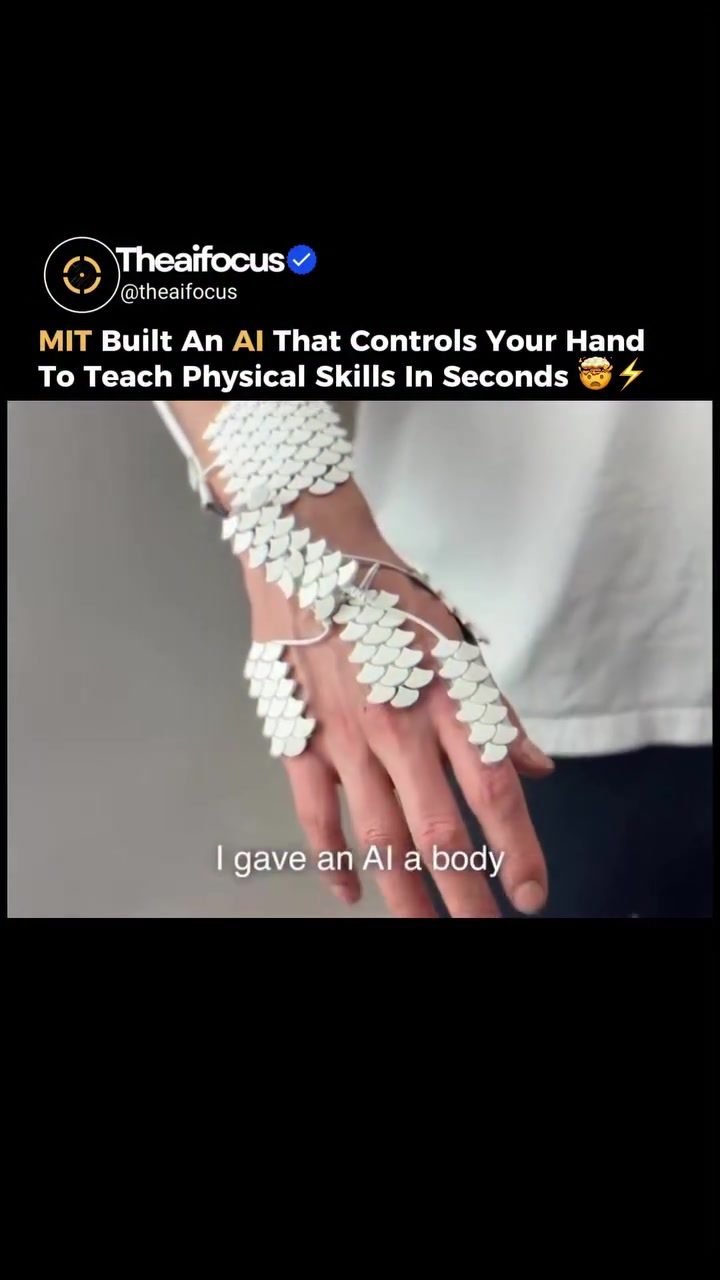
AI-Controlled Robotic Glove for Rapid Skill Acquisition
The Human Operator, developed by MIT researchers, is a cutting-edge wearable technology that pairs AI vision with electrical muscle stimulation (EMS) to guide a user's hand muscles. This device, created by theaifocus, is designed to help users learn complex motor skills rapidly, offering potential benefits for both healthy individuals and those recovering from injuries, such as stroke patients. This technology is a significant advancement in human augmentation, providing a unique interface between the human body and AI.
Why This Matters
The Human Operator represents a groundbreaking approach to skill acquisition and rehabilitation. By integrating AI vision and EMS, this wearable technology can facilitate the rapid learning of complex motor skills, which has implications for various fields, including education, rehabilitation, and even artistic pursuits. Understanding how this technology works can open up new possibilities for enhancing human capabilities and improving quality of life.
Main Discussion
Vision-to-Muscle Intelligence
The core of the Human Operator's functionality lies in its vision-to-muscle intelligence system. This system involves a head-mounted camera that scans the environment in real-time. The camera feeds visual data to the Claude AI, which then plans the necessary finger and wrist movements based on voice commands. This seamless integration of visual input and AI processing allows for precise and immediate responses to the user's environment.
Electrical Muscle Stimulation (EMS)
Another critical component of the Human Operator is electrical muscle stimulation (EMS). This technology sends micro-current pulses directly to the forearm and hand muscles, triggering involuntary, precise contractions. These contractions enable the user to perform complex movements, such as playing the piano or drawing, without conscious effort. The EMS system is finely tuned to work in sync with the AI's commands, ensuring that the user can execute movements accurately and efficiently.
Accelerated Skill Acquisition
One of the most exciting aspects of the Human Operator is its ability to bypass traditional motor practice. By directly guiding the user's muscles, the device allows individuals to physically experience complex motor movements almost instantly. This accelerated skill acquisition can significantly reduce the learning curve for new tasks, making it an invaluable tool for both educational and rehabilitation purposes.
Practical Tips
If you're considering using the Human Operator or similar AI-controlled wearable devices, here are some practical tips to maximize its benefits:
Start with Simple Tasks
Begin by using the device to perform simple tasks, such as picking up small objects or making basic hand gestures. This will help you get accustomed to the feel and response of the EMS and ensure that the AI is correctly interpreting your commands.
Gradually Increase Complexity
As you become more comfortable with the device, gradually increase the complexity of the tasks you attempt. This gradual progression will help you build muscle memory and improve your overall dexterity.
Practice Regularly
Consistency is key when using the Human Operator. Regular practice will help you develop a stronger connection between the AI and your muscles, leading to more fluid and precise movements over time.
Important Takeaways
The Human Operator, created by the MIT researchers, showcases the immense potential of AI-controlled wearable technology in enhancing human capabilities. By combining AI vision with EMS, this device can facilitate rapid skill acquisition and aid in rehabilitation, opening up new possibilities for both healthy individuals and those recovering from injuries.
The Future of Rehabilitation
For those recovering from strokes or other injuries, the Human Operator could revolutionize rehabilitation programs. By enabling users to perform complex motor movements, this device can help accelerate recovery and improve motor function, ultimately enhancing the quality of life for patients.
Educational Applications
In educational settings, the Human Operator can provide a unique way for students to learn and practice complex motor skills. Whether in music, art, or even scientific research, this technology can help students gain hands-on experience and develop new abilities more efficiently.
Ethical Considerations
While the Human Operator offers numerous benefits, it is also important to consider the ethical implications of AI-controlled wearable technology. As these devices become more advanced, it will be crucial to ensure that they are used responsibly and ethically, with a focus on enhancing human capabilities without compromising individual autonomy or privacy.
Conclusion
The Human Operator, developed by MIT researchers and showcased by theaifocus, represents a groundbreaking advancement in AI-controlled wearable technology. By integrating AI vision with electrical muscle stimulation, this device enables rapid skill acquisition and holds immense potential for both educational and rehabilitation purposes. As we continue to explore the possibilities of human augmentation, technologies like the Human Operator will play a pivotal role in shaping the future of human capabilities and quality of life.
Watch the Reel
Questions readers ask
How does the Human Operator assist in rapid skill acquisition?
The Human Operator uses AI-driven computer vision to analyze hand movements and provide real-time feedback. This feedback is delivered through electrical muscle stimulation, guiding the user's muscles to perform the desired actions, thereby accelerating the learning process.
Can the Human Operator be beneficial for rehabilitation purposes?
Yes, the Human Operator is particularly useful for rehabilitation, especially for individuals recovering from injuries like strokes. The device can help retrain muscles and improve motor skills through guided, repetitive movements and real-time feedback.
What is the role of electrical muscle stimulation (EMS) in the Human Operator?
Electrical muscle stimulation (EMS) in the Human Operator is used to gently stimulate the muscles in the user's hand, guiding them to perform specific movements. This stimulation helps reinforce correct movements and aids in learning or relearning complex motor skills.
How does the Human Operator interface with the human body?
The Human Operator interfaces with the human body through a wearable glove that houses sensors and electrodes. These components work together to monitor hand movements, provide real-time feedback, and stimulate the muscles to guide the user's hand through the desired motions.
What are the potential benefits of using the Human Operator for healthy individuals?
For healthy individuals, the Human Operator can help in mastering complex tasks, such as playing musical instruments or performing intricate surgeries, by providing real-time feedback and muscle guidance, thus enhancing performance and efficiency.
Is the Human Operator suitable for individuals with no prior experience in the skill they want to acquire?
Yes, the Human Operator is designed to be user-friendly and can assist individuals with no prior experience. The device provides step-by-step guidance and real-time feedback, making it easier for users to learn and master new skills from the beginning.
Related deep dives
Similar reads based on topic and creator.




Recent articles
Fresh deep dives from the latest Reels we unpacked.




Comments
Be the first to comment.