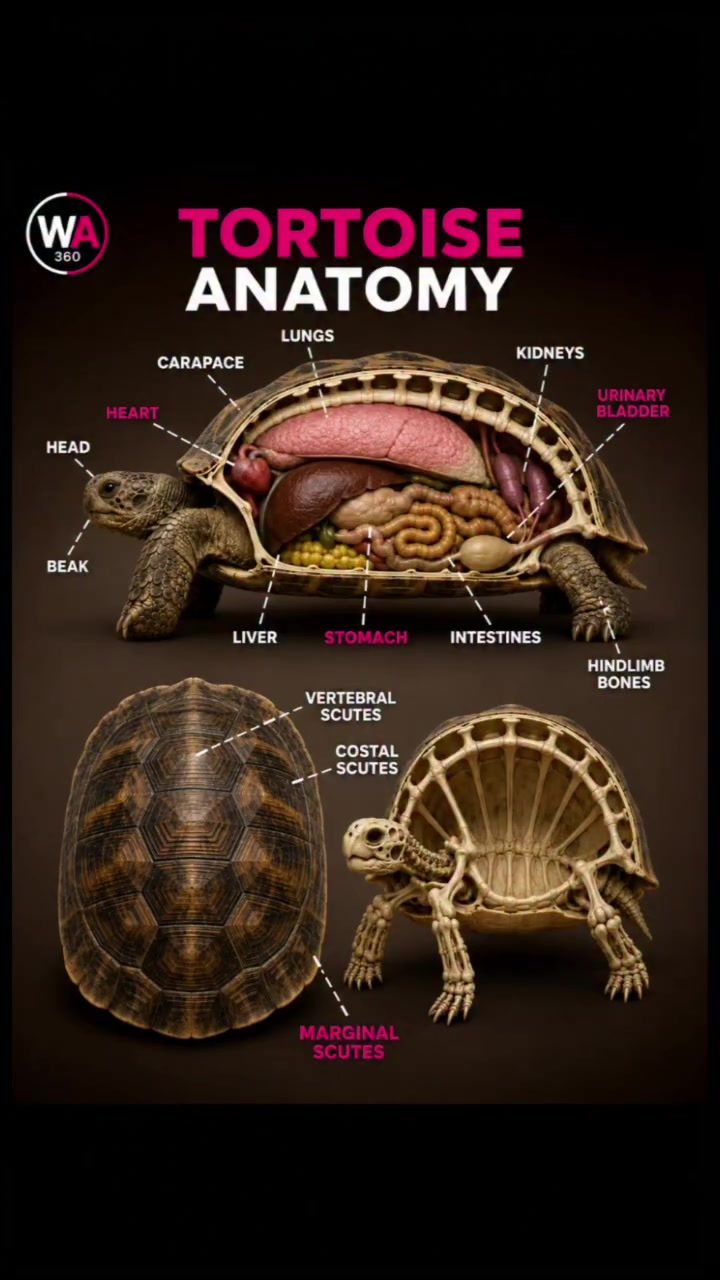
Tortoise Anatomy
Tortoises are fascinating creatures, renowned for their unique shells and slow, methodical movements. But their anatomy is more than just a protective shell; it's a marvel of natural engineering. Understanding the intricate anatomy of a tortoise reveals how these creatures have evolved to thrive in various environments.
Why This Matters
The tortoise's anatomy is a testament to nature's ingenuity. By examining the shell and the internal organs, we gain insights into how these animals have adapted over millions of years. This knowledge is not just for curiosity's sake; it highlights the importance of biodiversity and the remarkable adaptations that allow species to survive and flourish.
The Tortoise Shell: More Than Just Protection
The tortoise's shell is its most distinctive feature. Unlike many animals, a tortoise's ribs and spine are fused directly to the shell, creating a strong, natural armor. This fusion forms two main parts: the domed carapace on top and the plastron underneath. This design provides unparalleled protection, shielding the tortoise from predators and environmental hazards.
The Carapace and Plastron
The carapace is the upper part of the shell, while the plastron forms the lower part. These two sections are connected by a series of bony bridges, creating a robust, enclosed structure. The shell is not just a passive barrier; it is a dynamic part of the tortoise's skeleton, allowing for limited movement and flexibility.
Scutes: The Shell's Armor
Scutes are the horny, bony plates that cover the shell. They are classified into different types based on their location and function:
- Vertebral Scutes: These are the largest scutes, located along the midline of the carapace. They protect the spine and provide structural support.
- Costal Scutes: Found on the sides of the carapace, these scutes protect the ribs and provide additional strength.
- Marginal Scutes: These scutes form the outer edge of the shell, protecting the sides and providing a smooth, continuous surface.
Internal Organs: Efficiently Arranged
Inside the shell, the tortoise's vital organs are carefully arranged to fit within the limited space. This compact structure ensures that all organs function efficiently, despite the constraints of the shell.
The Respiratory and Circulatory Systems
- Lungs: Tortoises have simple, efficient lungs that are adapted to slow, steady breathing. This aligns with their low-energy lifestyle, allowing them to conserve oxygen.
- Heart: The heart is positioned near the center of the body, pumping blood to the various organs. It is relatively small, reflecting the tortoise's slow metabolism.
Digestive and Excretory Systems
- Liver, Stomach, and Intestines: These organs are compactly arranged to maximize space. The liver aids in digestion and detoxification, while the stomach and intestines handle the digestion and absorption of nutrients.
- Kidneys and Urinary Bladder: The kidneys filter waste products from the blood, and the urinary bladder stores urine until it can be excreted. These organs are essential for maintaining the tortoise's fluid balance.
The Head and Beak
The tortoise's head is relatively small and retractable, fitting neatly into the shell when needed. The beak is a powerful tool used for foraging and defense. It is strong enough to crush tough plant material, making it an essential adaptation for herbivorous tortoises.
Practical Tips for Observing Tortoise Anatomy
While tortoises are fascinating to observe, it's important to do so responsibly. Here are some tips for getting the most out of your observations:
- Respect Their Space: Never handle or disturb a tortoise without a good reason. Remember, they are wild animals and deserve to be treated with care.
- Observe from a Distance: Use binoculars or a camera with a good zoom lens to get a close look without disturbing the tortoise.
- Learn About Their Habitat: Understanding the environment where tortoises live can give you insights into their behavior and adaptations. For example, some species are adapted to desert environments, while others thrive in forests.
- Educational Resources: Books, documentaries, and online resources can provide a wealth of information about tortoise anatomy and behavior. Use these resources to deepen your understanding.
Important Takeaways
Tortoise anatomy is a marvel of natural engineering, showcasing how these creatures have adapted to thrive in various environments. Key takeaways include:
- Shell Structure: The shell is a dynamic part of the tortoise's skeleton, providing protection and structural support.
- Internal Organs: The internal organs are compactly arranged to maximize efficiency within the constraints of the shell.
- Adaptations: Tortoises have evolved unique adaptations, such as a powerful beak and efficient lungs, to suit their low-energy lifestyle.
Conclusion
The anatomy of a tortoise is a testament to nature's ingenuity and the remarkable adaptations that allow these creatures to thrive. By understanding the intricate details of their anatomy, we gain a deeper appreciation for the complexity and beauty of the natural world. Whether you're a wildlife enthusiast, a student, or simply curious about these fascinating creatures, exploring the anatomy of a tortoise offers a wealth of knowledge and awe.
Watch the Reel
Questions readers ask
What are the main parts of a tortoise's shell?
A tortoise's shell is composed of two primary parts: the carapace (upper shell) and the plastron (lower shell). The carapace and plastron are connected by the bridge, forming a complete protective structure. The shell is made up of about 60 bones, including the ribs, vertebrae, and shoulder blade, all fused together to create a hard outer shell.
How does a tortoise breathe with its unique anatomy?
Tortoises have a unique lung structure that is adapted to their shell anatomy. Their lungs are large and efficient, designed to extract as much oxygen as possible with each breath. Because the shell limits the expansion of the chest, tortoises rely on the movement of the forelimb muscles, the pelvic muscles and the diaphragm to facilitate breathing.
What role do tortoise scutes play in their anatomy?
Scutes are the flat, horny plates that cover the tortoise's shell. They are part of the keratin layer which protect the underlying shell from damage. Each scute is connected to the underlying bone and grows continuously throughout the tortoise's life, making them an excellent indicator of a tortoise's age and health.
How does the tortoise's digestive system work?
Tortoises have a long, slow digestive system designed to extract the most nutrients from their plant-based diet. Their stomach and intestines can take days or even weeks to process food, making them well-suited to environments with limited food sources. The large intestine is particularly important for water reabsorption, helping the tortoise to conserve water in arid conditions.
What are the key features of a tortoise's heart structure?
The tortoise's heart is a three-chambered organ, similar to other reptiles, with two atria and one ventricle. The heart is encased in a thick pericardial sac for protection. The unique arrangement allows the heart to pump blood efficiently, supporting the tortoise's slow metabolism and long lifespan.
What is the function of tortoise kidneys in their anatomy?
Tortoise kidneys play a critical role in water and electrolyte balance, as well as waste excretion. They are highly efficient at conserving water, which is crucial for tortoises living in arid environments. The kidneys also produce uric acid as a waste product, which is less soluble than urea, helping to minimize water loss.
Related deep dives
Similar reads based on topic and creator.




Recent articles
Fresh deep dives from the latest Reels we unpacked.




Comments
Be the first to comment.