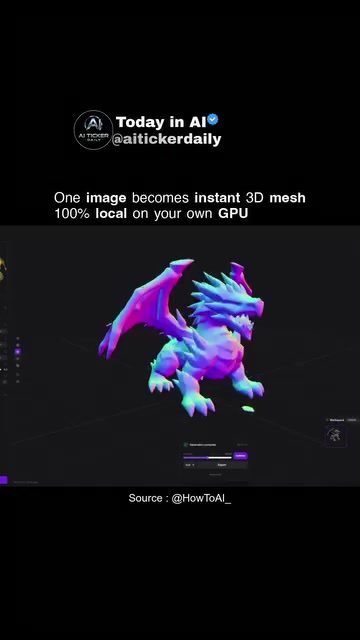
AI 3D Mesh Generation with Modly: Turning Images into 3D Models on Your GPU
AI 3D mesh generation has revolutionized the way we approach 3D modeling. Modly, a desktop application from AI Ticker Daily, exemplifies this innovation by transforming a single image into a 3D mesh using the power of your local GPU. This eliminates the need for cloud services or API calls, making the process both efficient and cost-effective.
Why This Matters
The ability to generate 3D meshes from single images has significant implications for various fields, including gaming, animation, and industrial design. By leveraging AI and GPU processing, this technology democratizes 3D modeling, making it accessible to a broader range of users who may not have the resources or expertise to use traditional 3D modeling software.
Main Discussion
Understanding AI 3D Mesh Generation
AI 3D mesh generation involves using machine learning algorithms to analyze a 2D image and reconstruct it into a 3D model. This process typically involves converting the image into a mesh, which is a collection of vertices, edges, and faces that define the shape of the 3D object. AI algorithms can then infer the depth and structure of the object, creating a realistic 3D representation.
How Modly Works
Modly, from AI Ticker Daily, stands out by running the entire process locally on your GPU. This local processing ensures that your data remains secure and private, and it eliminates the need for cloud or API bills. The app takes a single image and, through advanced AI algorithms, generates a 3D mesh in real-time. The process is remarkably efficient, allowing users to see the 3D model being created as they observe the image.
Benefits of Local GPU Processing
Running 3D mesh generation locally on your GPU offers several advantages:
- Cost Efficiency: By avoiding cloud or API bills, users can save significant costs, especially for large-scale projects.
- Data Privacy: Keeping the data and processing on your local machine ensures that sensitive information remains secure.
- Speed and Performance: GPUs are designed for parallel processing, making them ideal for the intensive computations required in 3D modeling.
Practical Applications
The applications of AI 3D mesh generation are vast and varied. Here are a few areas where this technology could be particularly impactful:
- Gaming and Animation: Creating 3D models from 2D images can significantly speed up the production process, allowing artists to focus on more creative aspects.
- Industrial Design: Engineers and designers can quickly prototype and visualize their ideas in 3D, accelerating the design process.
- Augmented Reality (AR): AR applications can benefit from the ability to generate 3D models from images, enhancing user experiences in real-time.
- Medical Imaging: AI 3D mesh generation can help create accurate 3D models from 2D medical images, aiding in diagnosis and treatment planning.
Limitations and Considerations
While AI 3D mesh generation is a powerful tool, it's important to verify the mesh quality for your specific use case before relying on it for production. The accuracy of the 3D model can vary depending on the complexity of the image and the algorithms used. For critical applications, additional refinement and validation may be necessary.
Practical Tips
Getting Started with Modly
To get started with Modly, follow these steps:
- Download and Install: Visit the AI Ticker Daily post for the open-source software and follow the installation instructions.
- Prepare Your Image: Ensure you have a high-quality image that clearly defines the object you want to convert into a 3D mesh.
- Run the Software: Launch Modly and load your image. The software will process the image and generate the 3D mesh.
- Verify and Refine: Check the quality of the 3D mesh and make any necessary adjustments to ensure it meets your requirements.
Optimizing Performance
To optimize the performance of Modly:
- Use a Powerful GPU: A high-end GPU will significantly improve the speed and quality of the 3D mesh generation.
- Optimize Image Quality: Ensure your input image is of high resolution and clarity. This will help the AI algorithms generate a more accurate 3D model.
- Adjust Settings: Experiment with different settings within Modly to find the best configuration for your specific use case.
Important Takeaways
AI 3D mesh generation is a game-changer in the field of 3D modeling, offering efficiency, cost savings, and enhanced privacy. Modly, by AI Ticker Daily, exemplifies this technology by allowing users to generate 3D meshes from single images using their local GPU. This innovative approach opens up new possibilities for various industries, from gaming to medical imaging.
Conclusion
AI 3D mesh generation is transforming the way we create and interact with 3D models. With tools like Modly, users can harness the power of AI and local GPU processing to generate high-quality 3D meshes from single images. This technology not only makes 3D modeling more accessible but also offers significant benefits in terms of cost, privacy, and performance. As the field continues to evolve, we can expect to see even more innovative applications and improvements in this exciting area.
Watch the Reel
Questions readers ask
How does Modly generate 3D meshes from single images?
Modly uses advanced AI algorithms to analyze a single 2D image and infer the 3D structure, creating a 3D mesh. This process leverages the computational power of your local GPU to generate the 3D model efficiently and quickly.
Why is local GPU processing beneficial for 3D mesh generation?
Local GPU processing allows for faster, more efficient 3D mesh generation by utilizing the computing power of your own device, eliminating the need for external cloud services or API calls. This results in cost savings and reduced latency, as well as increased privacy, since your data stays on your machine.
What are the primary benefits of using Modly for 3D modeling?
Modly offers cost-effective 3D modeling by eliminating the need for expensive cloud services. It's accessible and user-friendly, making it ideal for various industries including gaming, animation, and industrial design. Additionally, it democratizes 3D modeling by making it available to users with varying levels of expertise.
Can Modly be used for professional 3D modeling tasks?
Yes, Modly is suitable for professional tasks in fields such as gaming, animation, and industrial design. Its ability to generate 3D meshes from single images streamlines the modeling process, saving time and resources for professionals in these industries.
Is an internet connection required to use Modly?
No, an internet connection is not required to use Modly. Since it processes 3D mesh generation locally on your GPU, you can work offline. This makes it convenient for users who need to work in remote locations or prefer to keep their data private.
What kind of images can be used with Modly to generate 3D meshes?
Modly can work with a variety of single images, but the best results are typically achieved with clear, high-resolution images that have well-defined edges and features. The more detailed and distinct the subject in the image, the more accurate the 3D mesh generated by Modly will be.
How does Modly support different industries such as gaming, animation, and industrial design?
Modly supports these industries by providing a quick and efficient way to create 3D models from single images. For gaming and animation, it can help in rapidly prototyping characters, environments, and objects. In industrial design, it can be used for reverse engineering, creating 3D models from blueprints or photographs, and visualizing products and components.
Related deep dives
Similar reads based on topic and creator.

Recent articles
Fresh deep dives from the latest Reels we unpacked.




Comments
Be the first to comment.