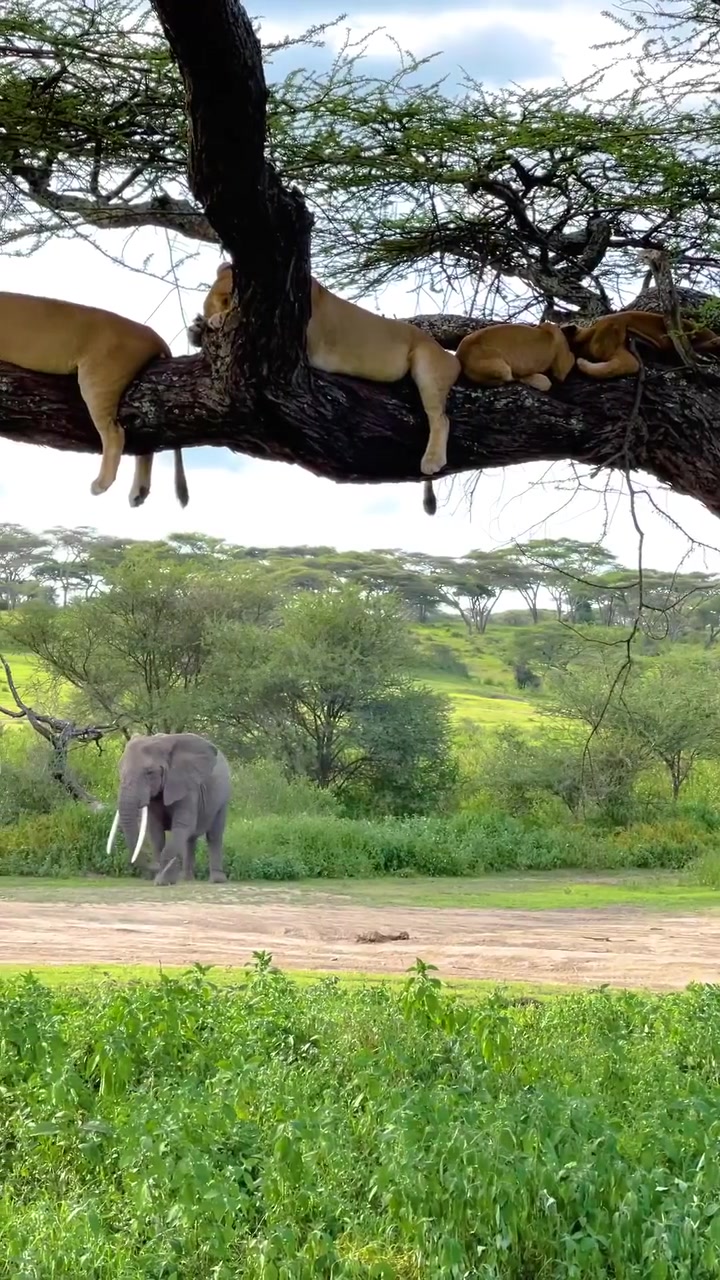
Lions are powerful predators, but few animals can be as comfortable in a tree as a lion. In the African savanna, a group of lions lounging on a tree branch. This unexpected scene was captured next to an elephant walking through the grass.
Out of the Savanna ordinary
Lions spry in unexpected heights. This activity is not the typical image of lions for most people. But this behavior is a distinctive trait of tree-climbing lions. These big cats often haul their massive bodies into trees, especially acacia trees, to rest or escape the heat. The savanna does not support trees, so where the lions are lounging is out of their natural habitat. Without any obvious danger from the elephant grazing below, the lions seem to be safe, and the elephant doesn't appear to notice. These lions might find their branches because of the acacia trees that have thorns that most predators can’t climb up.
Larger reflects on lions' changing role in the ecosystem
Lions are the apex predators. But their primary role in the ecosystem is rapidly being redefined due to interactions that undermine their abilities to hunt effectively. Wildlife managers and the public are beginning to understand that if lions continue to lose their ability to hunt at will, they will continue to lose prey, and their populations will continue to decline. If lions become incapable of performing this basic function of their existence, they risk being relegated to the status of mere zoo attractions. , the lack of strong prey species places enormous pressure on the lions, and the results of this interaction are yet to be determined. The lack of strong prey species impacts zoo exhibits and the African wildlife ecosystem.
The curious behavior of tree-climbing lions
Tree-climbing lions are not unique to this savanna. They are found in specific regions of Africa, such as the Lake Manyara National Park in Tanzania. The specific motivations behind this behavior remain unclear, but it is believed to be driven by a combination of factors. Researchers have observed that lions may climb on branches to rest and avoid the heat of the day, especially in areas where the heat is at its peak. This behavior is also a consequence of the increasing food competition from larger predators and other animals. There are several theories as to why lions climb trees. The most popular theory is that lions climb trees to avoid the heat of the day. 2 The temperature in the savanna can get quite high, and lions need to find a way to cool down. Climbing to a higher altitude where the air is cooler might be one of the solutions for the lions. The dense canopy of the tree provides a cooler environment than the open savanna. The canopy also provides protection from the sun and predators.
In the presence of gentle elephants
Elephants are large animals, but they are herbivores. Therefore, they don’t pose a threat to these lions on trees. The lions are not hunting the elephants. Elephants are crucial in maintaining the balance of the ecosystem. However, they are facing a growing threat. Poaching and habitat loss have led to a sharp decline in the elephant population. The survival of elephants is crucial for the health of the African savanna. These lions seem to be safe, but there are conflicting reports about why the lions are on the tars.
An elephant's lunch
Elephants are known to roam freely through the savanna, grazing on various plants. Elephants have a strong sense of smell, and this allows them to locate food sources. Elephants are also known to eat for long periods, and this allows them to maintain their high energy levels. Elephants can travel up to 50 miles per day in search of food and water. Elephants are one of the few animals that can spend up to 16 hours a day eating, which is a testament to their strong appetite.
Lions under branches
Lions are known to have a strong sense of smell and hearing, allowing them to detect prey from long distances. They can also run very fast, up to 50 miles per hour, which makes them formidable hunters. Lions are a social species, and they live in groups called prides. These prides are made up of related females, their cubs, and a few adult males. The females are the primary hunters, and they work together to take down prey. Lions lounging are not hunting the elephants. Lions are known to hunt in packs, and they often target weaker prey.
The lion's tree proves the savanna
The tree where the lions were lounging is essential to the ecosystem. Trees provide habitat for various animals, including birds, insects, and small mammals. They also play a crucial role in maintaining the health of the soil. Trees help to prevent soil erosion by holding the soil in place with their roots. They also provide shade, which helps to regulate the temperature of the soil. Trees are also essential for the carbon cycle, as they absorb carbon dioxide from the atmosphere. Trees are also essential for the water cycle, as they release water vapor into the atmosphere through a process called transpiration.
Watch the Reel
Related deep dives
Similar reads based on topic and creator.




Recent articles
Fresh deep dives from the latest Reels we unpacked.




Comments
Be the first to comment.