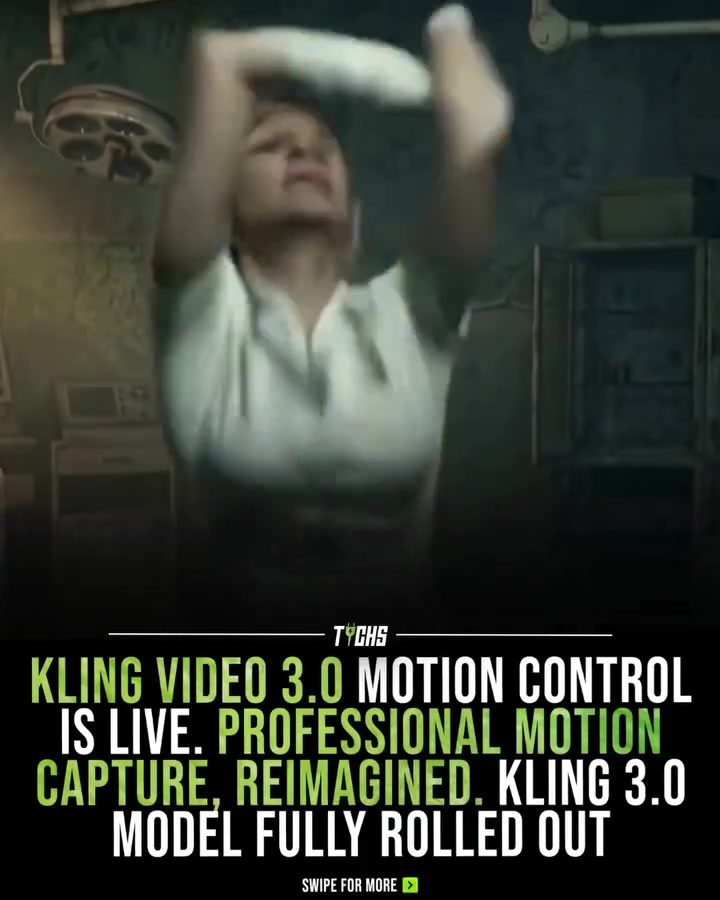
Motion Capture Technology with Kling 3.0
The launch of the Kling 3.0 Model by Kling AI represents a significant advancement in motion capture technology. This new model is now fully available, offering high-precision motion capture, cinematic performance, and versatility across diverse entertainment scenarios. The system is designed to push the boundaries of what's possible in motion control, making it a game-changer for professionals in the industry.
Context / Why this matters
Motion capture technology has revolutionized the way we create digital content, from films and video games to virtual reality experiences. The ability to accurately capture and replicate human movements and expressions has opened up new creative possibilities. The Kling 3.0 Model by T^CHS takes this technology to the next level, offering a range of features that enhance the quality and realism of motion capture.
Main discussion
Cinematic Performance and High-Precision Motion Capture
One of the standout features of the Kling 3.0 Model is its ability to deliver cinematic performance and high-precision motion capture. This is achieved through a combination of advanced sensors, algorithms, and cameras that work together to capture every nuanced movement. The result is a level of detail and accuracy that was previously unattainable, making it ideal for filmmakers, game developers, and other professionals who demand the highest standards in motion capture.
360° Consistency
The Kling 3.0 Model ensures 360° consistency, meaning that the captured facial identity remains flawless across any angle or rotation. This is crucial for creating seamless and realistic performances, especially in complex scenes where characters move freely and dynamically. Whether the character is facing the camera directly or turning away, the facial details are preserved with remarkable accuracy.
Complex Emotion
Another key feature of the Kling 3.0 Model is its ability to replicate complex emotions with high fidelity. The system can capture and replicate nuanced expressions, bringing characters to life in a way that feels authentic and emotionally resonant. This is particularly important for performances that require a deep emotional range, such as dramatic scenes in films or intricate storytelling in video games.
Occlusion Recovery
Occlusion recovery is another area where the Kling 3.0 Model excels. This feature ensures that the identity of a character is maintained even when faces are momentarily covered. This is particularly useful in dynamic and fast-paced scenarios, where characters may quickly turn away or interact with objects, making it difficult to maintain a consistent facial capture. The Kling 3.0 Model uses advanced algorithms to predict and fill in these gaps, ensuring a seamless and uninterrupted performance.
Practical tips
Setting Up the Kling 3.0 Model
To get the most out of the Kling 3.0 Model, it's important to properly set up the system. This involves positioning the cameras and sensors in a way that ensures optimal coverage and accuracy. The system comes with detailed instructions and support to help users get started, but it's also helpful to consult with a professional if you're new to motion capture technology.
Calibrating the System
Calibration is a crucial step in ensuring the accuracy of the motion capture data. The Kling 3.0 Model includes tools for calibrating the system, and it's important to follow these steps carefully. This involves ensuring that the sensors and cameras are properly aligned and that the environment is free from interference that could affect the capture.
Important takeaways
The Kling 3.0 Model by T^CHS represents a significant leap forward in motion capture technology. Its advanced features, including 360° consistency, complex emotion replication, and occlusion recovery, make it a powerful tool for professionals in the entertainment industry. By understanding and utilizing these features, creators can deliver more realistic and emotionally resonant performances, pushing the boundaries of what's possible in digital content creation.
Conclusion
The Kling 3.0 Model's launch by KlingAI marks a new era in motion capture technology. With its high-precision capabilities, cinematic performance, and versatility, it is set to revolutionize how motion capture is used in films, video games, and other forms of digital content. By embracing this technology, creators can unlock new levels of realism and emotional depth, captivating audiences in ways never before possible.
Watch the Reel
Questions readers ask
What sets Kling 3.0 apart from other motion capture systems?
Kling 3.0 stands out due to its high-precision control and 360° consistency, ensuring that movements are captured accurately from every angle. Additionally, its advanced sensors deliver cinematic quality, making it ideal for professionals in film, gaming, and virtual reality.
Can Kling 3.0 be used for applications beyond film and gaming?
Yes, Kling 3.0's versatility extends to various entertainment scenarios. Its realistic motion capture capabilities make it suitable for creating digital content across different industries, including virtual reality and other immersive experiences.
What kind of sensors does Kling 3.0 use to achieve high-precision motion control?
Kling 3.0 employs advanced sensors that are designed to detect and capture even the subtlest of movements with exceptional accuracy. These sensors work in tandem to ensure that every motion is replicated faithfully, delivering top-tier performance.
Is Kling 3.0 suitable for beginners in motion capture?
While Kling 3.0 is a powerful tool, it is primarily designed for professionals who require high-precision and cinematic quality in their motion capture work. Beginners might find it beneficial to start with more user-friendly systems before advancing to Kling 3.0.
How does Kling 3.0 enhance the quality of digital content creation?
Kling 3.0 enhances digital content creation by providing unparalleled realism and precision in motion capture. Its ability to deliver cinematic quality ensures that the captured movements are lifelike, making it an invaluable tool for creating compelling and immersive digital experiences.
Related deep dives
Similar reads based on topic and creator.




Recent articles
Fresh deep dives from the latest Reels we unpacked.




Comments
Be the first to comment.