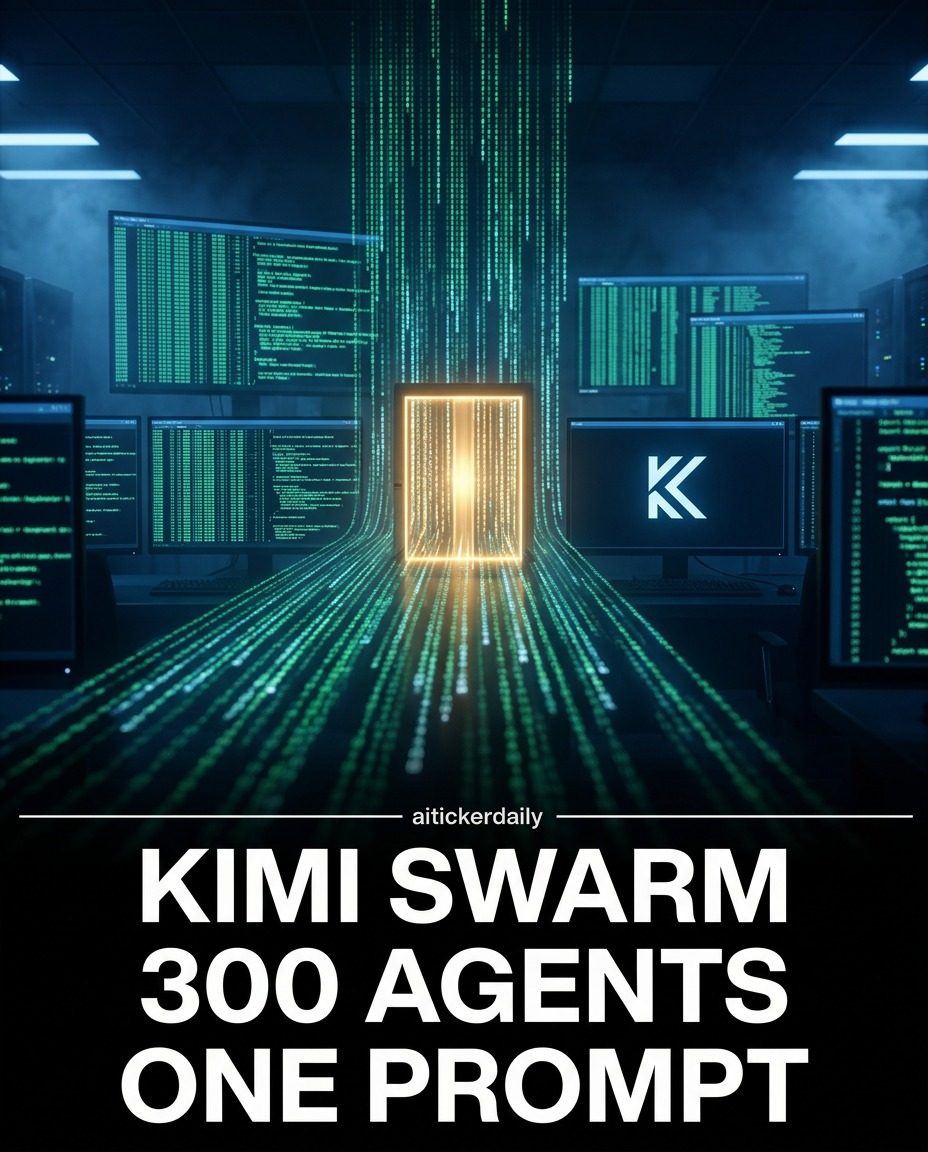
AI Swarm Agents: Harnessing the Power of Collective Intelligence
AI swarm agents represent a cutting-edge approach in artificial intelligence, leveraging the collective power of multiple agents working in parallel to achieve complex tasks. This innovative method is exemplified by Kimi Swarm, an advanced AI system that utilizes 300 agents to execute tasks from a single prompt. This approach not only enhances efficiency but also ensures that the AI system learns and improves with every run.
Why This Matters
In an era where AI is increasingly integrated into various industries, the ability to harness the power of swarm intelligence can revolutionize how tasks are approached and completed. By coordinating multiple agents, AI swarm systems can tackle complex problems more effectively, reduce the risk of errors, and deliver more reliable outcomes. This method is particularly relevant for tasks that require extensive data collection, analysis, and synthesis.
Understanding AI Swarm Agents
The Basics of Swarm Intelligence
Swarm intelligence is inspired by the behavior of natural swarms, such as bees or ants, which work collectively to achieve common goals. In the context of AI, swarm agents operate similarly, collaborating to solve problems, gather information, and refine their processes. This collective approach allows for a more robust and adaptable system, capable of handling a wide range of tasks.
The Role of Kimi Swarm
Kimi Swarm is a prime example of how AI swarm agents can be utilized effectively. The system runs 300 parallel agents across 4,000 coordinated steps from a single prompt. This level of coordination ensures that tasks are broken down into manageable parts, each handled by a specialized agent. The agents work together to execute the task, making Kimi Swarm a powerful tool for data-driven decision-making and problem-solving.
Specs vs. Prompts
One of the key insights from Kimi Swarm is the importance of writing specifications (specs) rather than relying on prompts. A spec defines what to collect, valid sources, output format, and conflict resolution. Essentially, a spec is a detailed order that the swarm executes, ensuring that the task is completed accurately and efficiently. In contrast, a prompt is more like a wish, lacking the specificity needed for effective execution. This distinction is crucial for maximizing the potential of swarm agents.
Key Elements of a Spec
- What to Collect: Clear directives on the type and scope of data to be gathered.
- Valid Sources: Guidelines on where to source the information.
- Output Format: Specific instructions on how the data should be presented.
- Conflict Resolution: Protocols for addressing discrepancies or conflicts among agents.
The Verify Gate
One of the known flaws of AI swarm systems is the potential for confident, under-cited claims and contradictions among sub-agents. To address this, Kimi Swarm employs Opus 4.8 as a verify gate. Opus 4.8 is designed to refute flawed results, ensuring that only accurate and well-supported information passes through. This verification step is essential for maintaining the integrity of the AI system and the reliability of its outputs.
Features of Opus 4.8
- Explicit Verification: Ensures that claims are well-supported and free from contradictions.
- Refute, Not Praise: Focuses on identifying and correcting errors rather than affirming incorrect information.
- Trustworthy Check: Acts as a reliable gatekeeper, ensuring that the swarm's outputs are trustworthy.
Practical Tips for Implementing AI Swarm Agents
Write Detailed Specs
To get the most out of AI swarm agents, it's essential to write detailed specs. This involves:
- Clearly defining the task and objectives.
- Specifying the data collection process, including valid sources and formats.
- Outlining conflict resolution protocols.
Ensure Adequate Verification
Implementing a robust verification process, such as using Opus 4.8, ensures that the outputs of the swarm are reliable. This step is crucial for maintaining the integrity of the data and the overall system.
Stay Updated with AI Briefings
For those interested in staying ahead in the rapidly evolving field of AI, consider following AI briefings that curate the latest models, chips, policy updates, and more. These resources can provide valuable insights and keep you informed about the latest developments.
Curated AI News
- Models: Stay updated on the latest AI models and their applications.
- Chips: Keep track of advancements in hardware that support AI operations.
- Deals and Policies: Be informed about industry trends, deals, and regulatory changes.
Important Takeaways
- Swarm Agents: Utilize 300 parallel agents to handle complex tasks efficiently.
- Specifications: Write detailed specs to define the task, sources, output format, and conflict resolution.
- Verification: Implement a robust verification process to ensure reliable outputs.
- Stay Informed: Follow AI briefings to stay updated with the latest developments in the field.
Conclusion
AI swarm agents, as exemplified by Kimi Swarm, represent a significant advancement in AI technology. By leveraging the collective intelligence of multiple agents, this approach can handle complex tasks more effectively and efficiently. Understanding the importance of detailed specs and robust verification processes is key to maximizing the potential of AI swarm systems. Whether you're a developer, researcher, or enthusiast, staying informed about the latest developments in AI swarm agents can provide valuable insights and opportunities.
Watch the Reel
Questions readers ask
What is Kimi Swarm and how does it work?
Kimi Swarm is an advanced AI system that employs 300 AI agents working together in parallel to execute tasks. It uses swarm intelligence, which means the agents collaborate and coordinate their actions to complete complex tasks more efficiently and effectively. This approach allows the system to tackle data-driven problems with increased accuracy and reduced errors.
What are the benefits of using swarm intelligence in AI?
Swarm intelligence in AI, as used in Kimi Swarm, offers several benefits. It enhances efficiency by allowing multiple agents to work on a task simultaneously. This parallel processing can speed up task execution and improve the system's ability to handle complex problems. Additionally, the collective approach helps to reduce the risk of errors, as the system can learn and improve with each task run.
How does Kimi Swarm improve task execution?
Kimi Swarm improves task execution by distributing the workload across 300 AI agents working in parallel, each agent contributes to the overall task. This parallel processing approach not only speeds up the completion of tasks but also ensures that the system can handle more complex and larger-scale problems effectively. The collective efforts of the agents help the system to learn and optimize its performance over time.
Can Kimi Swarm be used in different industries?
Yes, the advanced AI system, Kimi Swarm, is designed to be versatile and can be applied across various industries. Its ability to handle complex, data-driven problems makes it valuable for sectors such as finance, healthcare, manufacturing, and more. By integrating Kimi Swarm, industries can enhance their operational efficiency and problem-solving capabilities.
How does Kimi Swarm manage and coordinate 300 AI agents?
Kimi Swarm manages and coordinates its 300 AI agents through a sophisticated system that ensures each agent contributes effectively to the overall task. The system uses algorithms and protocols to control the agents, ensuring they communicate and collaborate seamlessly. This coordination is key to the system's ability to tackle complex tasks and learn from each execution, improving its performance over time.
What kinds of tasks can Kimi Swarm handle?
Kimi Swarm is designed to handle a wide range of complex tasks, especially those that are data-driven and require significant processing power. With its 300 agents working in parallel, the system can manage tasks such as large-scale data analysis, predictive modeling, optimization problems, and more. The versatility of Kimi Swarm makes it suitable for various applications, from business analytics to scientific research.
How does the parallel processing in Kimi Swarm reduce errors?
The parallel processing in Kimi Swarm reduces errors by distributing the workload among multiple agents, each working on different parts of the task. This distribution minimizes the risk of a single point of failure and allows for error checking and correction across the swarm. The collective intelligence of the agents also helps in identifying and mitigating errors, ensuring more accurate and reliable outcomes.
Related deep dives
Similar reads based on topic and creator.




Recent articles
Fresh deep dives from the latest Reels we unpacked.




Comments
Be the first to comment.