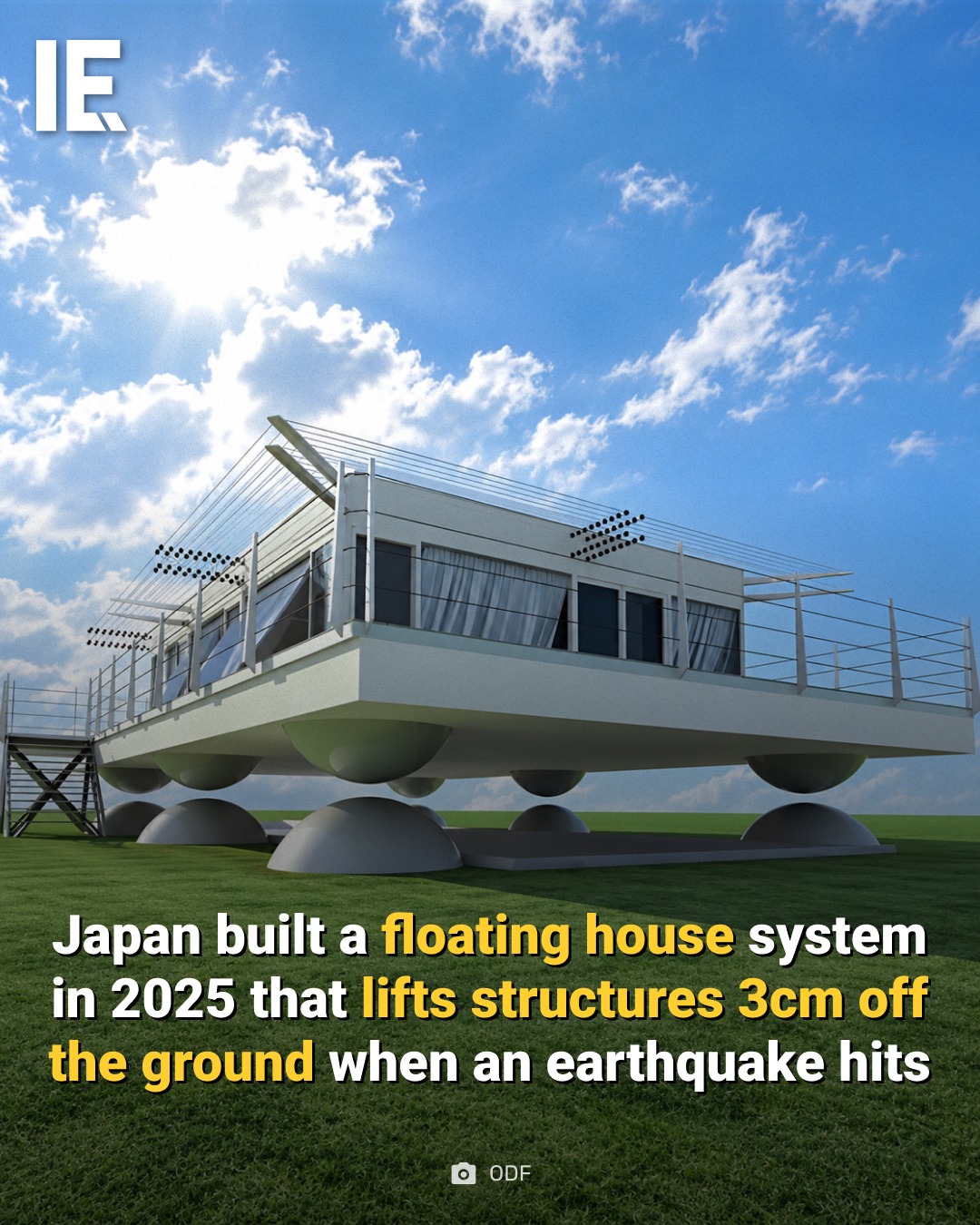
In 2025, Japan launched an innovative floating house system designed to safeguard buildings from earthquake damage. The system lifts structures a mere 3cm off the ground during seismic activity. The design epitomizes Japan's long history of innovation in earthquake engineering, blending state-of-the-art technology with a deep understanding of geological challenges. And yet, this invention is not just a testament to Japan’s engineering prowess but also a crucial step towards mitigating the risks posed by earthquakes across the globe.
The Floating House System
A floating earthquake-resistant house is exactly what it sounds like: a home elevated on spherical supports that float above the ground. The spherical supports, a key feature of the design, enable the house to float during an earthquake, which significantly reduces the shaking forces and potential damage caused by the ground movement. Japan's floating house system was introduced in 2025. The system operates by lifting the house 3cm from the ground upon detecting an earthquake. The spherical supports cushion the impact, preventing severe damage. This offsets the primary challenge of seismic design: to prevent the house from sustaining damage when the ground shifts violently. This design is distinctive in several ways. The floating mechanism itself is groundbreaking, offering a new approach to seismic isolation. The spherical design makes the system adaptable to different soil types and house foundations. Furthermore, its raised height allows for a dual purpose: earthquake protection and space for utilities.
Earthquake Preparedness in Urbanization
Japan’s floating house system aligns with — and pushes — a global trend towards earthquake-resistant infrastructure. Urbanization brings more people into densely populated areas, placing them at greater risk of earthquake damage. But innovative technology can mitigate that risk. Japan is no stranger to earthquakes. The 2023 Tokai earthquake provided a stark reminder that the country is situated in an earthquake-prone area. Traditional seismic isolation systems, which focus on absorbing vibrations and ground motion, have made remarkable strides. However, the floating system propels seismic design further by lifting the structure entirely.
The Countervailing Supports
The spherical supports are central to the floating house system. Typically made of steel, they use fundamental physics to elevate the structure. The supports can be fixed or adjustable, depending on the foundation and soil type of the house. They are particularly crucial during an earthquake, when the supports interact with the ground to dampen vibrations and reduce the risk of collapse. A floating house can be constructed quickly, without a significant increase in cost compared to standard houses. The spherical supports are durable, and modern manufacturing techniques ensure that build times remain competitive. At the same time, the geometric design of the supports provides additional stability — it’s easier to design for strength and resilience with a spherical form.
The Mechanics of the Mechanism
How does the floating house system function? The system employs sensors to detect the onset of an earthquake, activating the lifting mechanism instantaneously. The spherical supports contain hydraulic or pneumatic systems that respond to the seismic activity. These systems rapidly elevate the house, ensuring that the structure remains stable and secure. The elevation process occurs on a fault line, where the structure is most vulnerable to ground movement. When an earthquake occurs, the system identifies the tremors and activates the supports, which dilate to lift the house. The process is automatic, swift, and highly accurate. This immediate response is critical for minimizing damage and ensuring the safety of occupants.
A Lesson Learned: Earthquake Aftermath
The floating house system offers a lesson in earthquake aftermath. Traditional seismic design has successfully reduced damage, but aftershocks and secondary effects can still cause significant destruction. By lifting the house off the ground, the floating system mitigates some of these secondary effects. This approach can reduce the risk of further damage to the structure and infrastructure. The system’s resilient performance minimizes immediate risk. However, it is equally crucial to address structural integrity after earthquakes. Inspections and repairs are necessary to ensure the stability of the house.
Seismic Isolation and Beyond
The floating house system expands seismic isolation beyond the typical scope. It’s a tangible solution compared to other earthquake-resistant technologies. Traditional seismic technologies tend to focus on isolating the structure from ground motion. Conversely, the floating house system takes a comprehensive approach to prevent the overall building integrity from being compromised during seismic events. This innovation could be the template for future seismic protection in earthquake-prone areas. The system’s simplicity and effectiveness ensure that traditional isolation methods are enhanced, making earthquake protection more accessible and efficient.
The Practical Approach to Floating Houses
For anyone considering building or investing in a floating house system, here are some practical guidelines:
- Building Code Compliance: Ensure that the house design meets local building codes. Compliance will vary by region and will likely require specialized engineering certification.
- Professional Installation: Engage experts in seismic engineering. The installation process is intricate and requires a deep understanding of the technology and its application. It is not a DIY project.
- Regular Maintenance: Regularly inspect and maintain the spherical supports. The longevity of the system depends on the upkeep of its components. Maintenance must be rigorous to ensure reliability when an earthquake strikes.
- Educate Residents: Ensure that residents understand how the system works. Their awareness can prevent panic and ensure a swift response in the event of an emergency. Embracing this system could provide a real step forward towards enhancing earthquake resilience in vulnerable communities.
Watch the Reel
Questions readers ask
How exactly does the floating house system detect earthquakes?
The system employs sensors that detect the initial tremors of an earthquake. Once an earthquake is detected, the spherical supports automatically lift the house 3cm off the ground to minimize the impact of the seismic activity.
Can this floating house system be integrated into existing homes, or is it only for new constructions?
The article doesn't explicitly mention retrofitting. Given the design, it might be more feasible for new constructions. However, it's worth reaching out to the developers for specific details on retrofitting options.
How does the floating house system compare to traditional seismic isolation methods?
Traditional systems focus on absorbing vibrations and ground motion. In contrast, the floating house system lifts the structure entirely, which can potentially offer better protection by reducing the direct impact of ground movement.
Are there any limitations to the floating house system, such as soil type or foundation requirements?
The spherical supports are designed to be adaptable to different soil types and house foundations. However, specific soil conditions might require adjustable supports, so it's important to consider the local geology and consult with the developers.
Can the floating house system be used in other earthquake-prone regions outside Japan?
Yes, the system could potentially be used in other earthquake-prone regions. The design is innovative and could be adapted to different geographies and building standards.
Related deep dives
Similar reads based on topic and creator.

Recent articles
Fresh deep dives from the latest Reels we unpacked.




Comments
Be the first to comment.