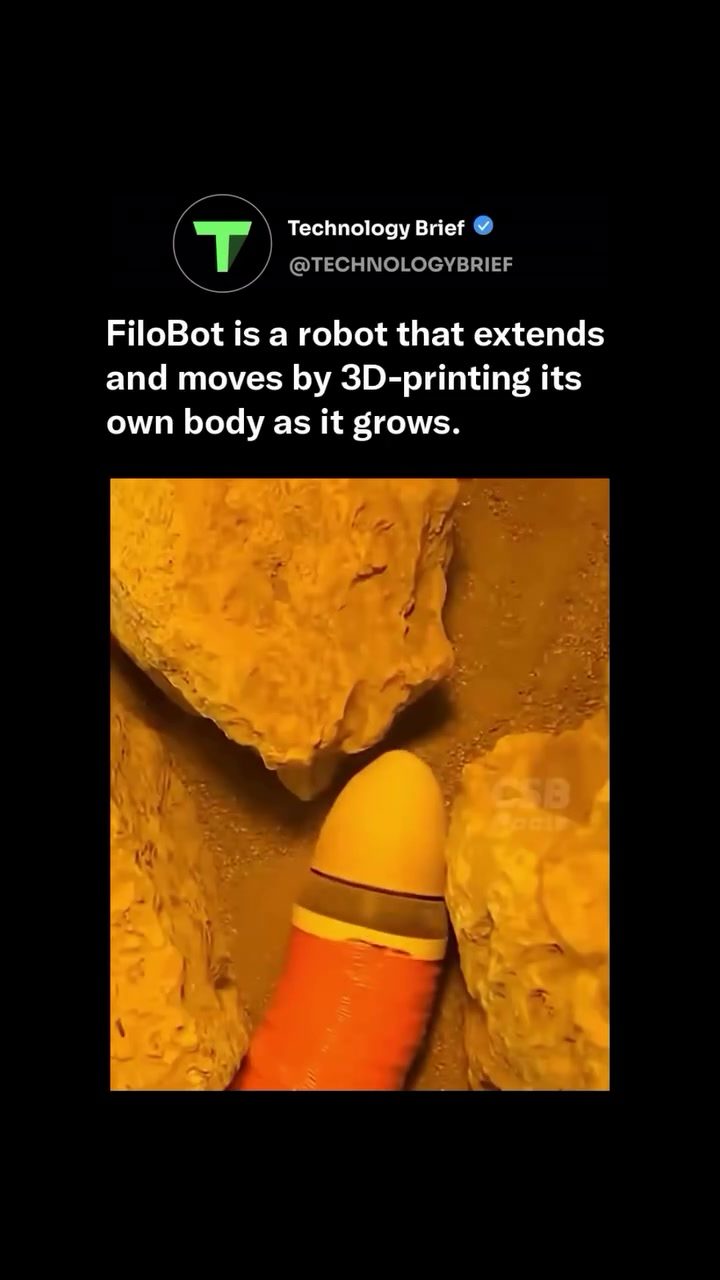
FileoBot: The Vine-Inspired Robot That Builds Its Own Body
FileoBot is a revolutionary robot inspired by the growth patterns of vines. Developed by researchers at Italy’s Istituto Italiano di Tecnologia, this innovative robot moves and extends by 3D-printing its own body. Instead of relying on traditional methods of locomotion like wheels or legs, FileoBot grows and navigates its environment by constructing itself.
Why This Matters
The unique capabilities of FileoBot open up new possibilities for robotics, especially in environments that are challenging for traditional robots. By growing and extending its body, FileoBot can adapt to various terrains and conditions, making it ideal for tasks that require flexibility and adaptability. The potential applications of this technology are vast, ranging from search and rescue missions to environmental monitoring.
FileoBot's Growth and Movement
The 3D-Printing Process
FileoBot’s movement is facilitated by a spinning head that pulls plastic filament up from a spool at its base. This filament is then melted and layered into coiled tubes, creating a stem-like structure that extends behind the robot. This process allows FileoBot to grow and move simultaneously, a unique feature that sets it apart from other robotic systems.
Sensors and Navigation
The robot’s head is equipped with sensors that detect light, shade, and gravity. These sensors play a crucial role in guiding the robot’s growth. By adjusting the deposition of plastic material, FileoBot can steer its growth in a chosen direction. For example, it can curve toward a light source, climb and wind around support structures, or even print a stiffer body to bridge gaps. This adaptability is key to its effectiveness in various environments.
The European GrowBot Project
FileoBot is part of a broader research initiative known as the European GrowBot project, led by Emanuela Del Dottore. The project, which took nearly ten years to develop, aims to create robots that can grow and adapt to their surroundings. The research has been published in the journal Science Robotics, highlighting the significance and potential of this technology.
Potential Applications
Search and Rescue
One of the most promising applications of FileoBot is in search and rescue operations. Its ability to grow and navigate through challenging terrains makes it an ideal tool for reaching areas that are inaccessible to traditional robots. This could be particularly useful in disaster zones where time and access are critical.
Pollution Monitoring
Another potential use is in monitoring pollution in hard-to-reach areas. FileoBot’s adaptability allows it to navigate through dense forests, rocky terrains, and other challenging environments, making it an effective tool for environmental monitoring. This could be especially valuable in areas where traditional methods of monitoring are infeasible.
Risk Assessment
FileoBot can also be used to assess risks in hazardous environments, such as avalanches. Its ability to grow and extend makes it capable of reaching areas that are otherwise inaccessible, providing valuable data for risk assessment and mitigation.
Practical Tips for Utilizing FileoBot
While FileoBot is still in the research phase, there are practical considerations that could guide its future development and deployment. Here are a few tips to keep in mind:
Understanding the Environment
Before deploying FileoBot, it’s essential to understand the environmental conditions it will encounter. This includes factors like terrain, temperature, and the presence of obstacles. This knowledge will help in programming the robot to navigate effectively.
Customizing the Growth Pattern
FileoBot’s growth pattern can be customized to suit specific tasks. For instance, if the goal is to reach a high point, the robot can be programmed to grow taller. If navigation through dense vegetation is required, the growth pattern can be adjusted to ensure the robot can push through obstructions.
Maintenance and Upkeep
Given that FileoBot is a self-growing robot, regular maintenance is crucial. This includes ensuring that the filament supply remains consistent and that the sensors are calibrated correctly. Regular checks can help in identifying any issues early, ensuring the robot operates at its best.
Important Takeaways
FileoBot represents a groundbreaking development in robotics, showcasing how robots can adapt and grow to meet environmental challenges. Its unique 3D-printing mechanism and sensor-guided growth make it a versatile tool with numerous potential applications. From search and rescue to environmental monitoring, FileoBot’s capabilities open up new avenues for robotics in challenging terrains.
Conclusion
FileoBot is a testament to the innovative potential of robotics. By mimicking the growth patterns of vines, this robot offers a new paradigm in how we think about robotic movement and adaptation. As research continues, the possibilities for FileoBot are vast, and its potential applications in various fields are promising. The technology behind FileoBot could pave the way for future advancements in robotics, making it a key player in the evolving landscape of technology.
Watch the Reel
Questions readers ask
How does FileoBot's design differ from traditional robots?
FileoBot's design is unique because it mimics the growth patterns of vines. Unlike traditional robots that use wheels or legs for movement, FileoBot extends its body using 3D printing, allowing it to navigate complex environments in a flexible and adaptable manner.
What are the primary benefits of FileoBot's 3D printing capability?
FileoBot's ability to 3D print its own body as it moves offers several benefits. It allows the robot to adapt to intricate challenges and various terrains, making it ideal for tasks that require a high degree of flexibility and adaptability.
Who developed FileoBot and where is it based?
FileoBot was developed by researchers at the Istituto Italiano di Tecnologia, an institution based in Italy. The unique design and capabilities of this robot reflect the innovative prowess of the Italian research community.
What are the potential applications of FileoBot's technology?
FileoBot's capabilities make it particularly suitable for tasks such as search and rescue operations and environmental monitoring. Its ability to adapt to different terrains and conditions allows it to reach areas that are difficult for traditional robots to access.
How does FileoBot's vine-inspired design help in navigating challenging environments?
FileoBot's vine-like design allows it to grow and extend its body, making it highly adaptable to various terrains. This growth mechanism enables the robot to navigate through narrow spaces, climb obstacles, and traverse uneven surfaces with greater ease compared to traditional robotic designs.
What makes FileoBot a promising tool for search and rescue missions?
FileoBot's ability to extend its body and navigate through intricate challenges makes it an ideal tool for search and rescue missions. It can reach areas that are inaccessible to traditional robots, providing a more comprehensive search and rescue effort in disaster zones or remote locations.
Can FileoBot operate autonomously, and if so, how does it navigate its environment?
FileoBot is designed to operate autonomously, utilizing sensors and algorithms to navigate its environment. By 3D printing its body as it moves, the robot can adapt to changing conditions and complex terrains, ensuring it can continue its mission without external intervention.
Related deep dives
Similar reads based on topic and creator.




Recent articles
Fresh deep dives from the latest Reels we unpacked.




Comments
Be the first to comment.