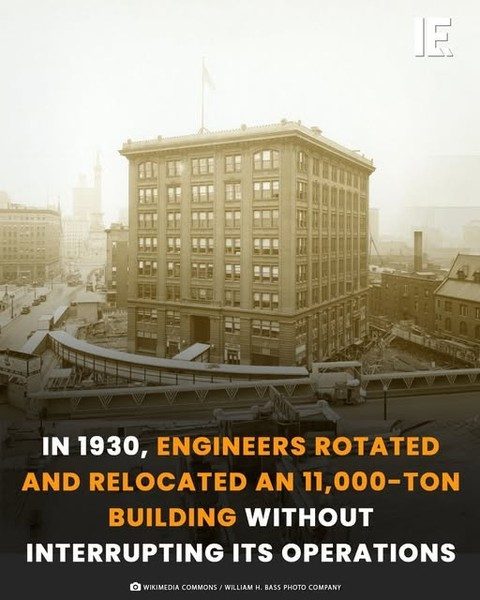
Historical Building Relocation
In 1930, the Indiana Bell Telephone Company undertook an extraordinary engineering feat by relocating and rotating its eight-story, 22-million-pound headquarters. This impressive project involved moving the building 52 feet south and rotating it 90 degrees over 34 days, all while 600 employees continued working inside. Utilities such as gas, water, and electricity remained connected throughout the process, ensuring uninterrupted operations. This remarkable achievement highlights the ingenuity and precision of early 20th-century engineering.
Why This Matters
The relocation of the Indiana Bell Telephone Company's headquarters is more than just an interesting historical event. It serves as a testament to the innovative solutions that engineers can devise to tackle complex challenges. The project demonstrates how strategic planning, meticulous execution, and adaptability can overcome the most daunting obstacles. This case study offers valuable insights into the history of engineering and the evolving capabilities of modern infrastructure.
Key Aspects of the Project
The Challenging Task
Moving an 11,000-ton building without interrupting its operations was no small feat. The building, which housed the headquarters of the Indiana Bell Telephone Company, was an essential hub for communication services in the region. The sheer size and weight of the structure posed significant logistical challenges. Engineers had to devise a method that not only moved the building but also ensured that it could continue to function during the relocation.
The Engineering Solutions
To accomplish this, engineers employed a combination of sophisticated techniques and practical solutions. The building was carefully lifted and placed onto a series of hydraulic jacks. These jacks allowed for precise control over the movement, ensuring that the structure remained stable throughout the process.
Flexible lines for utilities were another crucial component. By using flexible piping and wiring, engineers ensured that gas, water, and electricity remained connected without interruption. This allowed the 600 employees working inside to continue their duties uninterrupted, maintaining the building's operational status.
The Logistics of Movement
The relocation involved moving the building 52 feet south and rotating it 90 degrees. This required a meticulous plan to ensure that the structure didn't sustain any damage. The rotation was particularly complex, as it required precise coordination to avoid any disruptions to the internal operations. Over the course of 34 days, the engineers executed this plan flawlessly, moving the building to its new position without any major issues.
Historical Context
The Indiana Bell Telephone Company's headquarters relocation is a notable event in engineering history. It was a time when infrastructure development was rapidly advancing, and this project showcased the cutting-edge techniques of the era. The building, which was inaugurated in 1925, was designed by noted architect William E. Boehne. By 1930, the need for expansion became apparent, leading to the ambitious relocation project.
Practical Tips for Modern Engineers
While the specific techniques used in 1930 may seem outdated, the principles behind them remain relevant. Here are some practical tips derived from this historical project:
Plan Thoroughly
A detailed and well-thought-out plan is crucial for any large-scale engineering project. The Indiana Bell Telephone Company's relocation was a testament to the importance of thorough planning and execution. Modern engineers can benefit from studying historical cases to understand the significance of meticulous planning.
Adaptability is Key
Flexibility in design and execution is essential. The use of flexible utility lines in this project allowed operations to continue uninterrupted. Similarly, engineers today can adopt adaptable solutions to ensure that projects run smoothly, even in the face of unexpected challenges.
Precision Matters
The precision required to rotate and move the building without any damage highlights the importance of accuracy in engineering. Modern engineers can adopt precision engineering techniques to ensure the success of their projects.
Important Takeaways
The relocation of the Indiana Bell Telephone Company's headquarters offers several important lessons:
Innovation Can Overcome Challenges
The project showcases how innovative engineering solutions can overcome seemingly insurmountable challenges. The techniques and strategies used in this project can inspire modern engineers to think creatively and find innovative solutions to complex problems.
Historical Projects Provide Valuable Insights
Studying historical engineering projects can provide valuable insights into the evolution of engineering practices. The Indiana Bell Telephone Company's relocation project is a prime example of how early 20th-century engineering techniques laid the foundation for modern practices.
Human Ingenuity and Precision
The project was a testament to the ingenuity and precision of human engineering. The careful planning, meticulous execution, and adaptability demonstrated in this project are qualities that remain essential for successful engineering projects today.
Conclusion
The relocation of the Indiana Bell Telephone Company's headquarters in 1930 stands as a remarkable feat of engineering. From the meticulous planning to the innovative use of flexible utility lines, this project showcased the ingenuity and precision that are hallmarks of successful engineering endeavors. By studying this historical event, modern engineers can gain valuable insights into the principles and techniques that continue to guide the field today.
Watch the Reel
Questions readers ask
Why did the Indiana Bell Telephone Company move its headquarters in 1930?
The Indiana Bell Telephone Company moved its headquarters to facilitate the expansion of Monument Circle, a prominent landmark in Indianapolis. The move allowed for the creation of a larger traffic circle and the development of surrounding streets.
How was the building moved without interrupting the employees' work?
The building was moved 52 feet south and rotated 90 degrees using a complex system of hydraulic jacks, steel beams, and rail tracks. The 600 employees continued to work inside, with utilities such as gas, water, and electricity remaining connected throughout the 34-day process.
What challenges did the engineers face during the building move?
Engineers had to ensure the building's structural integrity while it was moved. They also had to precisely coordinate the movement to avoid damaging nearby structures. Additionally, they had to keep utilities connected and maintain a safe and functional work environment for employees.
What made this building move unique for its time?
The scale and precision of the move were unprecedented for the era. The fact that the building was occupied and operational throughout the process made it a remarkable engineering achievement. This feat showcased the innovative problem-solving and technical capabilities of early 20th-century engineers.
How long did the building move take, and what was the final position?
The entire process took 34 days. The building was moved 52 feet south and rotated 90 degrees to its final position, allowing for the expansion of Monument Circle and the development of the surrounding area.
What can we learn from the Indiana Bell Telephone Company's building move today?
This historic event demonstrates the importance of innovative thinking and precise engineering. It also highlights the potential for complex, large-scale projects to be executed successfully, even in challenging conditions. Today, such projects often involve careful planning and coordination to minimize disruptions and ensure safety.
Were there any similar building moves during that time period?
While there were other notable building relocations in the early 20th century, the Indiana Bell Telephone Company's move stands out due to its scale, precision, and the fact that it was carried out while the building was fully occupied and operational. Other notable moves include the relocation of the Manhattan Building in New York City and the moving of the Bank of America Building in Los Angeles, but both were conducted under different circumstances.
Related deep dives
Similar reads based on topic and creator.



Recent articles
Fresh deep dives from the latest Reels we unpacked.




Comments
Be the first to comment.