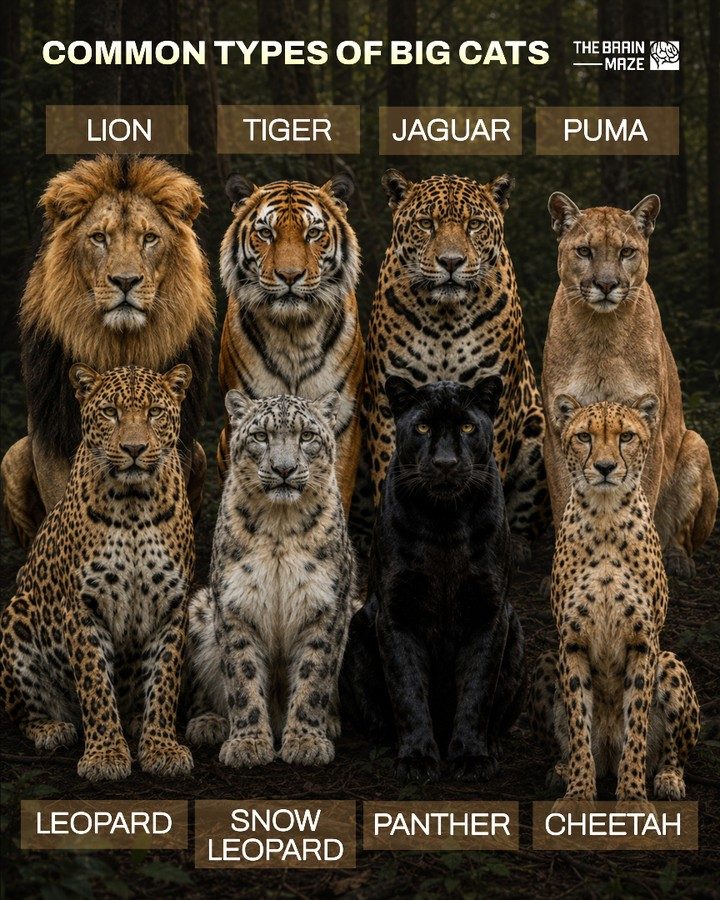
Big Cat Identification
Big cats are some of the most awe-inspiring and powerful predators on the planet. Each species has evolved unique hunting skills and survival strategies that allow them to thrive in diverse environments. From the open savannas to dense forests and towering mountains, these felines exhibit a remarkable range of adaptations. Let's explore the common types of big cats, their distinctive characteristics, and what makes them so extraordinary.
Context / Why this matters
Understanding the different types of big cats is more than just a fascinating journey into the natural world; it's also crucial for conservation efforts. Each species faces unique challenges, from habitat loss to poaching, and recognizing their individual needs is vital for their survival.
Main discussion
Lions: The Social Hunters
Lions are renowned for their social structure, living in prides that can include up to three males, a dozen or so females, and their young. This cooperative lifestyle is a key to their success in open landscapes. Lions are apex predators, meaning they sit at the top of the food chain, and their hunting strategies often involve teamwork. These big cats are known for their strength and powerful jaws, which they use to take down large prey such as zebras, buffaloes, and even young elephants.
Lions are also known for their distinctive manes in males, which serve as a signal of health and dominance. These majestic creatures are found in various habitats across Africa and a small population in the Gir Forest of India.
Tigers: The Stealthy Powerhouses
Tigers are solitary hunters, relying on stealth and explosive power to ambush their prey. They are the largest species of the cat family and are known for their distinctive orange and black stripes, which provide excellent camouflage in their forest habitats. Tigers are powerful swimmers and climbers, making them versatile hunters in diverse environments, from dense forests to grasslands and even mangrove swamps.
Unlike lions, tigers are territorial and usually hunt alone. Their powerful jaws and sharp claws enable them to take down prey much larger than themselves, including deer, wild pigs, and even young elephants. Despite their strength, tigers face significant threats from habitat loss and poaching, making conservation efforts crucial for their survival.
Jaguars: The Strong Biters
Jaguars possess one of the strongest bites of any cat, with powerful jaws that allow them to pierce the shells of armadillos and the tough hides of caimans. They are found in a variety of habitats, including tropical rainforests, grasslands, and even deserts. Jaguars are excellent swimmers and climbers, using these skills to ambush prey from trees or water.
Their distinctive rosytailed pattern provides excellent camouflage, making them difficult to spot in their natural habitat. Jaguars are known for their adaptability, thriving in a range of environments from the Amazon rainforest to the savannas of Central America. They play a crucial role in maintaining the balance of their ecosystems by controlling the populations of their prey.
Leopards: The Agile Climbers
Leopards are known for their agility and adaptability, thriving in a variety of environments from dense forests to arid deserts. They are skilled climbers, often dragging their prey up into trees to keep it safe from other predators. Leopards have a distinctive rosette pattern on their coat, which provides excellent camouflage in their habitats.
These big cats are solitary and territorial, hunting alone and marking their territories with scent marks and vocalizations. Leopards are opportunistic hunters, preying on a variety of animals from small rodents to large ungulates. Their adaptability and versatility make them one of the most successful big cat species.
Snow Leopards: The Mountain Specialists
The snow leopard is adapted to survive in the harsh, cold environment of the mountains. Their thick coat provides insulation against the cold, and their large, furry paws act as natural snowshoes, helping them navigate through deep snow. Snow leopards are solitary and territorial, hunting alone and marking their territories with scent marks and vocalizations.
Their primary prey includes ibex, blue sheep, and marmots, which they stalk and ambush with stealth and speed. Despite their elusive nature, snow leopards face significant threats from habitat loss and poaching, making conservation efforts crucial for their survival.
Pumas: The Versatile Hunters
Pumas, also known as mountain lions or cougars, are found throughout the Americas, from Canada to South America. They are known for their versatility and adaptability, thriving in a variety of habitats from dense forests to deserts and grasslands. Pumas are solitary and territorial, hunting alone and marking their territories with scent marks and vocalizations.
Their powerful bodies and sharp claws make them formidable hunters, capable of taking down prey much larger than themselves, including deer, elk, and even moose. Pumas are known for their stealth and patience, often stalking their prey for long periods before making a quick and powerful attack.
Panthers: The Melanistic Marvels
The term "panther" is often used to describe any large cat with a black coat, which can include black leopards, jaguars, and even black tigers. Melanism, the condition that causes this dark coloration, provides excellent camouflage in low-light conditions. Panthers are known for their powerful bodies and sharp claws, making them formidable hunters.
Their diet varies depending on the species, but they typically prey on a variety of animals, from small rodents to large ungulates. Panthers are territorial and solitary, hunting alone and marking their territories with scent marks and vocalizations.
Cheetahs: The Speed Icons
Cheetahs are renowned for their unmatched speed, capable of reaching speeds up to 70-75 miles per hour in short bursts. This incredible speed, along with their long, slender bodies and distinctive "tear marks" running from the corners of their eyes to their mouths, makes them one of the most recognizable big cats. Cheetahs are found primarily in the open grasslands and savannas of Africa, where their speed and agility allow them to take down prey such as gazelles, impalas, and even young wildebeest.
Cheetahs are also known for their distinctive hunting style, using their speed to chase down their prey in short, explosive bursts. Despite their speed, cheetahs face significant threats from habitat loss and human-wildlife conflict, making conservation efforts crucial for their survival.
Practical tips
Identifying Big Cats
Identifying big cats can be a challenging but rewarding experience. Here are some practical tips to help you distinguish between these remarkable felines:
- Coat Patterns and Colors: Each big cat has a unique coat pattern and coloration. For example, leopards have rosettes, jaguars have rosettes with spots in the center, and tigers have distinctive stripes.
- Body Shape and Size: The body shape and size of big cats can vary significantly. For instance, cheetahs have long, slender bodies, while lions and tigers are more muscular and robust.
- Behavior and Habitat: Observing the behavior and habitat of big cats can also provide clues to their identity. For example, lions are social and live in prides, while tigers are solitary and territorial.
- Geographic Location: Knowing the geographic location can help narrow down the possibilities. For example, snow leopards are found in the mountainous regions of Central Asia, while cheetahs are found in the open grasslands of Africa.
Conservation and Ethics
When observing or studying big cats, it's essential to prioritize their well-being and conservation. Here are some ethical considerations to keep in mind:
- Respect Their Habitat: Always maintain a safe and respectful distance from wild animals. Avoid disturbing their habitats or causing stress to the animals.
- Support Conservation Efforts: Contribute to organizations that work towards the conservation of big cats and their habitats. This can include donating, volunteering, or spreading awareness about their plight.
- Follow Local Guidelines: Adhere to local guidelines and regulations regarding wildlife observation and photography. This can help ensure the safety and well-being of both the animals and the observers.
Important takeaways
Big cats are not only fascinating creatures but also play a crucial role in their ecosystems. Each species has unique adaptations and behaviors that allow them to thrive in diverse environments. By understanding and appreciating these remarkable felines, we can contribute to their conservation and ensure their survival for future generations.
Conclusion
The world of big cats is a testament to the incredible diversity and power of nature's hunters. From the social lions to the stealthy tigers, the strong-biting jaguars, and the agile leopards, each species showcases unique survival strategies and adaptations. Recognizing and appreciating these exceptional predators is the first step towards ensuring their protection and the preservation of their habitats. By supporting conservation efforts and promoting responsible observation, we can help safeguard the future of these magnificent creatures.
Watch the Reel
Questions readers ask
What are the eight big cat species and where can they be found?
The eight big cat species are lions, tigers, jaguars, leopards, snow leopards, cheetahs, pumas, and panthers. They inhabit various locations, from the savannas of Africa (lions, cheetahs) and the rainforests of South America (jaguars, panthers) to the dense forests of Asia (tigers, leopards) and the mountains of Central Asia (snow leopards). Pumas are found throughout the Americas, from Canada to South America.
What makes a big cat a big cat?
Big cats are defined by their size and strength, but also by their ability to roar. This capability is due to a unique throat structure with a fully ossified hyoid bone, which amplifies the sound. However, not all big cats roar; for instance, cheetahs and pumas purr instead, retaining a flexible hyoid bone.
What are the key differences between lion behavior and tiger hunting?
Lions are social animals, living in prides and collaborating in hunting, while tigers are solitary and hunt alone. Tigers are also known for their aquatic prowess, often stalking and taking prey from water, a trait not seen in lions.
What makes jaguar habitat unique among big cats?
Jaguars are the largest cats in the Americas and are well-adapted to various environments, from dense rainforests to open grasslands and deserts. They are exceptional swimmers and climbers, using these skills to hunt and navigate their habitats. Jaguars are also known to have a powerful bite, strong enough to pierce turtle shells.
How do leopards and snow leopards differ in their survival strategies?
Leopards are known for their strength and stealth, often dragging prey up into trees to keep it safe from competitors. They inhabit a wide range of habitats across Africa and Asia. Snow leopards, on the other hand, are adapted to the cold, high-altitude environments of Central Asia, with thick fur and a long tail for balance in rocky terrains.
Why is cheetah speed so remarkable among big cats?
Cheetahs are the fastest land animals, capable of reaching speeds up to 70 miles per hour in short bursts. Their speed is due to a unique physique, including long legs, a flexible spine, and a unique gait that allows them to cover large distances quickly. Their hunting strategy relies on this speed to catch fast-moving prey, such as gazelles and impalas.
What are some key puma characteristics that set them apart from other big cats?
Pumas, also known as mountain lions, are known for their adaptability and versatility. They have a wide range, from Canada to South America, and can thrive in various habitats, including forests and deserts. Pumas are solitary and territorial, relying on their strength and stealth for hunting, with a diverse diet that includes deer, elk, and even porcupines.
Recent articles
Fresh deep dives from the latest Reels we unpacked.




Comments
Be the first to comment.