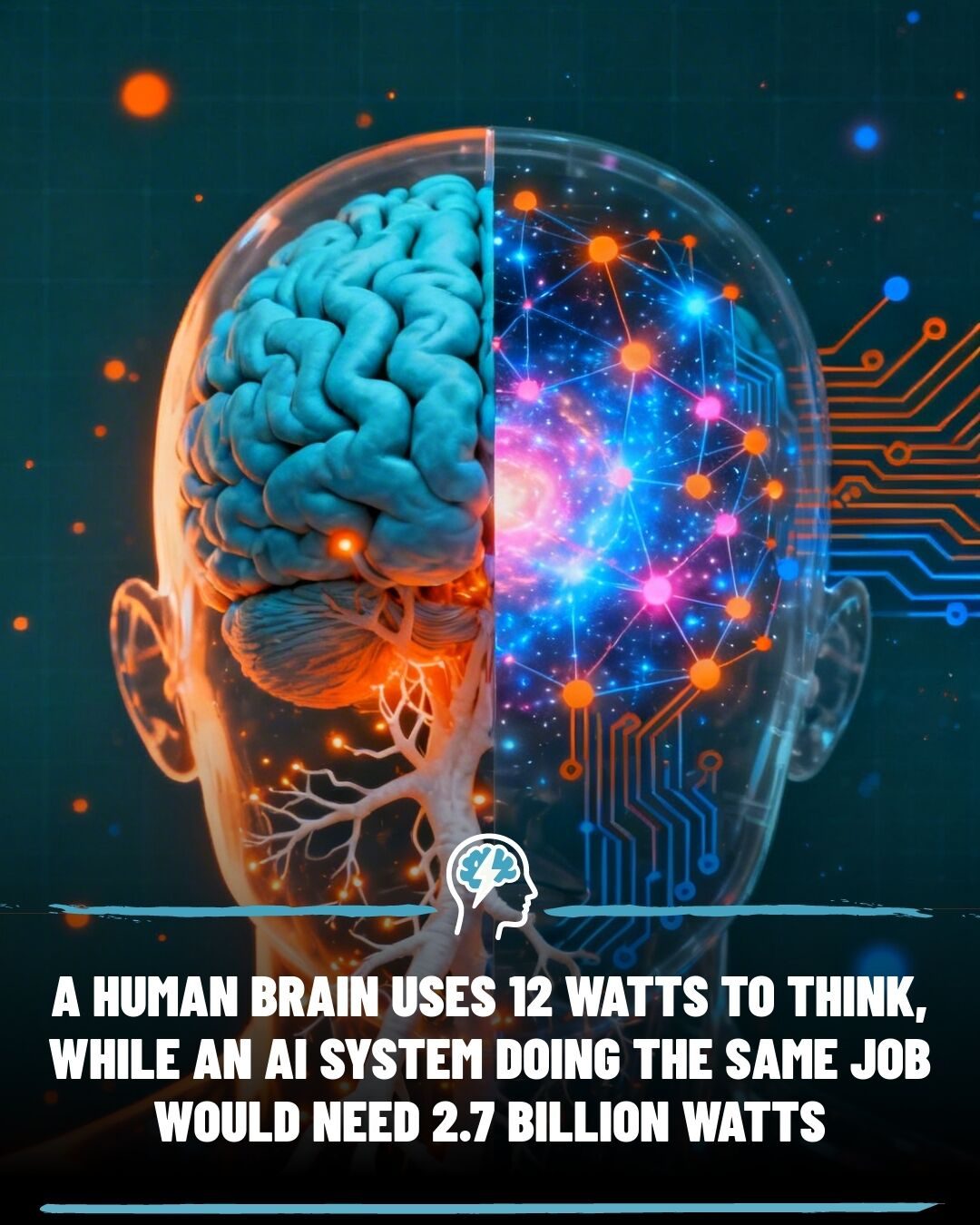
AI vs. Human Brain Power
The human brain is an incredible machine, operating on mere watts while performing complex tasks like memory retention, emotional processing, and creative problem-solving. This biological marvel is often compared to advanced AI systems and supercomputers, highlighting just how efficient the brain truly is.
Context / Why this matters
Understanding the power efficiency of the human brain is crucial for several reasons. Firstly, it provides insights into the remarkable capabilities of biological neural networks. Secondly, it serves as a benchmark for developing more energy-efficient computing systems. Lastly, it sparks interest in neuromorphic computing, a field focused on creating AI systems inspired by the brain's structure and function.
Main discussion
Power Consumption
The human brain uses a mere 12 to 20 watts of power to think, which is roughly the same as a dim lightbulb. In contrast, an AI system performing the same cognitive tasks would require an astonishing 2.7 billion watts. This stark difference in energy consumption is what makes the human brain one of the most energy-efficient systems known to us. The Frontier supercomputer, for instance, one of the world's most powerful machines, requires around 20 megawatts to perform its calculations. This is approximately a million times more energy than the brain uses.
Efficiency and Processing
The brain's efficiency lies in its ability to integrate learning, memory, and processing all within the same physical structures. Unlike traditional computers that separate these functions, the brain's neurons handle multiple tasks simultaneously. This parallel processing allows the brain to perform complex operations with minimal energy expenditure.
Neuromorphic Computing
The gap in efficiency between the human brain and AI systems has sparked the field of neuromorphic computing. This involves designing chips inspired by biological brain mechanisms. The goal is to create AI systems that don't require enormous power supplies to operate. By mimicking the brain's processing methods, researchers hope to develop more sustainable and efficient technology.
Limitations and Caveats
While the brain excels at pattern recognition and adaptive learning, supercomputers still outperform it at specific calculations. These represent fundamentally different types of processing, and direct comparisons can oversimplify complex realities. For example, supercomputers excel at performing a large number of calculations very quickly, which is useful for tasks like weather modeling and cryptography. Meanwhile, the brain's strength lies in its ability to perform complex, adaptive tasks using a fraction of the energy.
Additionally, specific energy claims for AI systems can vary widely depending on how measurements are taken. The broader efficiency gap is well supported, but precise figures should be interpreted carefully. It's important to note that the energy consumption of AI systems and supercomputers can fluctuate based on factors such as the complexity of the task, the efficiency of the hardware, and the specific algorithms used.
Practical tips
For researchers and engineers aiming to bridge the efficiency gap, here are some practical tips:
- Study Biological Neural Networks: Deepen understanding of how the brain processes information and applies it to create more efficient algorithms.
- Design Integrated Systems: Create hardware and software that integrate learning, memory, and processing in a similar way to the brain.
- Optimize for Parallel Processing: Focus on developing systems that can handle multiple tasks simultaneously, reducing the need for high energy consumption.
- Explore Alternative Materials: Research materials that can replicate the brain's efficiency in energy use, such as those used in neuromorphic computing.
- Benchmark Against Biological Models: Use the brain as a benchmark for developing more sustainable and efficient computing systems.
Important takeaways
- Energy Efficiency: The human brain is remarkably energy-efficient, using only 12 to 20 watts to perform complex cognitive tasks.
- Parallel Processing: The brain's ability to handle multiple tasks simultaneously is a key factor in its efficiency.
- Neuromorphic Computing: Inspired by the brain, this field aims to create more sustainable and efficient AI systems.
- Different Strengths: While the brain excels at pattern recognition and adaptive learning, supercomputers are superior at specific calculations.
- Research Opportunities: Understanding the brain's efficiency can lead to advancements in sustainable technology.
Conclusion
The human brain's energy efficiency is a source of inspiration and a benchmark for developing more sustainable technology. By studying biological neural networks and applying these principles to future technology, researchers can create AI systems that are both powerful and energy-efficient. The future of technology lies in bridging the gap between biological and artificial intelligence, and understanding the brain's efficiency is a critical step in this journey.
Watch the Reel
Questions readers ask
Why is the human brain considered more efficient than AI systems?
The human brain is considered more efficient due to its ability to perform complex tasks using only 12 to 20 watts of power, while AI systems and supercomputers require significantly more energy to achieve similar cognitive tasks.
What kind of tasks can the human brain perform efficiently?
The human brain can efficiently handle a wide range of tasks, including memory retention, emotional processing, and creative problem-solving, all while consuming minimal power.
How does the brain's structure contribute to its efficiency?
The brain's unique structure and processing capabilities allow it to perform complex tasks efficiently. Researchers are inspired by these features to develop more energy-efficient AI systems.
What is neuromorphic computing, and why is it important?
Neuromorphic computing is a field focused on creating AI systems inspired by the brain's structure and function. It is important because it aims to develop more energy-efficient computing systems by mimicking the brain's processing power.
Why is it important to compare the power efficiency of the human brain to AI systems?
Comparing the power efficiency of the human brain to AI systems provides insights into the remarkable capabilities of biological neural networks and serves as a benchmark for developing more energy-efficient computing systems.
How much power does the human brain consume?
The human brain consumes only 12 to 20 watts of power, making it an astonishingly efficient machine capable of performing complex tasks with minimal energy.
What can AI researchers learn from the human brain's efficiency?
AI researchers can learn about the brain's unique structure and processing capabilities, which could inspire the development of more energy-efficient AI systems. This comparison highlights the brain's incredible power and efficiency.
Related deep dives
Similar reads based on topic and creator.



Recent articles
Fresh deep dives from the latest Reels we unpacked.




Comments
Be the first to comment.