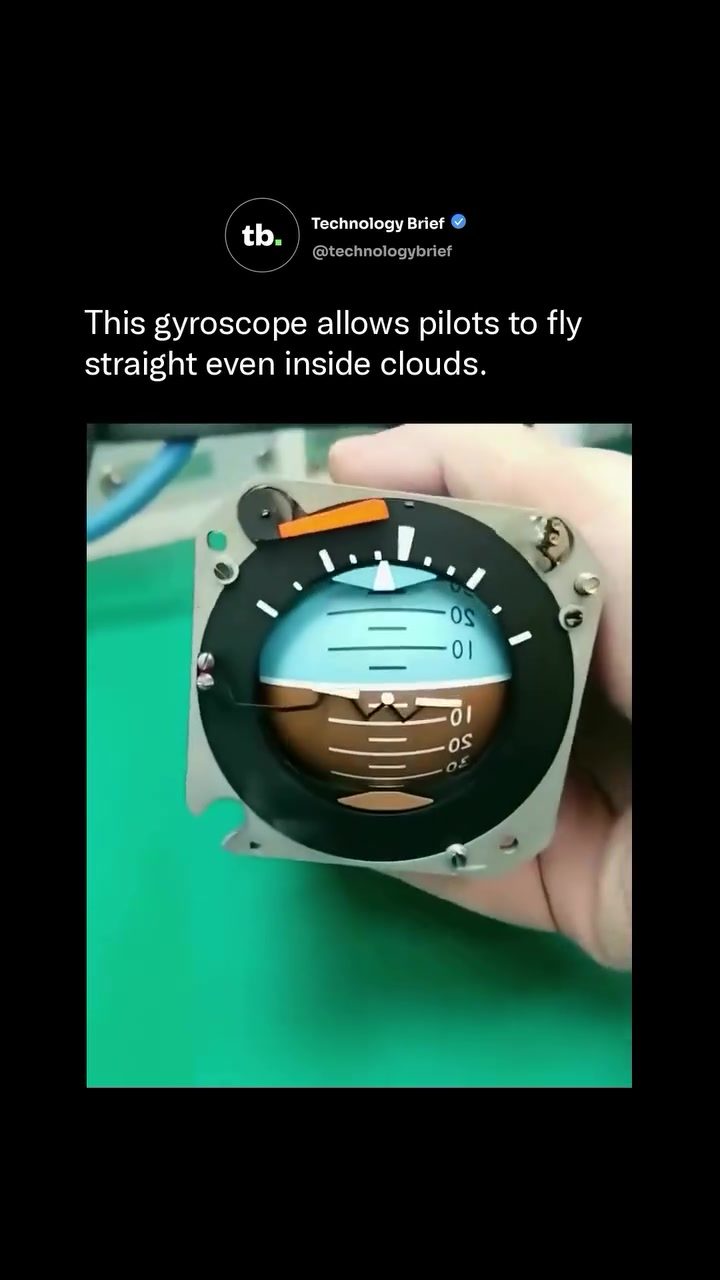
Gyroscopes in Aviation: Maintaining Orientation in the Sky
Gyroscopes are essential tools in aviation, particularly for maintaining orientation and stability. They are especially crucial for pilots flying through clouds, fog, or darkness, where visual references are obscured. This article delves into the workings of gyroscopes, their role in the attitude indicator, and their significance in modern and traditional aviation.
Why This Matters
Understanding gyroscopes and their application in aviation is vital for appreciating how pilots navigate and maintain control of their aircraft, especially in challenging conditions. The attitude indicator, also known as the artificial horizon, is a critical instrument in the cockpit that relies on a gyroscope. This instrument helps pilots read their exact pitch and bank, ensuring they can fly straight and level even when visual references are unavailable.
The Attitude Indicator and Gyroscopes
The Design and Function of the Attitude Indicator
The attitude indicator displays a blue upper half representing the sky and a brown lower half representing the ground. Degree markings at 10, 20, and 30 degrees allow pilots to quickly assess their pitch and bank. The key component of this instrument is a gyroscope spinning at an incredible speed of between 10,000 and 15,000 revolutions per minute. This high-speed rotation creates a property called rigidity in space, meaning the gyroscope resists any change to its orientation.
How Gyroscopes Work
When the aircraft rolls or pitches, the instrument case moves around the gyroscope, but the gyroscope itself remains locked in place. This stability ensures that the displayed horizon stays accurate, regardless of the aircraft's maneuvers. The rigidity in space allows the gyroscope to maintain its orientation, providing a reliable reference point for the pilot.
Gyroscopes in Challenging Conditions
The attitude indicator is indispensable for flying through clouds, fog, or darkness. In these conditions, there is no real horizon to look at, and the inner ear cannot reliably detect gradual turns or rolls. Without the attitude indicator, pilots can easily become disoriented, leading to potentially dangerous situations. The gyroscope's ability to maintain a stable reference point helps pilots stay oriented and navigate safely.
For example, imagine flying through a thick cloud where the pilot can't see the ground or the sky. The attitude indicator, powered by the gyroscope, provides a steady visual cue, allowing the pilot to maintain a straight and level flight path.
Modern Aviation and Gyroscopes
The Evolution of Gyroscopes
In modern glass cockpit aircraft, the traditional spinning gyroscope has been replaced with solid-state sensors. These sensors use advanced technology to mimic the properties of a spinning gyroscope, providing the same reliable orientation data without the mechanical components. Despite this technological advancement, the fundamental principles remain the same.
The Importance of Gyroscopes in Modern Cockpits
Even with the shift to digital displays, the core idea of using a gyroscope to maintain orientation persists. Modern aircraft still rely on the concept of rigidity in space to provide accurate and reliable information to the pilot. This ensures that even in the most challenging conditions, pilots have the tools they need to navigate safely.
Practical Tips for Understanding Gyroscopes
Recognizing the Attitude Indicator
When flying or observing an aircraft cockpit, take a moment to locate the attitude indicator. Notice the blue and brown halves and the degree markings. Understanding how to read this instrument can provide a deeper appreciation for the role of gyroscopes in aviation.
Observing Gyroscope Demonstrations
Watch demonstrations of gyroscopes in action. Seeing the high-speed rotation and understanding how it achieves rigidity in space can provide a clearer picture of how this technology is applied in aviation.
Exploring Modern Cockpits
Visit aviation museums or take a tour of a modern cockpit to see how gyroscopes and their digital counterparts are integrated into the systems. This hands-on experience can enhance your understanding of how these instruments work and their significance in aviation.
Important Takeaways
The Crucial Role of Gyroscopes
Gyroscopes are fundamental to the operation of the attitude indicator, providing pilots with a reliable reference point for maintaining orientation. Their ability to resist changes in orientation makes them indispensable for safe navigation in challenging conditions.
The Evolution from Mechanical to Digital
While traditional gyroscopes are still used, modern glass cockpit aircraft have transitioned to solid-state sensors. However, the core principles of gyroscopes remain the foundation of these advanced systems.
The Significance in Aviation
Understanding gyroscopes and their applications in aviation enhances appreciation for the technology that keeps pilots and passengers safe. Whether in traditional or modern cockpits, gyroscopes play a vital role in maintaining orientation and ensuring safe flights.
Conclusion
Gyroscopes are more than just spinning mechanisms; they are the backbone of aviation navigation. By providing a stable reference point, they enable pilots to maintain control and navigate safely, even in the most challenging conditions. Whether in traditional aircraft or modern glass cockpits, the principles of gyroscopic rigidity in space remain essential for safe and reliable flight. Next time you see an attitude indicator, remember the gyroscope inside that keeps the horizon steady, ensuring the safety of everyone on board.
Watch the Reel
Questions readers ask
What is the primary function of a gyroscope in aviation navigation?
The primary function of a gyroscope in aviation navigation is to maintain a stable reference point, which helps pilots determine the aircraft's pitch and bank. This is especially crucial in low-visibility conditions where external visual references are minimal or absent.
How does a gyroscope help with instrument flying?
A gyroscope assists in instrument flying by powering essential cockpit instruments like the attitude indicator. This instrument displays the aircraft's orientation relative to the earth's horizon, allowing pilots to maintain control and navigate safely even when flying through clouds or in darkness.
What is the attitude indicator, and how is it related to the gyroscope?
The attitude indicator, also known as the artificial horizon, is a cockpit instrument that shows the aircraft's pitch and bank. It relies on a gyroscope to maintain a stable reference point, ensuring that pilots can read and trust the instrument's display, which is vital for safe navigation.
Can a gyroscope be used for aircraft stabilization?
Yes, a gyroscope can significantly contribute to aircraft stabilization. By providing a steady reference point, gyroscopes help stabilize the aircraft's orientation, which is particularly important in maintaining control during turbulence or in low-visibility conditions.
How do pilots use a gyroscope when flying in low visibility?
When flying in low visibility, such as through clouds or fog, pilots rely on the gyroscope-powered attitude indicator to maintain situational awareness. The instrument provides critical information on the aircraft's orientation, helping pilots to navigate safely without relying on external visual cues.
What happens if the gyroscope in a cockpit malfunctions?
If the gyroscope in a cockpit malfunctions, pilots may lose a critical reference point for maintaining orientation. This can make it difficult to navigate, especially in low-visibility conditions. Pilots are trained to recognize and respond to such failures, often relying on other navigational aids and instruments to maintain control of the aircraft.
How is the gyroscope integrated into modern aviation systems?
In modern aviation systems, the gyroscope is often integrated into various instruments and systems, including the attitude indicator, heading indicator, and autopilot. These integrations ensure that pilots have reliable information on the aircraft's orientation and can maintain stable flight paths, even in challenging conditions.
Related deep dives
Similar reads based on topic and creator.




Recent articles
Fresh deep dives from the latest Reels we unpacked.




Comments
Be the first to comment.