ChatGPT 4 and the New Benchmarks of AI Intelligence
ChatGPT, the language model developed by OpenAI, has garnered significant attention for its ability to generate human-like responses across a variety of situations. The conversation around AI capabilities has taken a leap forward with the release of OpenAI's GPT-4 in March 2023. This model showcases impressive results on various standardized tests, offering a real-world perspective on its intelligence.
Context / Why This Matters
The benchmarking of AI models against standardized tests is crucial for understanding their practical applications and limitations. GPT-4's performance on exams like the GRE, LSAT, and advanced placement tests provides insights into its capabilities and areas where it still needs improvement.
Main Discussion
GPT-4 vs. Human Examinees
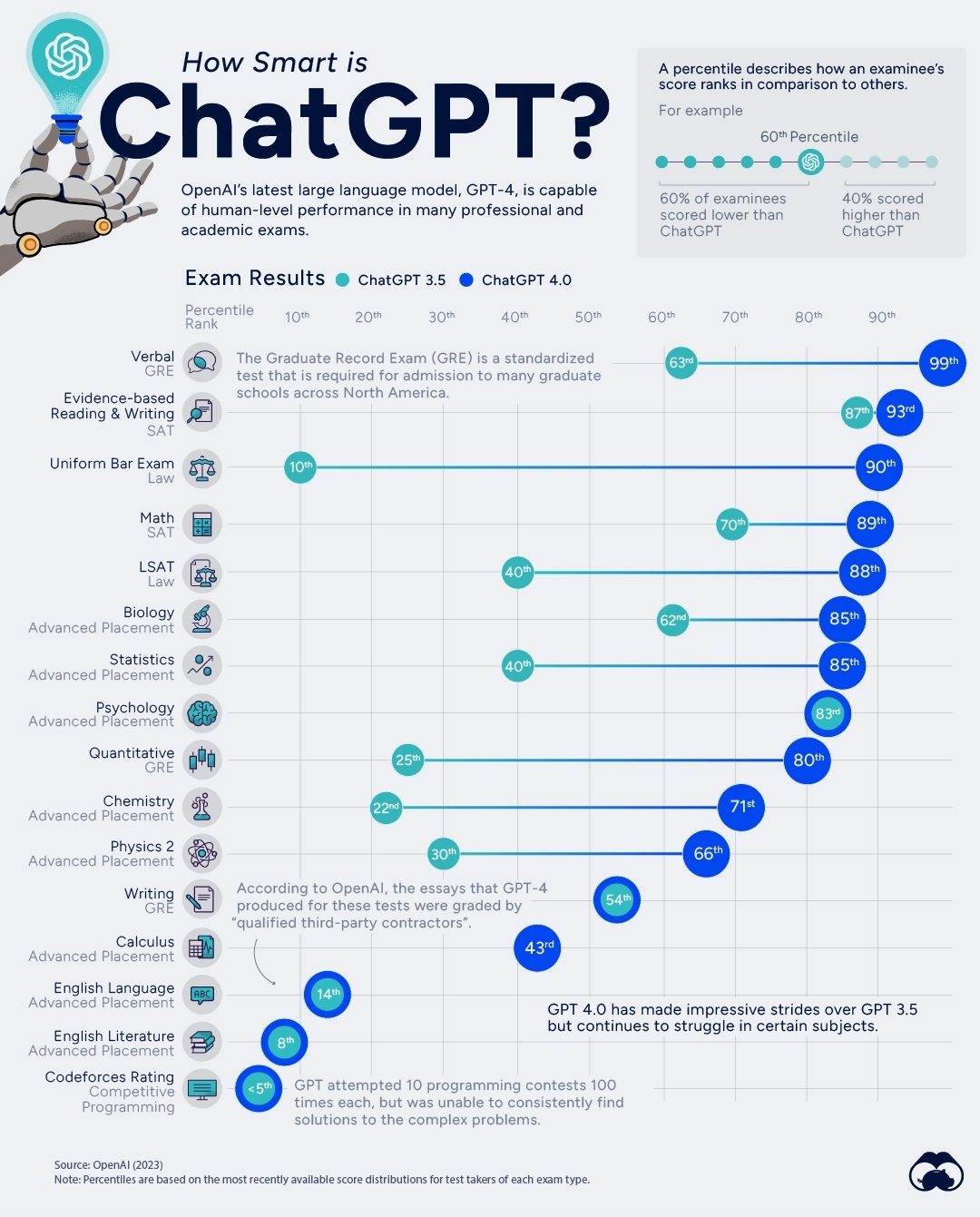
GPT-4 demonstrates a high level of competency in various professional and academic exams, often matching or surpassing the average human performance. The infographic released by OpenAI compares GPT-4's percentile rankings against human examinees, highlighting both its strengths and weaknesses.
Strong Areas
Verbal and Writing Skills
GPT-4 excels in tests that require strong verbal and writing skills. For instance, it ranks in the 93rd percentile for the verbal reasoning section of the GRE and the 99th percentile for the writing section of the Advanced Placement exams. This indicates that GPT-4 can generate coherent and contextually appropriate text, making it a valuable tool for tasks involving written communication.
Legal and Academic Proficiency
In the Uniform Bar Exam and the LSAT, GPT-4 ranks in the 87th and 88th percentiles, respectively. These results show that GPT-4 has a strong grasp of legal and academic concepts, making it a useful tool for legal research and academic writing.
Areas for Improvement
Mathematical and Scientific Reasoning
While GPT-4 performs well in many areas, it struggles with certain subjects, particularly those requiring complex mathematical and scientific reasoning. For example, it ranks in the 65th percentile for the quantitative section of the GRE and the 60th percentile for the Math SAT. This suggests that GPT-4 may not be as reliable for tasks that involve advanced mathematical calculations or scientific problem-solving.
Advanced Placement Exams
In Advanced Placement (AP) exams, GPT-4's performance varies widely. It excels in subjects like Psychology, where it ranks in the 93rd percentile, but struggles in subjects like Chemistry and Physics 2, where it ranks in the 43rd and 54th percentiles, respectively. This variability indicates that while GPT-4 can handle some complex subjects, it may not be a reliable tool for all academic tasks.
Programming Challenges
One of the most significant challenges for GPT-4 is programming. Despite attempting 10 programming contests 100 times each, GPT-4 was unable to consistently find solutions to the complex problems presented. This suggests that while GPT-4 can generate code, it may not be adept at solving intricate programming challenges that require deep algorithmic thinking.
Practical Tips
If you're considering using GPT-4 for professional or academic tasks, here are some practical tips to keep in mind:
- Utilize its Strengths: Leverage GPT-4 for tasks that require strong verbal and writing skills, such as drafting emails, writing reports, or conducting legal research.
- Be Aware of Limitations: Recognize that GPT-4 may struggle with complex mathematical and scientific tasks, as well as intricate programming challenges. For these tasks, consider using specialized tools or consulting with experts in the relevant fields.
- Complement with Human Expertise: While GPT-4 can generate impressive results, it should be used as a complement to human expertise rather than a replacement. Always verify the accuracy and context of the information provided by GPT-4.
Important Takeaways
- GPT-4 demonstrates human-level performance in many professional and academic exams, particularly in areas that require strong verbal and writing skills.
- The model's performance varies widely across different subjects, with notable strengths in legal and academic proficiency and weaknesses in complex mathematical and scientific reasoning, as well as in programming.
- GPT-4 should be used as a complement to human expertise, leveraging its strengths while being mindful of its limitations.
Conclusion
The release of GPT-4 marks a significant milestone in the evolution of AI language models. Its impressive performance on various standardized tests provides valuable insights into its capabilities and limitations. While GPT-4 excels in areas requiring strong verbal and writing skills, it still faces challenges in complex mathematical and scientific reasoning, as well as in programming. By understanding these strengths and limitations, users can effectively integrate GPT-4 into their workflows, leveraging its capabilities while being mindful of its constraints.
Watch the Reel
Questions readers ask
How does GPT-4's performance compare to human scores on standardized tests?
GPT-4 often matches or surpasses human scores on various standardized tests, demonstrating strong capabilities in verbal, writing, and legal fields. However, there are still areas where human performance excels, providing a clear distinction between AI and human capabilities.
What specific tests has GPT-4 been evaluated on?
GPT-4 has been tested on a range of standardized exams, including the GRE, LSAT, and advanced placement tests. These evaluations help highlight the model's strengths and weaknesses in different academic and professional contexts.
Can GPT-4 outperform humans in all areas of language-based tests?
While GPT-4 shows impressive performance in many language-based tests, it does not outperform humans in all areas. For instance, tasks requiring deep contextual understanding, emotional intelligence, and creative thinking are often areas where human performance remains superior.
What insights can be gained from comparing GPT-4's exam scores to human scores?
Comparing GPT-4's scores to human scores offers valuable insights into the practical applications and limitations of AI in real-world scenarios. It helps identify areas where AI can be effectively utilized and where human intervention is still necessary.
How does GPT-4's performance on the GRE and LSAT compare to human performance?
On the GRE, GPT-4 has demonstrated strong verbal and writing skills, often scoring within or above the range of average human test-takers. Similarly, on the LSAT, GPT-4’s logical reasoning and analytical performance is notable, although nuances of human reasoning may still give humans an edge.
What are the implications of GPT-4's performance on advanced placement tests?
GPT-4's performance on advanced placement tests indicates its potential to assist in high-school level subjects. This performance suggests that AI could be useful in tutoring, content creation, and assessment, but it also highlights the need for human oversight to ensure accuracy and relevance.
Are there any areas where GPT-4 significantly underperforms compared to humans?
GPT-4 may struggle with tasks that require a deep understanding of real-world context, complex reasoning, or emotional intelligence. These areas often reveal the gaps between AI's capabilities and human cognitive abilities, emphasizing the importance of human expertise in certain fields.
Related deep dives
Similar reads based on topic and creator.


Recent articles
Fresh deep dives from the latest Reels we unpacked.




Comments
Be the first to comment.