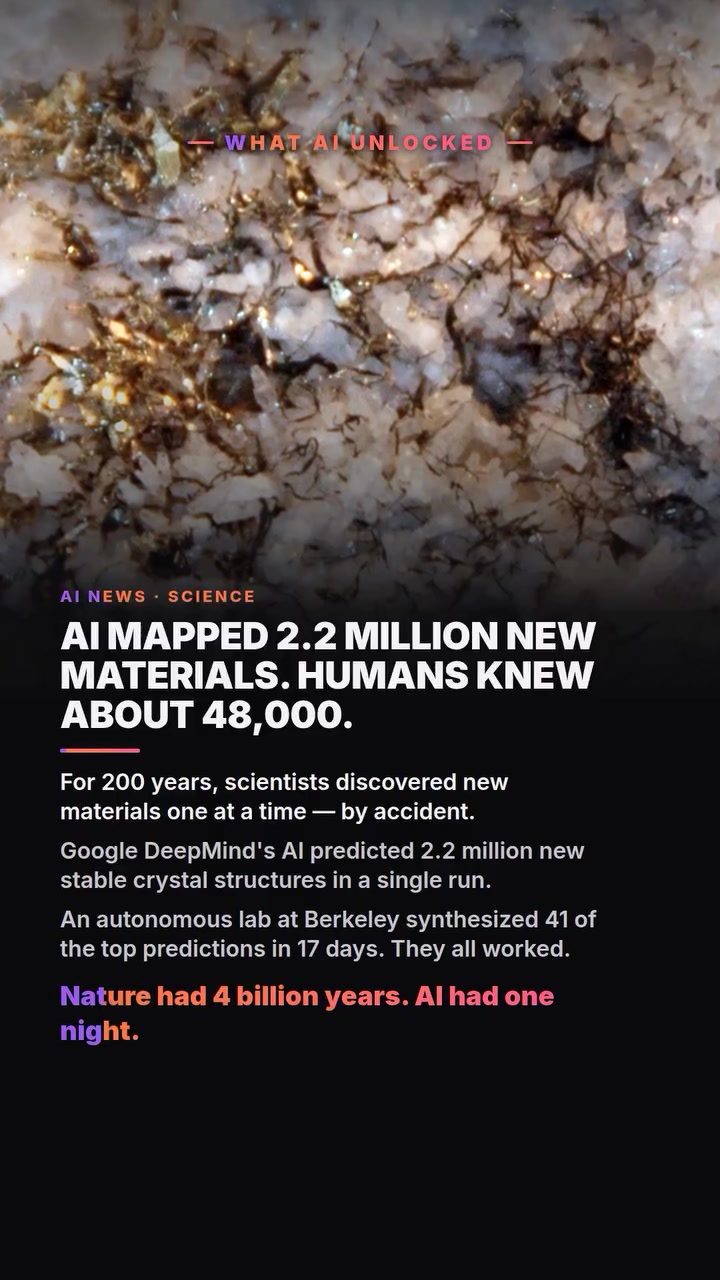
AI-Enabled Material Discovery: Predicting Millions of New Crystals
Every battery, solar panel, and computer chip relies on materials we already know exist. Until recently, the discovery of new materials was a slow, often accidental process. However, advancements in artificial intelligence have revolutionized the field of materials science, leading to groundbreaking predictions of millions of new crystal structures.
Context / Why this matters
The discovery of new materials has traditionally been a time-consuming and often unintentional process. For example, the discovery of materials like silicon for solar panels, lithium for batteries, and superconductors has historically relied on slow and often accidental processes over the past 200 years. However, in 2023, Google DeepMind's AI, GNoME, predicted 2.2 million new stable crystal structures — a staggering number compared to the approximately 48,000 materials previously known to humans. This leap forward in AI-driven material science has significant implications for various industries, including energy, technology, and sustainability.
The rapid synthesis of these predictions by an autonomous lab at Berkeley further underscores the potential of AI to accelerate discovery. This new capability could revolutionize materials science, accelerating the development of new technologies.
Main discussion
Google DeepMind's AI Prediction
Google DeepMind’s GNoME AI predicted 2.2 million new stable crystal structures in a single run. This is a monumental leap forward, as humans have known about only 48,000 materials. This breakthrough underscores the potential of AI in predicting materials with specific properties, which could lead to groundbreaking applications.
The Impact of AI in Materials Science
The autonomous lab at Berkeley synthesized 41 of the top predictions in just 17 days. This rapid synthesis demonstrates the efficiency and accuracy of AI in predicting stable crystal structures.
Nature typically takes billions of years to develop new materials. However, AI has compressed this timeline to a single night, showcasing its unparalleled potential in accelerating material discovery. This rapid progress has significant implications for various industries, including energy storage, solar technology, and computing.
Potential Applications
The new materials discovered by AI have the potential to revolutionize various fields. For instance, potential new battery materials that store more energy could lead to longer-lasting batteries for electric vehicles and portable electronics. Superconductors, which lose no power in transmission, could revolutionize energy distribution, reducing waste and increasing efficiency. Additionally, materials for more efficient solar cells could significantly enhance renewable energy production.
Practical tips
For researchers and industries looking to leverage AI in material discovery, here are some practical tips:
-
Invest in AI Technology: Integrate AI tools like GNoME into your research processes to accelerate material discovery. This can significantly reduce the time and resources required to identify new materials.
-
Collaborate with Autonomous Labs: Partner with autonomous labs that can rapidly synthesize AI predictions. This collaboration can validate AI predictions and bring new materials to market faster.
-
Stay Updated with Recent Developments: Keep abreast of the latest developments in AI-driven material science. Subscribe to journals, attend conferences, and join research groups focused on this area.
-
Explore Interdisciplinary Approaches: Combine AI with other scientific disciplines to unlock new possibilities. For example, integrating AI with chemistry, physics, and engineering can lead to innovative solutions and materials.
Important takeaways
-
AI's Impact on Material Discovery: AI has the potential to revolutionize material science by predicting millions of new stable crystal structures. This leap forward can accelerate the development of new technologies and materials.
-
Rapid Synthesis: The ability of autonomous labs to synthesize AI predictions quickly demonstrates AI's efficiency and accuracy. This capability can significantly reduce the time and resources required for material discovery.
-
Potential Applications: The new materials predicted by AI have the potential to revolutionize various fields, including energy storage, solar technology, and computing. These materials could lead to more efficient and sustainable technologies.
-
Future Prospects: The rapid progress in AI-driven material science suggests a bright future for material discovery. As AI continues to advance, it will likely lead to even more groundbreaking discoveries and innovations.
Conclusion
The future of material science is being shaped by AI, with groundbreaking predictions and rapid synthesis capabilities that were once unimaginable. The discovery of 2.2 million new stable crystal structures by Google DeepMind’s AI and the subsequent synthesis of these predictions by an autonomous lab at Berkeley highlight the transformative potential of AI in this field. As AI continues to advance, it is poised to revolutionize various industries, leading to more efficient, sustainable, and innovative technologies.
Watch the Reel
Questions readers ask
How does Google DeepMind's AI predict new materials?
Google DeepMind's AI uses advanced algorithms and machine learning techniques to analyze vast amounts of data on existing materials. By identifying patterns and relationships, the AI can predict new, stable crystal structures that have never been observed before. This process involves simulating and testing millions of potential combinations to find the most promising candidates.
What are crystal structures and why are they important?
Crystal structures refer to the arrangement of atoms in a solid material. They are crucial because the properties of a material, such as its strength, conductivity, and reactivity, are largely determined by its crystal structure. Predicting new crystal structures can lead to the discovery of materials with unique properties, which can be applied in various fields like energy, technology, and sustainability.
How many new materials has DeepMind's AI predicted?
DeepMind's AI has predicted 2.2 million new stable crystal structures. This is a significant advancement as it vastly expands the known material landscape, providing a wealth of new possibilities for research and development.
What are the potential applications of these predicted materials?
The predicted materials could have wide-ranging applications. For instance, new battery materials could improve energy storage, leading to advancements in electric vehicles and grid storage. New solar materials could enhance the efficiency of solar panels, and discoveries in the tech sector could lead to more efficient computer chips and other electronic components.
How does this AI-driven approach compare to traditional material discovery?
Traditional material discovery has often been a slow, trial-and-error process, relying heavily on experimentation and serendipity. In contrast, AI-driven approaches can predict new materials much more quickly by analyzing vast amounts of data and simulating potential structures, thereby accelerating research and innovation.
What role does AI play in sustainable material development?
AI can significantly contribute to sustainable material development by predicting new materials that are more efficient, durable, and environmentally friendly. For example, AI can help identify materials for more efficient solar panels or better battery storage, which are crucial for transitioning to renewable energy sources.
Can these predicted materials actually be created in a lab?
Yes, the predicted materials can be synthesized in a lab. Once the AI identifies a promising new crystal structure, researchers can use this information to guide their experiments. They can then attempt to create the material in a controlled environment, study its properties, and validate the AI's predictions.
Related deep dives
Similar reads based on topic and creator.




Recent articles
Fresh deep dives from the latest Reels we unpacked.




Comments
Be the first to comment.